


Proton Black Friday, until 30 November: 75% off Proton VPN Plus on the 24-month plan.
After the first term it renews at the regular price, shown on the offer page before you pay. See every Proton Black Friday deal.
Short answer: This Proton VPN review covers the Swiss VPN that offers a genuinely unlimited free plan with no ads and no data cap, and a paid VPN Plus plan with more than 20,000 servers in over 140 countries, streaming support, P2P and an ad and malware blocker. Its strongest point is evidence rather than marketing: Proton has passed five annual third-party audits of its no-logs policy and its transparency report shows it denied every one of the 59 legal orders it received for Proton VPN in 2025, because the logs did not exist. The catch is the price after the first term: VPN Plus costs $53.88 for the first year but renews at $83.88 a year, so the advertised monthly rate only lasts as long as the introductory period.
- Start free for one device, unlimited data, no ads, on servers in 10 countries picked for you.
- Pick VPN Plus for up to 10 devices, every server location, streaming, P2P and NetShield, from $3.49 a month on a two-year plan.
- Pick Proton Unlimited if you also want Proton Mail, Pass and Drive, from $7.99 a month on two years.
- Budget for renewal: VPN Plus renews at $83.88 a year after the first 12 or 24 months.
Free: $0. VPN Plus: $9.99/mo monthly, $53.88 first year, $83.76 first two years, then $83.88/yr. Proton Unlimited: $12.99/mo monthly, $119.88/yr, $191.76 first two years. 30-day money-back guarantee. Protonvpn.com, checked October 12, 2026.
Table of contents
What is Proton VPN?
Proton VPN is the virtual private network made by Proton AG, the Swiss company behind Proton Mail. A VPN routes your internet traffic through an encrypted tunnel to one of its servers, so your internet provider, the café Wi-Fi and the websites you visit see the VPN’s address instead of yours. Proton’s pitch rests on three things it repeats on every page: Swiss privacy law, a strict no-logs policy, and apps that are 100 percent open source so anyone can read the code.
It also has an unusual position in a crowded market. Most free VPNs are either throttled demos of a paid product or businesses that pay for themselves with ads and data. Proton’s free tier is neither: its free VPN page says the plan has “no data or speed limits,” “no advertisements” and “does not log your online activity,” funded by paying users. That makes Proton VPN one of the few services where it is reasonable to test the product properly before spending anything.
This Proton VPN review reads the pricing page in US dollars for each billing period, the server list, the free VPN page, Proton’s write-up of its no-logs audits and the legal transparency report, all on October 12, 2026, and then checks the Android app’s public rating on Google Play. If you are considering the wider Proton bundle, our Proton Mail review covers the email side.
The free plan: what “unlimited” really means
The free plan is genuinely useful, within clear limits. It covers one device at a time, at what the pricing page calls “medium” speed, on servers in 10 countries that are randomly selected rather than chosen by you. There are no ads, no data cap and no time limit, and Proton says all of its servers deliver at least 1 Gbps of bandwidth. The free plan also includes the kill switch, DNS leak prevention and the same secure protocols as the paid tiers.
What you give up is control and extras. You cannot pick a country, which rules out using the free plan to reach a specific region’s content. Streaming support, P2P file sharing, the NetShield ad and malware blocker, Secure Core servers and Tor over VPN are all paid features. For someone who wants a private connection on public Wi-Fi or a way past local censorship, the free plan does the job. For streaming or torrenting, it is a trial of the apps rather than of the service you would use.
VPN Plus features: servers, streaming, NetShield and Secure Core
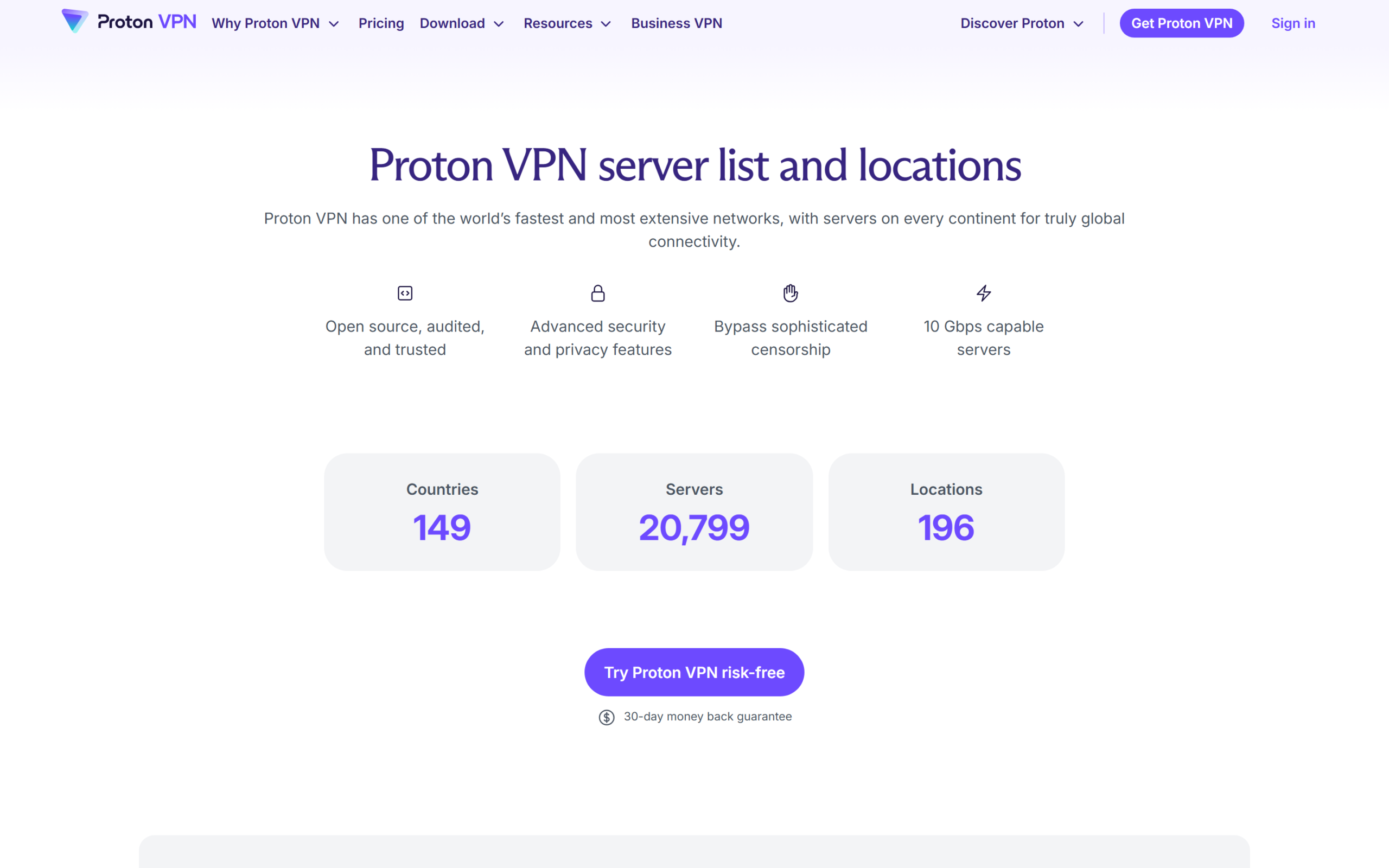
VPN Plus is where the network opens up. The server page listed 20,799 servers in 149 countries across 196 locations on the day this review was checked, with 17,985 of them reserved for Plus users and 124 Secure Core servers. Plus servers offer streaming support for services such as Netflix, Disney+ and Prime Video, P2P and BitTorrent, Tor over VPN with one click, and speeds of up to 10 Gbps in most locations.
Secure Core is Proton’s answer to a more sophisticated threat: someone watching traffic at a VPN server. The pricing page describes it as “another layer of protection” through Proton’s “custom VPN hop,” meaning your connection passes through an extra Proton server before it reaches the one that exits to the internet, so an observer at the exit point has a harder time tracing traffic back to you. It is slower and overkill for most people, but valuable for journalists and activists, the users Proton’s free VPN page says it serves around the world.
NetShield is the everyday feature most people will notice. It uses DNS filtering to block ads, trackers and malware sites, which speeds up some pages and removes a class of risk. Proton also advertises VPN Accelerator, which it says can increase VPN speed by up to 400 percent, a figure from Proton’s own testing rather than an independent benchmark, so treat it as a ceiling rather than a promise.
Apps, platforms and everyday protection
Proton VPN runs on the platforms most households actually use. The free VPN page lists apps for Windows, macOS, Android, iPhone and iPad, Linux, Chrome, Firefox, Chromebook, Android TV and Fire TV, and the site footer adds Apple TV. Because the free plan covers one device at a time and VPN Plus covers ten, a family can put the same paid account on laptops, phones and a living room TV without buying a second subscription.
The everyday protections are the same across plans. The kill switch blocks your connection if the VPN drops, so your real IP address is not exposed in the gap, and DNS leak prevention keeps the lookups that reveal which sites you visit inside the tunnel. Both are listed on every plan, including Free, along with secure protocols, unlimited bandwidth and router support. Split tunneling, which lets chosen apps bypass the VPN, is listed for Android and Windows on Proton’s own comparison table.
Censorship is a stated use case rather than an afterthought. The free VPN page talks about sidestepping blocked news and social media, and the server page lists the ability to “bypass sophisticated censorship” among its headline features. That matters for the activists and journalists Proton says use the service, and it is one reason the free tier exists at all.
Proton VPN pricing and the renewal price
Proton VPN sells three plans on three billing periods, and the pricing page spells out both the first payment and the renewal, which is more than many VPNs do. The figures below are in US dollars.
| Plan | 1 month | 1 year | 2 years | Renews at |
|---|---|---|---|---|
| Proton Free | $0 | $0 | $0 | Free |
| VPN Plus | $9.99/mo | $53.88 ($4.49/mo) | $83.76 ($3.49/mo) | $83.88 every 12 months |
| Proton Unlimited | $12.99/mo | $119.88 ($9.99/mo) | $191.76 ($7.99/mo) | $119.88 every 12 months |
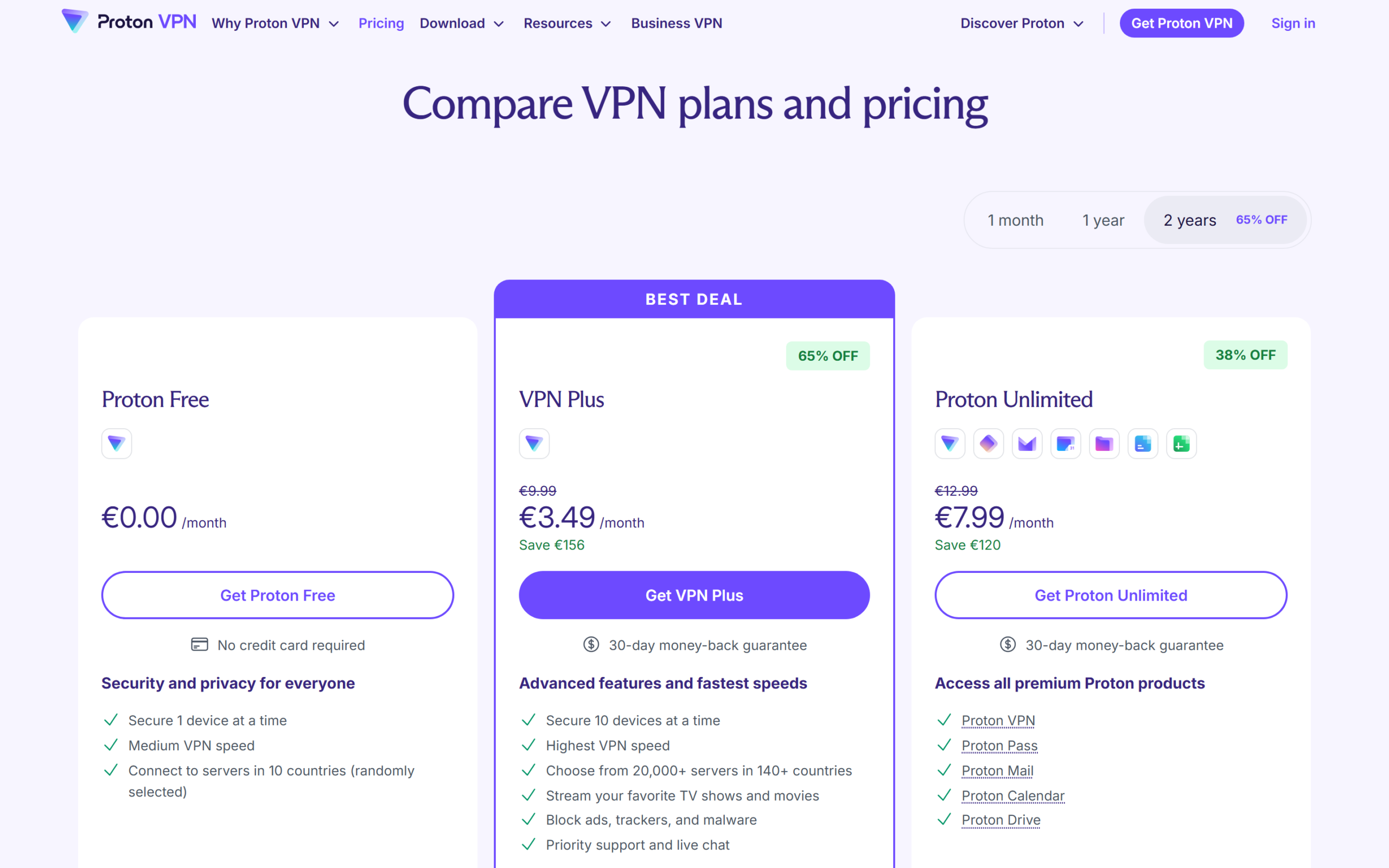
The renewal line is the one to read. On the one-year plan, VPN Plus costs $53.88 for the first 12 months and then renews at $83.88 a year, which works out to $6.99 a month from year two, about 56 percent more than the first year. On the two-year plan you pay $83.76 for the first 24 months and then $83.88 a year. Proton Unlimited, by contrast, renews at the same $119.88 a year as its one-year price. Every paid plan carries a 30-day money-back guarantee.
Proton Unlimited is worth a look even for VPN buyers. On the two-year plan it is $7.99 a month against $3.49 for VPN Plus, and it adds Proton Mail, Calendar, Drive with 500 GB and the full Proton Pass password manager with 50 vaults and unlimited hide-my-email aliases. If you would pay for a password manager or encrypted storage anyway, the bundle is often cheaper than buying separately. To compare the current offers side by side, see Proton VPN’s plans.
What Proton VPN costs over three years
Because the first term and the renewal differ, the fairest way to compare billing periods is the total over a realistic period. Over three years, the VPN Plus two-year plan costs $83.76 for the first 24 months plus one renewal at $83.88, a total of $167.64, or about $4.66 a month. Taking the one-year plan and renewing twice costs $53.88 plus two renewals of $83.88, a total of $221.64, about $6.16 a month. Paying monthly for 36 months at $9.99 costs $359.64.
| Plan and billing | Three-year total | Effective monthly cost |
|---|---|---|
| VPN Plus, 2-year plan then renewal | $167.64 | $4.66 |
| VPN Plus, 1-year plan then two renewals | $221.64 | $6.16 |
| VPN Plus, monthly | $359.64 | $9.99 |
| Proton Unlimited, 2-year plan then renewal | $311.64 | $8.66 |
The two-year VPN Plus plan is clearly the cheapest way to use Proton VPN for any length of time, and even after renewal it stays well below the monthly price. Proton Unlimited on the same basis costs $311.64 over three years, which is the number to weigh against what you would otherwise spend on separate email, storage and password-manager subscriptions. These totals are our arithmetic from the pricing page’s stated first-term and renewal prices, and they assume prices do not change at renewal.
The no-logs claim, tested in audits and court orders
Every VPN claims not to log. Proton VPN is one of the few that can point to repeated outside checks. Proton’s write-up of its fifth annual no-logs audit says the security firm Securitum has examined its infrastructure, not just its privacy policy, and that Proton publishes the full reports for anyone to read rather than behind an NDA or a paywall. The same post says Securitum’s audit of all Proton apps found no significant security issues, and that the no-logs policy has been tested in more than 400 legal cases where Proton was ordered to hand over logs and could not, because they did not exist.
The transparency report gives the year-by-year numbers for Proton VPN, and they are striking in a way the Proton Mail figures are not. Every order is listed as denied, because all of them asked who was connected to a specific server at a specific time, which Proton says it cannot answer.
| Year | Legal orders received (Proton VPN) | Denied |
|---|---|---|
| 2025 | 59 | 59 |
| 2024 | 53 | 53 |
| 2023 | 60 | 60 |
| 2022 | 80 | 80 |
| 2021 | 121 | 121 |
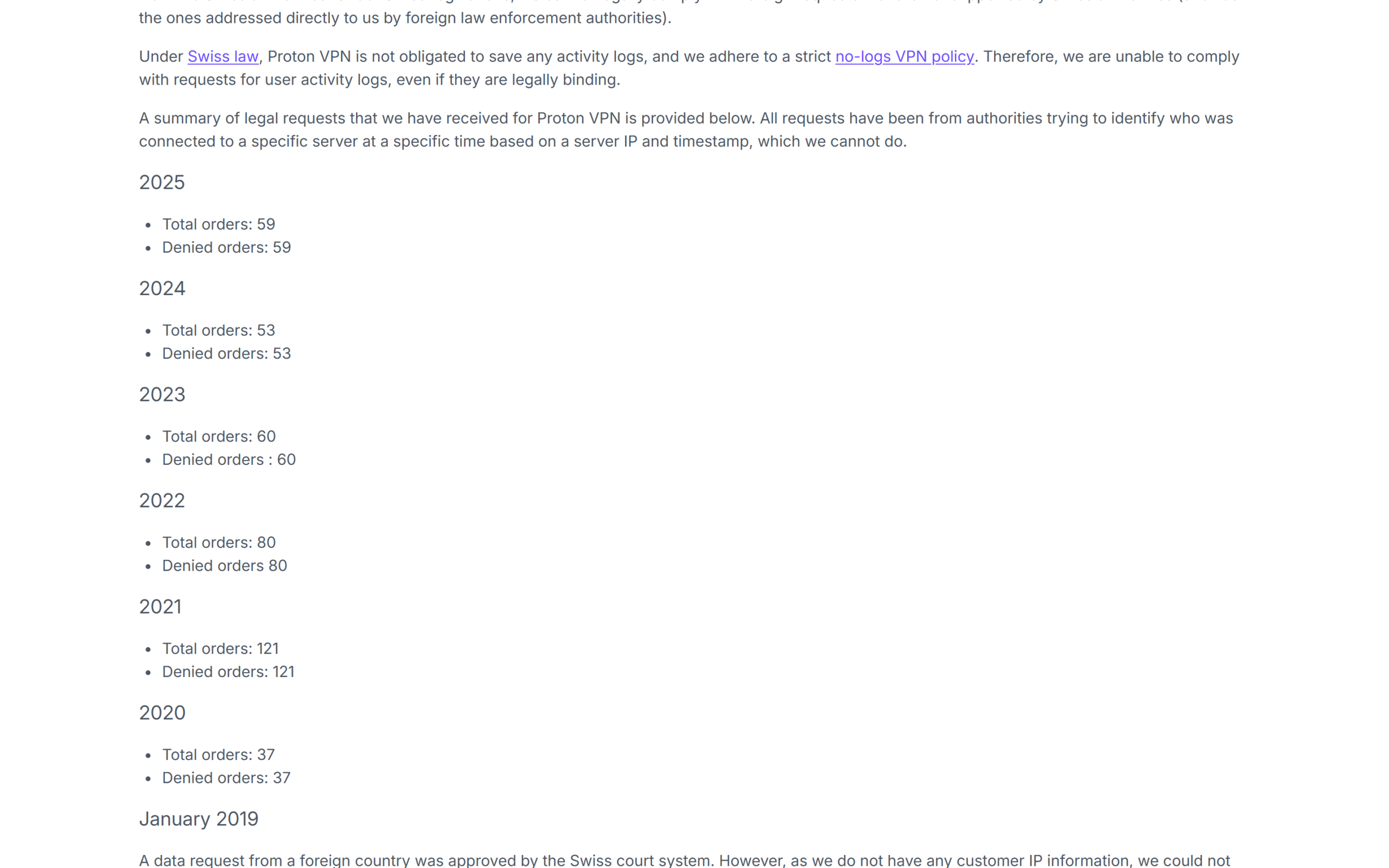
The report also explains why: under Swiss law Proton VPN is not obliged to keep activity logs, and legally binding requests must come through Swiss authorities. A no-logs policy is still a promise you cannot audit yourself, but five external audits and a public record of zero handed-over logs is about as strong as the evidence gets in this industry.
What independent data shows
The Proton VPN app on Google Play showed a 4.7 star rating from about 1.39 million reviews and more than 100 million downloads on October 12, 2026. That is a very large user base with consistently high ratings, and a good sign that the free plan, which most of those users are on, is not a frustrating teaser.
The pricing page also quotes outside reviewers, including one that gave Proton VPN a five-star rating and an Editor’s Choice award, but it does not name the publications in the quoted text, so this Proton VPN review gives that endorsement no weight. The audits and the transparency record are the independent evidence that matters for a VPN, and both point the same way.
Where Proton VPN is less strong
The renewal jump is the most important caveat. A buyer who sees “$4.49 a month” on the yearly plan will pay $83.88, not $53.88, in year two. Proton is open about it, which is more than many rivals manage, but the headline monthly figure is still an introductory price.
The free plan’s random server choice is a real limitation. You cannot choose a country, so you cannot rely on it to reach region-locked services, and “medium” speed is not the experience the paid plan delivers. Some of the most interesting features, Secure Core and Tor over VPN, also carry a speed cost by design.
Finally, much of the performance messaging, the “up to 400 percent” VPN Accelerator gain and “up to 10 Gbps” servers, comes from Proton’s own testing. Speeds depend heavily on where you are and which server you use, so the 30-day money-back guarantee is the honest way to find out what you will actually get.
Who Proton VPN is for, and who should look elsewhere
Proton VPN suits privacy-minded users who want a VPN with verified no-logs credentials, travellers who use public Wi-Fi, people in countries with censored internet, and anyone who wants to test a VPN for free before paying. It is a particularly good fit for people already using Proton Mail or Pass, because Proton Unlimited folds the VPN into a bundle. Households benefit too: ten simultaneous devices on one VPN Plus account covers a typical family’s phones, laptops and a streaming TV without a second subscription.
It is a weaker fit if your only goal is the cheapest long-term streaming VPN, because the renewal price makes the long-run cost higher than the headline suggests, or if you want a free VPN that lets you choose a location. If you want maximum anonymity with no account at all, consider whether any account-based VPN suits your threat model.
Proton VPN pros and cons
In this Proton VPN review the clearest advantages are a free plan with no ads, data cap or time limit, five annual third-party no-logs audits, a transparency report showing every legal order for VPN data denied, open-source apps, more than 20,000 servers in 149 countries, Secure Core, NetShield and a 30-day money-back guarantee.
Against that: VPN Plus renews at $83.88 a year after the first term, the free plan picks your server country for you, and several speed claims come from Proton’s own testing.
Frequently asked questions
Is Proton VPN really free?
Yes. The free plan covers one device with no ads, no data limit and no logs, on servers in 10 randomly selected countries at medium speed.
How much does Proton VPN cost?
VPN Plus is $9.99 a month on monthly billing, $53.88 for the first year or $83.76 for the first two years, then $83.88 a year. Proton Unlimited is $12.99 a month, $119.88 a year or $191.76 for two years.
Does Proton VPN keep logs?
Proton says no, and it has passed five annual external audits of its no-logs policy by Securitum. Its transparency report lists all 59 legal orders for VPN data in 2025 as denied.
Does Proton VPN work with Netflix?
Streaming support for services including Netflix, Disney+ and Prime Video is a VPN Plus feature on Plus servers. The free plan does not include it.
How many devices can I use?
One at a time on the free plan, and up to 10 at once on VPN Plus and Proton Unlimited.
Can I get a refund?
Paid plans come with a 30-day money-back guarantee, according to the pricing page.
Is Proton VPN worth it?
This Proton VPN review finds one of the most trustworthy VPNs available: a free plan that is actually usable, a large paid network with streaming, P2P and NetShield, and no-logs claims backed by five external audits and a clean legal record. The main thing to plan for is the renewal price, which is noticeably higher than the first-term rate on VPN Plus.
For anyone who wants a VPN they can trust, check Proton VPN’s current offers, start on the free plan, and upgrade when you need streaming, more devices or a choice of country.
8.5 Score
Pros
- Free plan with no ads, no data cap and no time limit.
- Five annual third-party no-logs audits, with every 2025 legal order for VPN data denied.
- 20,799 servers in 149 countries, Secure Core, NetShield, streaming and P2P on VPN Plus.
- Open-source apps and a 30-day money-back guarantee.
Cons
- VPN Plus renews at $83.88 a year after a $53.88 first year.
- The free plan picks one of 10 countries for you and runs at medium speed.
- Speed claims such as up to 400% from VPN Accelerator come from Proton's own testing.
- Secure Core and Tor over VPN trade speed for privacy.
Final Verdict
Proton VPN combines a genuinely usable free plan with a large paid network and no-logs claims backed by five external audits and a clean legal record. VPN Plus adds every location, streaming, P2P and NetShield, but it renews at $83.88 a year after the introductory term. For anyone who wants a VPN they can trust, it is the one to try first.