

Proton Black Friday, until 30 November: 60% off Proton Mail Plus on the 12-month plan, $23.88 for the first 12 months.
After that it renews at $47.88 a year, the regular price. See every Proton Black Friday deal.
Short answer: This Proton Mail review covers the Swiss encrypted email service that stores your inbox with zero-access encryption, so Proton itself cannot read your messages, and keeps a free plan that is genuinely usable for one address. The paid tiers start at $3.99 a month for Mail Plus on a yearly plan and $9.99 a month for Proton Unlimited, which adds the VPN, password manager and 500 GB of storage. The honest catches are a small free inbox (500 MB, up to 1 GB), subject lines that are encrypted but not end-to-end encrypted, and a transparency report showing Proton complied with 8,313 Swiss legal orders in 2025, so it protects content, not every scrap of metadata.
- Start free if you want one private address: 500 MB of mail storage (1 GB after a short checklist) and 150 messages a day.
- Pick Mail Plus at $3.99 a month (yearly) for 15 GB, 10 addresses, a custom domain and the Bridge app for Outlook or Apple Mail.
- Pick Proton Unlimited at $9.99 a month (yearly) if you also want Proton VPN, Pass and Drive in one bill.
- Skip it if you need full-text search on a huge archive in a browser or deep Google Workspace style integrations.
Free: $0. Mail Plus: $4.99/mo or $3.99/mo billed yearly ($47.88). Proton Unlimited: $12.99/mo or $9.99/mo billed yearly ($119.88). 30-day money-back guarantee. Proton.me, checked October 11, 2026.
Table of contents
What is Proton Mail and who runs it?
Proton Mail is an email service built around one promise: what is in your inbox is your business, not an advertiser’s. Its own homepage puts the contrast bluntly, saying Gmail and Microsoft Outlook “can technically scan your inbox,” while Proton Mail is “funded by subscribers, not your data.” The service is run by Proton AG, a Swiss company, and the product line has grown well past email into a VPN, a password manager, cloud storage, a calendar, documents, a wallet and an AI assistant called Lumo.
The company’s About page tells a short origin story. Proton was born in Switzerland in 2014, founded by a team of scientists who met at CERN, and it launched after a public crowdfunding campaign in which more than 10,000 people donated over $500,000. It also explains the ownership in a way few tech companies bother to: Proton AG’s primary shareholder is the non-profit Proton Foundation in Geneva, and the company says it has no venture capital investors. The Mail homepage claims Proton is trusted by over 100 million users and organizations.
This Proton Mail review reads the pricing page, the Mail homepage, the support article on how messages are encrypted, the Bridge page, the Easy Switch guide, the About page and Proton’s transparency report, all on October 11, 2026. It then checks the app’s public rating on Google Play, which Proton does not control. The goal is to separate what the encryption actually covers from what a privacy brand implies, because that gap is where most buyers get surprised.
What Proton Mail encrypts, and what it does not
The support article on how Proton Mail messages are encrypted is the most useful page Proton publishes, because it lists the limits as well as the guarantees. Every message and attachment in your inbox is stored with zero-access encryption, meaning nobody else can read it, “not even Proton.” Message bodies and attachments are stored with end-to-end encryption. Subject lines and the sender and recipient addresses are encrypted too, but they are not end-to-end encrypted.
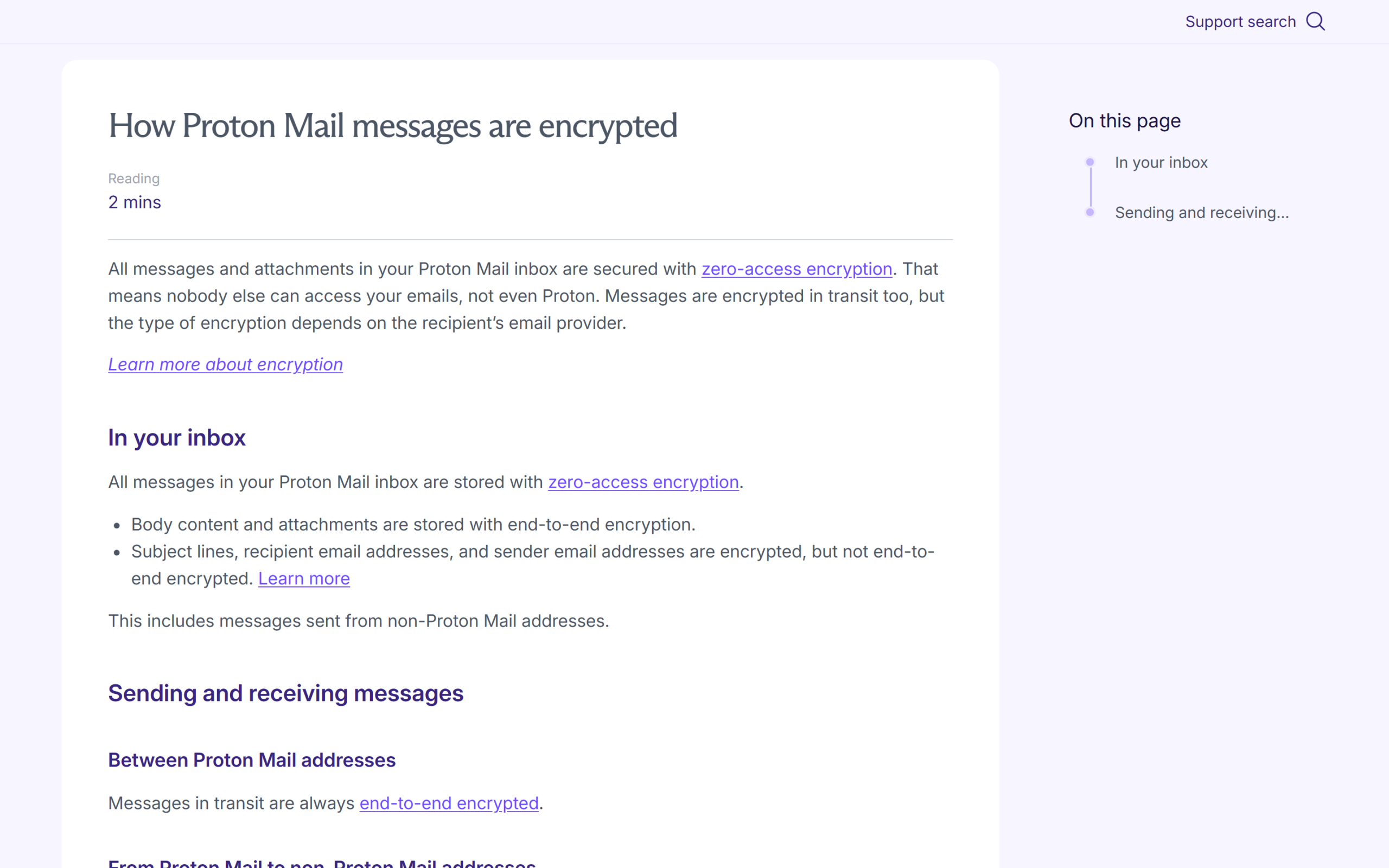
In transit the picture depends on who you are writing to. Between two Proton Mail addresses, messages are always end-to-end encrypted. From Proton Mail to Gmail, Outlook or any other provider, messages travel with TLS, which most providers support, but once they arrive the recipient’s provider may be able to read them. If you need end-to-end encryption with someone outside Proton, you can send a password-protected email, or exchange PGP keys. Mail arriving from outside Proton is encrypted with TLS on the way in and then stored with zero-access encryption, though the sender’s provider may keep its own copy.
The subject line point deserves a sentence of its own. Proton says subject lines are not end-to-end encrypted so that messages stay compliant with the OpenPGP standard and work with other email systems, and that getting them would require a court order approved by a Swiss judge. That is a reasonable trade-off, but it is a trade-off: write “Invoice” rather than “Re: my divorce lawyer” if the subject itself is sensitive. Proton also says all of its apps are open source and that it commissions independent third-party audits of its code.
Everyday features: aliases, filters, calendar and Scribe
Encryption alone would not keep anyone on a mail service, so the features matter. The pricing page’s comparison table is the clearest map. Every plan, including Free, gets end-to-end encryption, password-protected emails, encrypted contact details, HTML signatures and 25 MB attachments. The Free plan is capped at 150 messages a day, three folders, three labels and one custom filter. Mail Plus and Proton Unlimited lift all of those to unlimited and add auto-reply, catch-all addresses, automatic forwarding, scheduled and snoozed email, contact groups, a short @pm.me address and email client support through IMAP and SMTP.
Hide-my-email aliases are a quiet strength. They let you give a shop or newsletter a throwaway address that forwards to your real inbox, and you can switch an alias off when it starts to attract spam. The comparison table lists 10 aliases on Free and Mail Plus and unlimited aliases on Proton Unlimited. Proton also blocks email trackers, the hidden pixels that tell a sender when and where you opened a message, which the homepage describes as protection from “digital spies.”
Proton Calendar comes with every Mail plan. Here the vendor’s own pages disagree. The comparison table lists three personal calendars on Free and 25 on paid plans, while the pricing FAQ says a free account gets access to one personal calendar. It is a small thing, but it is the kind of inconsistency worth checking in the app rather than trusting either page. Paid plans also include one appointment booking page, Dark Web Monitoring, Emergency Access to a trusted contact and priority support, and Proton sells an AI writing assistant called Proton Scribe as an add-on with a free trial.
Moving in: Easy Switch and Bridge
The two tools that decide whether switching is painless are Easy Switch and Bridge. Easy Switch is built into Proton Mail and, according to its guide, imports emails from any provider that supports IMAP, with calendars and contacts as well depending on the provider. Gmail gets the deepest treatment: the homepage says you can connect a Gmail account for an automatic import and ongoing sync, then send and receive from your Gmail address without leaving Proton. The guide adds that Easy Switch can transfer from up to two accounts at once, but only one transfer at a time from the same account.
Bridge is the answer for people who live in a desktop client. It is a small app that runs in the background, decrypting and encrypting mail as it enters and leaves your computer, and exposes your account to Outlook, Thunderbird or Apple Mail through a local IMAP and SMTP server. The Bridge page is clear about the price of that convenience: Bridge “is available only with a paid plan that includes Proton Mail.” Proton says Bridge uses a separate password that never leaves your computer and does not permanently store decrypted message data on disk.
The desktop app is a similar story. The comparison table lists it as a 14-day free trial on the Free plan and included on paid plans. Taken together, a Free user gets the web app and the phone apps, while anyone who wants a desktop client experience should budget for at least Mail Plus.
Proton Mail pricing: Free, Mail Plus, Unlimited and family plans
Proton prices in US dollars, euros and Swiss francs, and the dollar and euro figures were identical on the day this review was checked. Annual billing is where the headline prices come from, and the page labels the yearly discount on each plan.
| Plan | Monthly billing | Yearly billing | Storage | Users | Addresses and domains |
|---|---|---|---|---|---|
| Proton Free | $0 | $0 | 500 MB mail (up to 1 GB) | 1 | 1 address |
| Mail Plus | $4.99/mo | $3.99/mo ($47.88/yr) | 15 GB | 1 | 10 addresses, 1 custom domain |
| Proton Unlimited | $12.99/mo | $9.99/mo ($119.88/yr) | 500 GB | 1 | 15 addresses, 3 custom domains |
| Proton Duo | $19.99/mo | $14.99/mo ($179.88/yr) | 2 TB | 2 | 30 addresses, 3 custom domains |
| Proton Family | $29.99/mo | $23.99/mo ($287.88/yr) | 3 TB | 6 | 90 addresses, 3 custom domains |
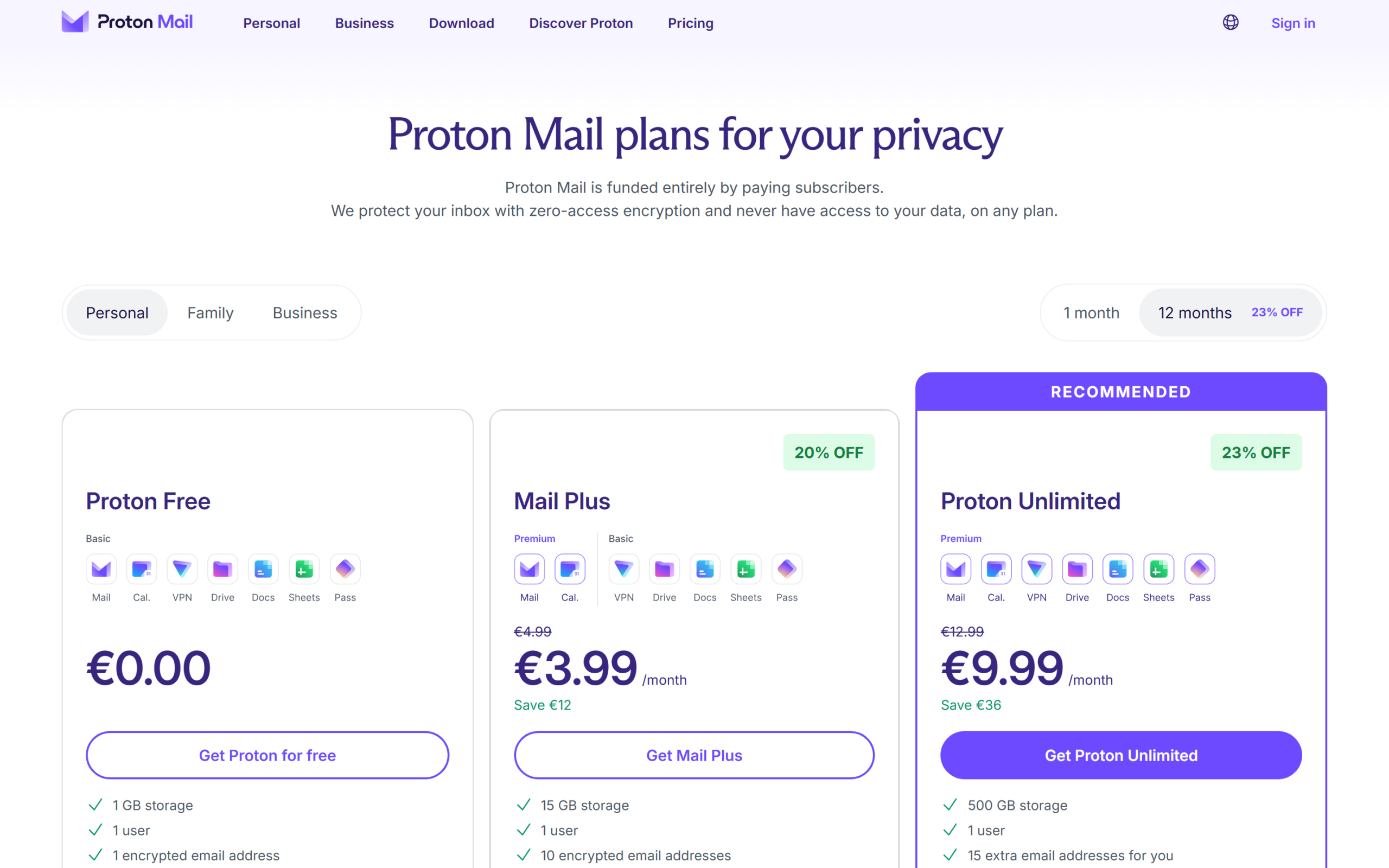
The yearly savings line up with the page’s labels: twelve months of Mail Plus at $4.99 would be $59.88, so the $47.88 yearly price saves $12, and twelve months of Unlimited at $12.99 is $155.88, so $119.88 saves $36. Every paid plan carries a 30-day money-back guarantee. The free storage line needs a footnote: the FAQ says the Free plan starts with 500 MB of mail storage and rises to 1 GB once you complete a “Get started” checklist, which includes steps such as installing the mobile app and setting up forwarding from Gmail.
The real decision is usually between Mail Plus and Unlimited. Mail Plus is the email-only upgrade. Unlimited costs $6 a month more on yearly billing and adds Proton VPN on up to 10 devices, the full Proton Pass password manager with 50 vaults, 500 GB shared with Drive and version history, unlimited aliases and Proton Sentinel, its advanced account protection program. If you would otherwise pay for a VPN or a password manager, Unlimited is the better value. If you only want private email, compare Proton Mail’s plans and start with Mail Plus.
What Proton can hand over: the transparency report
A privacy email service is only as private as the law around it, and Proton deserves credit for publishing the numbers. Its transparency report explains that, under Article 271 of the Swiss Criminal Code, Proton may not hand data directly to foreign authorities and rejects all such requests, while Swiss authorities can assist foreign ones through international legal assistance procedures that comply with Swiss law. It also states that emails, files and invites are encrypted and Proton “has no means to decrypt them.”
| Year | Legal orders received (Proton Mail) | Contested | Complied with |
|---|---|---|---|
| 2025 | 9,301 | 988 | 8,313 |
| 2024 | 11,023 | 655 | 10,368 |
| 2023 | 6,378 | 407 | 5,971 |
| 2017 | 26 | 3 | 23 |
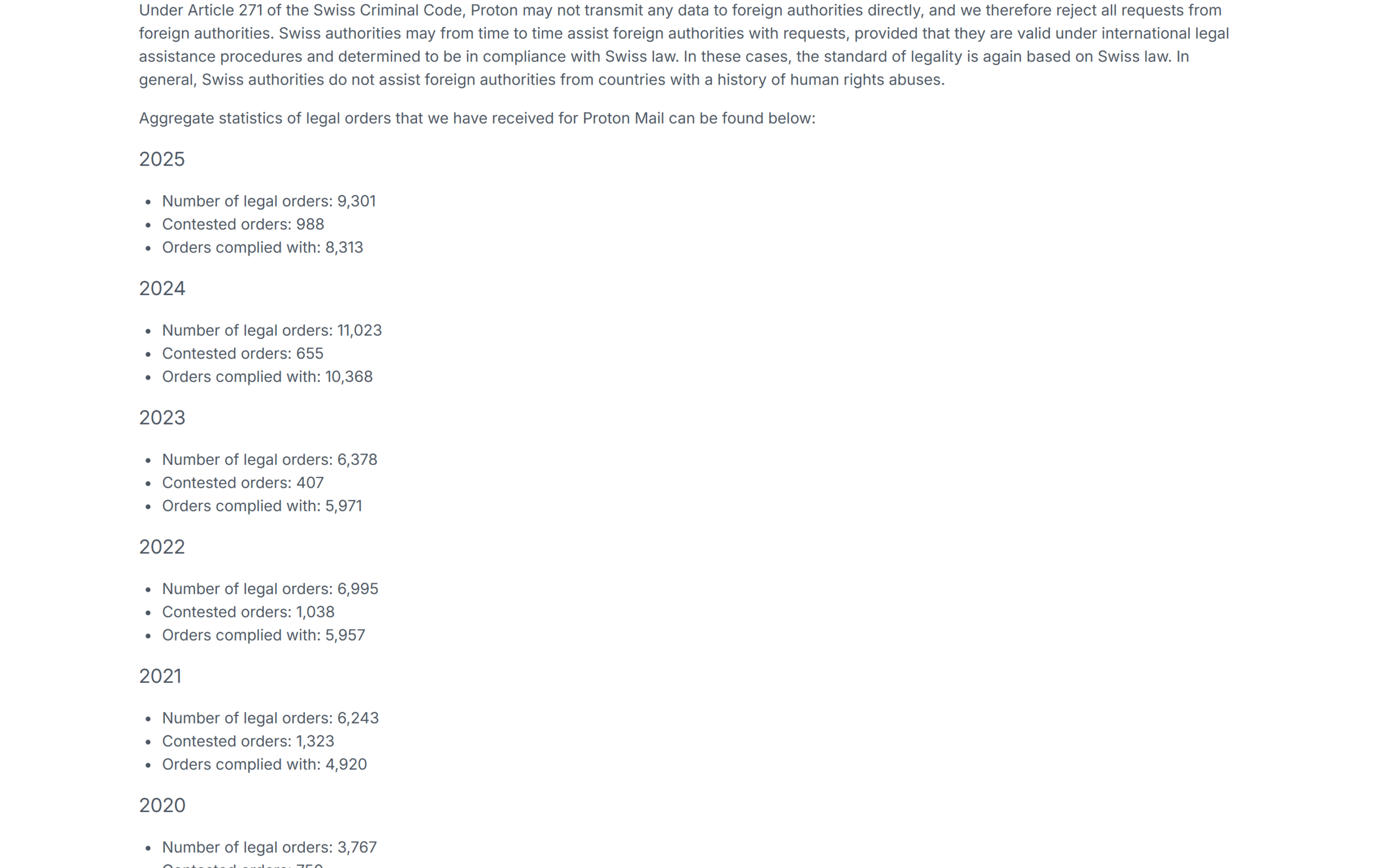
Read the “complied with” column carefully. In 2025 Proton complied with 8,313 of 9,301 orders, about 89 percent. Because message content is zero-access encrypted, what an order can reach is the information Proton can see, which its privacy policy covers, such as account details. The lesson is not that Proton is unsafe; it is that encrypted email protects what you write, while staying anonymous takes more, such as not linking a recovery email or phone number that identifies you.
What independent data shows
For an outside view, the Proton Mail app’s listing on Google Play showed a 4.5 star rating from about 95,000 reviews and more than 10 million downloads on October 11, 2026. That is a large, broadly satisfied user base for an app that asks people to give up the convenience of a big-tech inbox. Proton’s own homepage advertises a “4.5+ app rating,” which matches the Play figure.
The independent signals that matter most for a privacy product are structural rather than review scores: open-source apps that anyone can inspect, outside security audits that Proton says it commissions, and a legal record you can read year by year. This Proton Mail review treats the 100 million users figure as Proton’s own claim, since no outside source on the pages checked here confirms it.
Where Proton Mail is less strong
The free inbox is small. Starting at 500 MB, it fills quickly once newsletters with images arrive, and the 150 messages a day cap, three folders and one filter push anyone organised toward Mail Plus. That is by design, since Proton says the Free plan is funded by paying subscribers, but it means “free forever” is closer to “free for light use.”
Encryption shapes the experience in ways you notice. Desktop clients need Bridge and a paid plan. Subject lines are not end-to-end encrypted. Messages to non-Proton recipients are only as private as the recipient’s provider unless you use password-protected email. None of this is hidden, and all of it is spelled out on Proton’s support pages, but a buyer expecting “everything encrypted end to end, always” will be disappointed.
Finally, the plan structure is becoming a bundle story. Many of the most attractive extras, the VPN, Pass vaults, version history and unlimited aliases, sit in Unlimited or the family plans. That is good value if you use them, and less good if you only wanted email and keep being shown the bigger plan.
Who Proton Mail is for, and who should look elsewhere
Proton Mail suits anyone who wants their inbox content out of reach of an advertising business: journalists, lawyers and therapists dealing with confidential correspondence, small businesses that want a custom domain without handing their email to a big platform, and ordinary people who simply prefer not to be the product. It also suits Gmail users who want to leave gradually, since the ongoing Gmail sync lets you move without a hard cut-over.
It is a weaker fit for someone whose priority is the biggest free storage allowance, deep integration with office suites and third-party add-ons, or full offline desktop use without a paid plan. If you need guaranteed anonymity rather than private content, Proton Mail is one part of the answer, not all of it.
Proton Mail pros and cons
In this Proton Mail review the clearest advantages are zero-access encryption on every plan including Free, Swiss jurisdiction with a published legal record, open-source apps, hide-my-email aliases, tracker blocking, a smooth Gmail migration path and a 30-day money-back guarantee. The ownership structure, with a non-profit foundation as primary shareholder, is a genuine difference from venture-funded rivals.
Against that: a 500 MB starting inbox, Bridge and the desktop app locked to paid plans, subject lines that are not end-to-end encrypted, inconsistent calendar limits between the vendor’s own pages, and thousands of legal orders complied with each year for the metadata Proton can see.
Frequently asked questions
Is Proton Mail really free?
Yes. The Free plan includes one address, 500 MB of mail storage that rises to 1 GB after a short checklist, and 150 messages a day, with the same encryption as paid plans.
How much does Proton Mail cost?
Mail Plus is $4.99 a month or $3.99 a month billed yearly ($47.88). Proton Unlimited is $12.99 a month or $9.99 a month billed yearly ($119.88). Duo and Family plans cover 2 and 6 users.
Can Proton read my emails?
Proton says no: inbox contents are stored with zero-access encryption. Subject lines and addresses are encrypted but not end-to-end encrypted, and mail to non-Proton recipients is protected by TLS in transit.
Does Proton Mail work with Outlook or Apple Mail?
Yes, through Proton Mail Bridge, which creates a local IMAP and SMTP server. Bridge is only available on paid plans that include Proton Mail.
Does Proton hand data to governments?
It rejects direct foreign requests but complies with valid Swiss orders. Its transparency report lists 8,313 orders complied with in 2025, for information Proton can access rather than encrypted message content.
Can I move from Gmail to Proton Mail?
Yes. Easy Switch imports mail from Gmail, Outlook, Yahoo and any IMAP provider, and for Gmail it can keep syncing new messages so you can switch gradually.
Is Proton Mail worth it?
This Proton Mail review finds a mature, honest privacy email service: zero-access encryption on every plan, a clear explanation of what is and is not end-to-end encrypted, a usable free tier, sensible paid upgrades and an unusually transparent legal record. The trade-offs are a small free inbox, paid-only desktop access through Bridge, and the reality that encryption protects content rather than all metadata.
For anyone ready to move their inbox away from ad-funded email, check Proton Mail’s current plans, start with the free account and upgrade once you know which features you actually use.
8.3 Score
Pros
- Zero-access encryption on every plan, including Free, with a clear public explanation of its limits.
- Swiss jurisdiction, open-source apps and a year-by-year transparency report.
- Hide-my-email aliases, tracker blocking and a smooth Gmail migration with ongoing sync.
- Mail Plus from $3.99 a month yearly, and a 30-day money-back guarantee on paid plans.
Cons
- Free inbox starts at 500 MB and caps sending at 150 messages a day.
- Bridge for Outlook, Thunderbird or Apple Mail requires a paid plan.
- Subject lines and addresses are not end-to-end encrypted.
- Proton complied with 8,313 Swiss legal orders in 2025 for the metadata it can access.
Final Verdict
Proton Mail is a mature privacy email service with zero-access encryption on every plan, a usable free tier, sensible paid upgrades from $3.99 a month and an unusually transparent legal record. Its free inbox is small, desktop clients need a paid plan, and encryption protects content rather than every piece of metadata. For anyone leaving ad-funded email, it is the default to try first.