


Proton Black Friday, until 30 November: 50% off Proton Unlimited on the 12-month plan, $77.88 for the first 12 months.
After that it renews at $119.88 a year, the regular price. See every Proton Black Friday deal.
Short answer: This Proton Lumo review looks at Proton’s privacy-first AI assistant, which stores your chat history with zero-access encryption, runs on open-source language models, and promises never to use your conversations to train AI. It is free to try without an account, and Lumo Plus costs $12.99 a month or $9.99 a month on a yearly plan for more usage, unlimited projects and longer history. The honest caveat comes from Proton itself: chats cannot be end-to-end encrypted in the usual sense, because the model has to read your message to answer it, so Proton describes the protection as “user-to-Lumo” encryption in transit plus encryption at rest, not classic end-to-end encryption.
- Try it free with no account, or create a free account to keep chat history and one project.
- Upgrade to Lumo Plus if you hit the free usage limits and want unlimited projects and Custom Lumos.
- Use it for sensitive questions you would not want stored, profiled or used for training by an ad-funded service.
- Do not expect the breadth of the largest mainstream assistants; its app ratings are lower than Proton’s other apps.
Free: $0. Lumo Plus: $12.99/mo, or $9.99/mo billed yearly ($119.88). 30-day money-back guarantee. Not included in Proton Unlimited. Proton.me, checked October 15, 2026.
Table of contents
What is Proton Lumo?
Lumo is an AI chat assistant from Proton AG, the Swiss company behind Proton Mail, Proton VPN and Proton Drive. It does the things people now expect from an AI assistant, answering questions, drafting text, analysing files, searching the web and generating images, but it is built around a premise its homepage states plainly: “AI should empower you, not exploit you for your data.” Proton says all conversations are stored with zero-access encryption, so not even Proton can read them, and that it never uses your data to train AI models.
Lumo is created, in Proton’s words, by “the scientists behind Proton Mail, Proton VPN, and the nonprofit Proton Foundation.” It is offered as a web app at lumo.proton.me, with mobile apps, and it can be used without creating an account at all. Its landing page shows a “Best Inventions of 2025” badge and claims Proton is trusted by over 100 million users and organizations; this Proton Lumo review treats both as Proton’s own presentation, since the page does not name the publication behind the badge.
This Proton Lumo review reads Lumo’s product page, its pricing page and FAQ in US dollars, Proton’s published Lumo security model and Proton Mail’s plan comparison table, all on October 15, 2026, and checks the Android app’s public rating on Google Play. Because Lumo is newer than Proton’s other apps and its plans are still changing, this piece describes what it does and who it suits rather than scoring it on price.
How Lumo protects your chats, and where the limits are
Proton has published an unusually candid explanation of Lumo’s privacy and security model, and it is worth reading before you trust any AI assistant with sensitive questions. The core admission is that full end-to-end encryption, the model Proton uses for email and cloud storage, is not practical for AI today. The language model has to read your message to answer it. The technique that would let a model work on encrypted data, homomorphic encryption, is in Proton’s words “very, very resource-intensive and extremely slow,” with experiments taking more than a day per response.
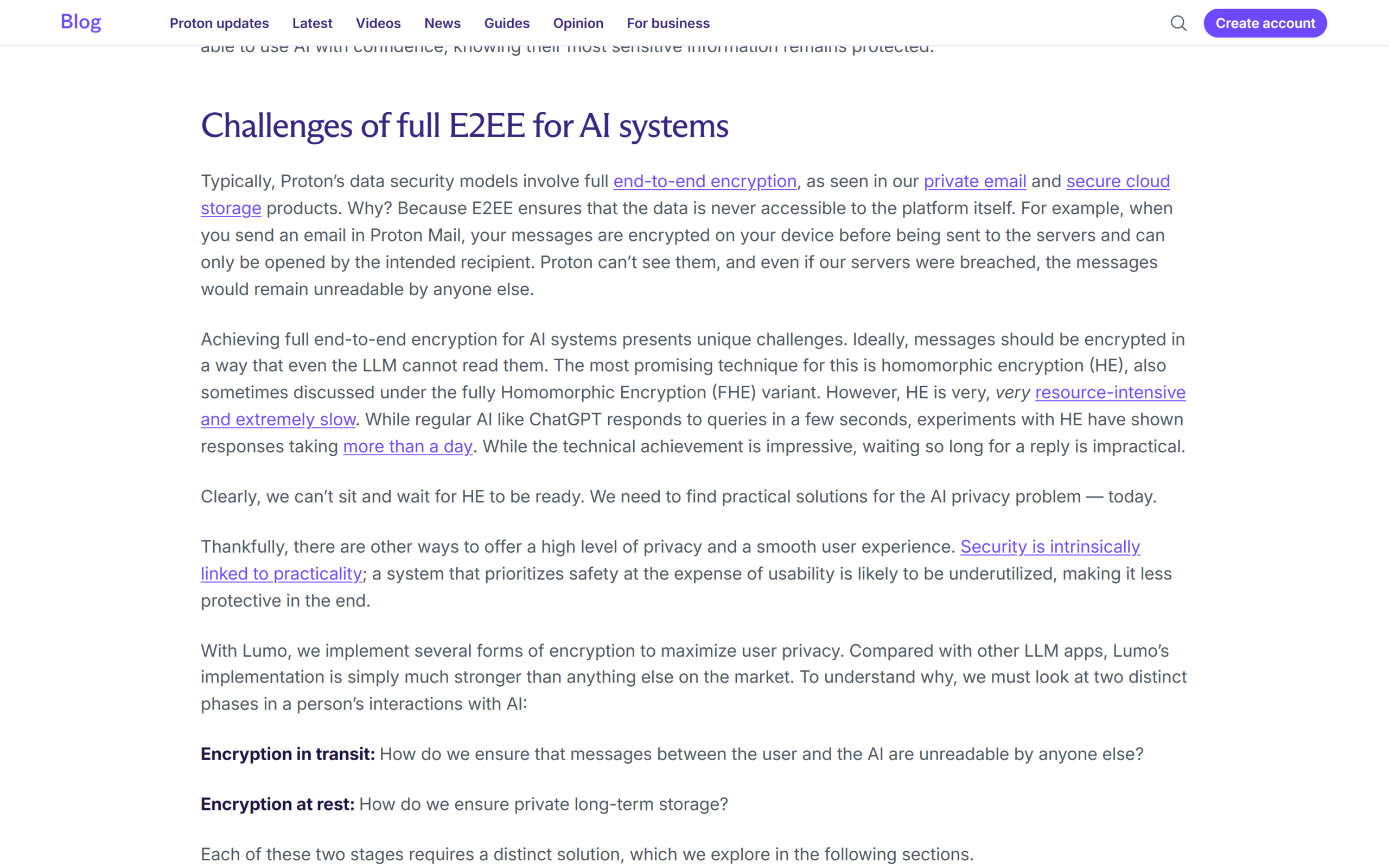
So Proton protects the two stages it can. In transit, it uses what it calls user-to-Lumo (U2L) encryption: your device generates a fresh symmetric AES key for each request, encrypts the message and the expected response with it, and encrypts that key with a public PGP key published by the Lumo server, so only the Lumo server can read the request. Proton is explicit that this “is not the regular definition of end-to-end encryption,” which is why it gave it a different name. The post also says the language model server is “memoryless” and keeps no logs of conversations between sessions, which is why each new message sends the whole conversation again.
At rest, your saved chat history is stored with zero-access encryption, meaning it is encrypted with keys Proton does not hold. In plain terms: Proton’s servers briefly see a message in clear text to generate a reply, but are designed not to log it, and the stored history is encrypted so that only you can read it. That is meaningfully stronger than an assistant that keeps readable transcripts and uses them for training, and it is honestly described, but it is not the “nobody but you can ever read it” guarantee that Proton Mail gives for messages between two Proton users.
Put simply, there are three moments to think about. While a message travels from your device, it is encrypted so that only the Lumo server can open it. While the model writes its answer, the server works on the text in the clear, and Proton’s protection here is a design that keeps no logs. Once the conversation is saved, it sits in your account under zero-access encryption that Proton cannot unlock. Most mainstream assistants protect the first moment with standard transport encryption but keep readable transcripts at the third, which is the practical difference Lumo is built around.
What Lumo can do
Lumo covers the everyday jobs of an AI assistant. The pricing FAQ lists web search, chat history and uploading files on the free plan, and the product page describes creating visuals from descriptions, researching topics in depth, getting organised, analysing data and working on documents. Proton adds a privacy note to each: generated images, for example, will “never be reused by Lumo’s model to inspire someone else’s design.”
Two features organise longer work. Projects group related chats, files and instructions in one place, and Custom Lumos let you set up tailored assistants for recurring tasks. The free plan includes one project, while Lumo Plus makes both projects and Custom Lumos unlimited. For people already in the Proton ecosystem, Lumo can also link files and folders from Proton Drive to give a conversation context, according to the pricing page, so documents you keep in encrypted storage can be analysed without uploading them to another company’s AI. Our Proton Drive review covers that storage side.
Under the hood, Proton’s security post says Lumo is powered by open-source language models, and the product page says Lumo’s own code is fully open source. That combination is rare among AI assistants and means outside researchers can check how the app handles data, even if they cannot inspect every model weight in every response.
Free vs Lumo Plus
Lumo has two personal plans. The free plan needs no credit card, and you can even chat without creating a Proton account, though creating one keeps your chat history. Lumo Plus raises the limits and adds features, at $12.99 a month on monthly billing or $9.99 a month on a yearly plan, billed at $119.88 every 12 months, with a 30-day money-back guarantee.
| Feature | Free | Lumo Plus |
|---|---|---|
| Price | $0, no credit card | $12.99/mo or $9.99/mo billed yearly |
| Max model usage | Limited | More |
| Messages and chat history | Limited | More, with extended history |
| Image generations | Limited | More |
| Projects | 1 | Unlimited |
| Custom Lumos | Limited | Unlimited |
| File uploads | Individual small files | Multiple large files |
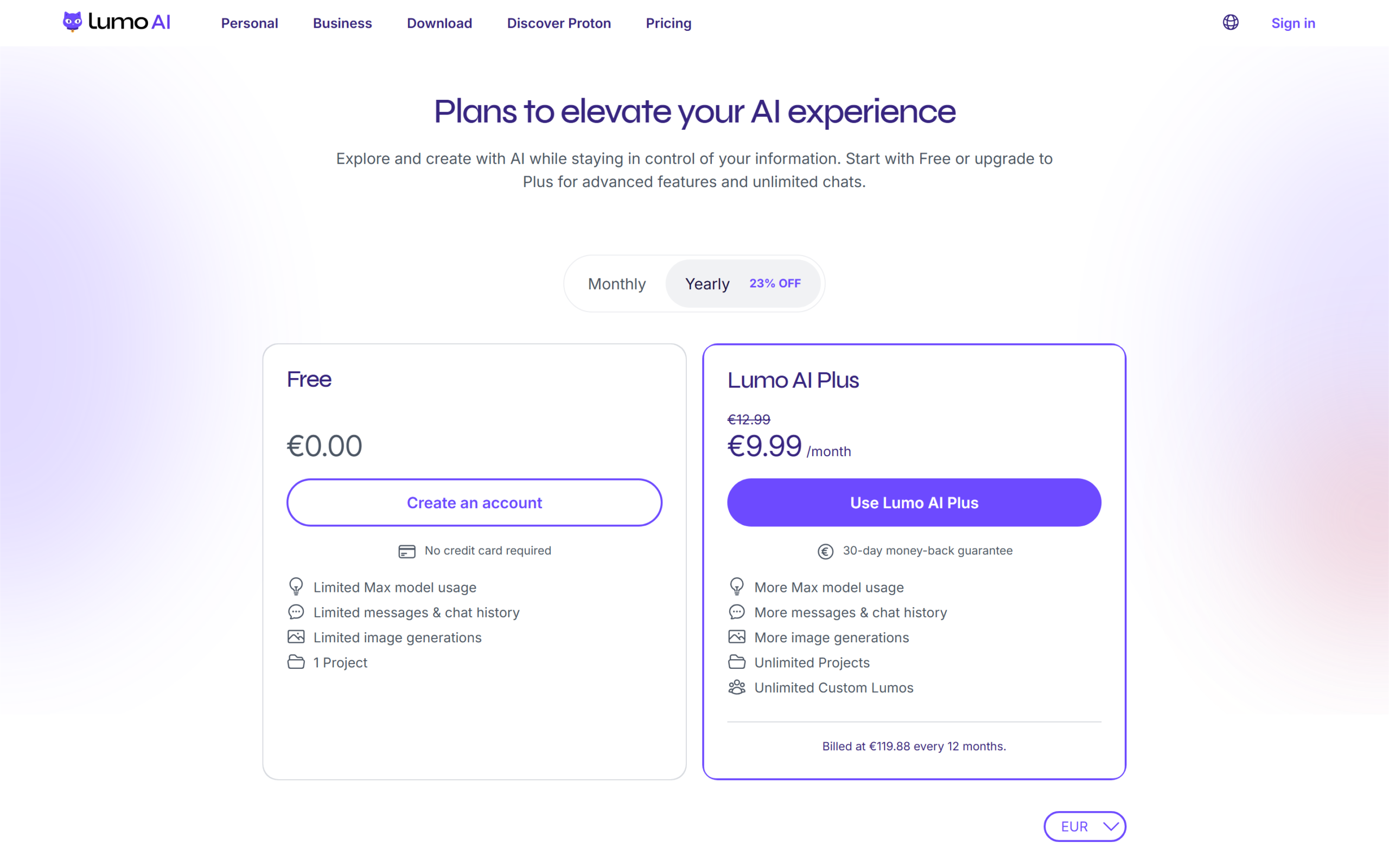
Proton does not publish exact message counts for either plan; the pricing page and FAQ describe limits as “limited” and “more” rather than numbers. The FAQ adds that your chat history carries over when you upgrade, and that if you downgrade, you keep your saved chats but lose Plus features at the end of the billing period, with no long-term commitment or cancellation fee.
One point surprises many Proton customers. Lumo Plus is not part of Proton Unlimited: Proton Mail’s plan comparison table lists Lumo usage as “Limited” on Proton Free, Mail Plus and Proton Unlimited alike. Since Lumo Plus on a yearly plan costs the same $119.88 a year as Proton Unlimited, an existing Unlimited subscriber who wants more Lumo would be paying for a second subscription. If you are new to Proton, our Proton Mail review explains what Unlimited does include. To see Lumo’s current offer, compare Lumo’s plans.
Proton’s comparison with mainstream assistants
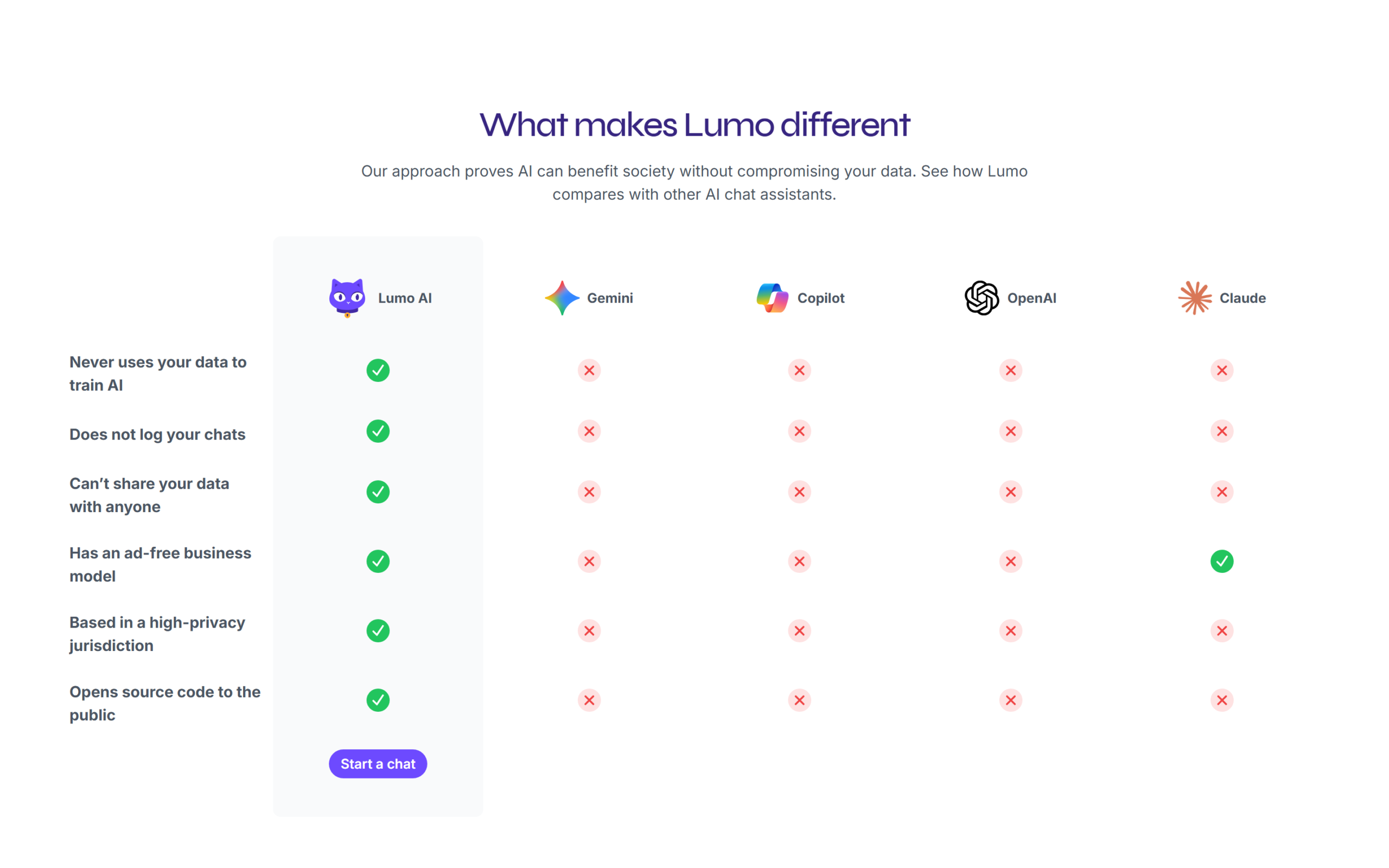
Lumo’s product page includes a comparison table against other AI chat assistants. It lists six properties, never using your data to train AI, not logging chats, being unable to share data with anyone, an ad-free business model, a high-privacy jurisdiction and public source code, and marks Lumo “Yes” on all six. Gemini, Copilot and OpenAI are marked “No” on all six, and Claude is marked “Yes” only on having an ad-free business model.
| Property (as Proton presents it) | Lumo | Gemini | Copilot | OpenAI | Claude |
|---|---|---|---|---|---|
| Never uses your data to train AI | Yes | No | No | No | No |
| Does not log your chats | Yes | No | No | No | No |
| Can’t share your data with anyone | Yes | No | No | No | No |
| Ad-free business model | Yes | No | No | No | Yes |
| High-privacy jurisdiction | Yes | No | No | No | No |
| Public source code | Yes | No | No | No | No |
Read it as Proton’s framing rather than an audit of the others. The table’s own description refers to “Lumo AI, Gemini, Copilot, Open AI and Deepseek,” while the visible columns show Claude instead of Deepseek, which suggests the table has been edited without updating its label. Mainstream assistants also offer settings, such as opting out of training or deleting history, that a simple yes or no column cannot capture. The table is still useful as a list of the questions to ask any AI provider about your data.
Getting started, and what to share
Starting is as simple as opening lumo.proton.me, which drops you into a guest chat with no sign-up. That is the right way to test whether Lumo’s answers are good enough for your questions. A guest chat is not saved, so create a free Proton account once you want history, projects or to come back to a conversation; the free account then offers to keep your chats and gives higher usage limits than guest mode, according to the sign-up prompt in the app.
A privacy-first assistant changes what is sensible to share, but it does not remove judgement. Proton’s own security model is clear that the server reads each message to answer it, so treat Lumo the way you would treat a trustworthy professional rather than a locked diary: questions about a health symptom, a contract clause or a money decision are exactly what it is built for, but there is still no reason to paste full passwords, card numbers or another person’s private data into any chat. If you link Proton Drive files, link the specific documents a task needs rather than whole folders.
A practical pattern many people will find useful is to keep two assistants: a mainstream tool for general research and coding where privacy matters less, and Lumo for anything personal or confidential. Because the free tier needs no account and no card, the cost of adding Lumo to that routine is a bookmark.
Lumo for Business
Proton sells Lumo to organisations too. The pricing FAQ says Lumo for Business is available through Lumo Professional or as part of Proton Workspace, which it describes as a privacy-first suite including email, calendar, cloud storage, VPN, password manager and video conferencing. Proton pitches it for drafting contracts, analysing data and brainstorming while keeping company and client information confidential, and stresses that Lumo is a European service outside United States jurisdiction that complies with GDPR. Business pricing was not listed on the personal pricing page checked for this review, so teams should ask Proton for a quote before planning a rollout.
What independent data shows
The Lumo app on Google Play showed a 3.7 star rating from about 3,170 reviews and more than 100,000 downloads on October 15, 2026. That is the lowest rating among Proton’s apps checked for our Proton reviews, well below Proton VPN’s 4.7 and Proton Mail’s 4.5, and from a much smaller user base. It fits a young product competing with assistants that have had years and very large budgets to mature.
The independent evidence that matters most for a privacy claim is structural: open-source code anyone can inspect and a published security model that names its own limits. Proton offers both. This Proton Lumo review did not find an independent audit specific to Lumo on the pages checked, so the privacy claims rest on Proton’s documentation and track record rather than an outside report.
Where Lumo is less strong
The privacy model is strong but not absolute. Because the model must read messages in clear text, protection depends on Proton’s servers not logging them, which Proton states they do not, rather than on cryptography alone. Anyone who needs a mathematically guaranteed private AI will not find it anywhere today, and Proton says as much.
Capability and polish are the other trade-off. The lower app rating, unpublished usage limits and plans that are still evolving all point to a product that is earlier in its life than the market leaders. If you depend on very large context windows, advanced coding agents or a wide ecosystem of plug-ins, a mainstream assistant may serve you better for those tasks, with Lumo reserved for the questions you would rather keep private.
Finally, the pricing overlap is awkward. Lumo Plus costs the same as Proton Unlimited but is not included in it, so loyal Proton customers do not get Lumo Plus as a bundle perk.
Who Lumo is for
Lumo suits people who want an AI assistant for sensitive questions, health, money, legal matters or confidential work, without contributing those questions to an advertising profile or a training dataset. It suits professionals bound by confidentiality, such as lawyers, therapists and consultants, and teams already on Proton who want AI that can work with files in Proton Drive. It is also a sensible second assistant for anyone who uses a mainstream tool for general work but wants a private place for private questions.
It is a weaker fit for users whose main need is maximum capability, deep integrations or the biggest model available, and for those who expected Lumo Plus to come free with Proton Unlimited.
Proton Lumo pros and cons
In this Proton Lumo review the clearest strengths are zero-access encrypted chat history, a no-training and no-logging policy, open-source code, a free tier usable without an account, Proton Drive integration, Projects and Custom Lumos, and an honest public explanation of what its encryption can and cannot do.
Against that: chats are not end-to-end encrypted in the classic sense, usage limits are not published as numbers, the Android app’s rating trails Proton’s other apps, and Lumo Plus is a separate subscription even for Proton Unlimited customers.
Frequently asked questions
Is Proton Lumo free?
Yes. You can chat without an account, and a free account adds chat history and one project. Free usage is limited.
How much is Lumo Plus?
$12.99 a month on monthly billing, or $9.99 a month billed yearly at $119.88, with a 30-day money-back guarantee.
Is Lumo end-to-end encrypted?
Not in the classic sense. Proton uses user-to-Lumo encryption in transit and zero-access encryption for stored history, and says its model servers keep no logs.
Does Lumo train on my chats?
Proton says no: Lumo never uses your data to train AI models, and its code is open source so this can be checked.
Is Lumo Plus included in Proton Unlimited?
No. Proton’s plan comparison lists Lumo usage as limited on Proton Unlimited, so Lumo Plus is a separate subscription.
Can Lumo read my Proton Drive files?
You can link files and folders from Proton Drive to give a conversation context, according to Lumo’s pricing page.
Is Proton Lumo worth trying?
This Proton Lumo review finds a genuinely privacy-first AI assistant with an honest security model, open-source code, encrypted history and no training on your data, offered free with sensible paid upgrades. It is not yet as capable or polished as the largest assistants, its encryption is strong but not classic end-to-end, and Lumo Plus sits outside Proton Unlimited.
For anyone who wants a private place to ask private questions, try Lumo free, no account needed, and upgrade only if you hit the limits.
7.4 Score
Pros
- Chat history stored with zero-access encryption, and a stated no-training, no-logging policy.
- Open-source code and open-source language models, with a candid public security model.
- Free to use without an account; Lumo Plus adds unlimited projects and Custom Lumos.
- Can link Proton Drive files and folders for context.
Cons
- Not classic end-to-end encryption: the model reads messages in clear text to answer.
- Usage limits are described as limited or more, without published numbers.
- Android app rated 3.7, below Proton's other apps.
- Lumo Plus is not included in Proton Unlimited despite costing the same yearly.
Final Verdict
Proton Lumo is a genuinely privacy-first AI assistant: encrypted chat history, no training on your data, open-source code and an honest explanation of why its chats cannot be classic end-to-end encrypted. It is younger and less capable than the market leaders, and Lumo Plus is a separate subscription even for Proton Unlimited customers. It is well worth trying free as a private place for private questions.