


Short answer: This Diginius review covers Diginius Insight, a PPC and marketing reporting platform sold on two separate pricing tracks, one for businesses managing their own advertising and one for agencies managing several clients’ campaigns. The business track runs Essential at $75 a month up to Core at $500 a month (most popular), with a Business tier at custom pricing; the agency track is priced per user at $25 a month and adds white-label branding, client budget pacing alerts, and finance automation for client fees. Both tracks unify reporting across Google, Microsoft, Meta and LinkedIn into one dashboard, plus SEO tracking and B2B lead intelligence features not every PPC reporting tool bundles together.
- Pick the business track if you manage your own company’s advertising and want unified reporting plus lead intelligence in one platform.
- Pick the agency track at $25 a month per user if you manage multiple clients’ campaigns and need white-label reporting and budget pacing alerts.
- Start with the free trial (30 days, with 100 Intent Leads a week during the trial) before committing to Core’s $500-a-month tier.
- Compare per-client cost carefully; Diginius prices per user or per flat tier, not strictly per client, which changes the math against a per-client competitor.
Business: Essential $75/mo, Pro $250/mo, Core $500/mo, Business custom. Agency: $25/mo per user. Diginius.com, checked September 16, 2026.
Table of contents
What is Diginius Insight and who is it for?
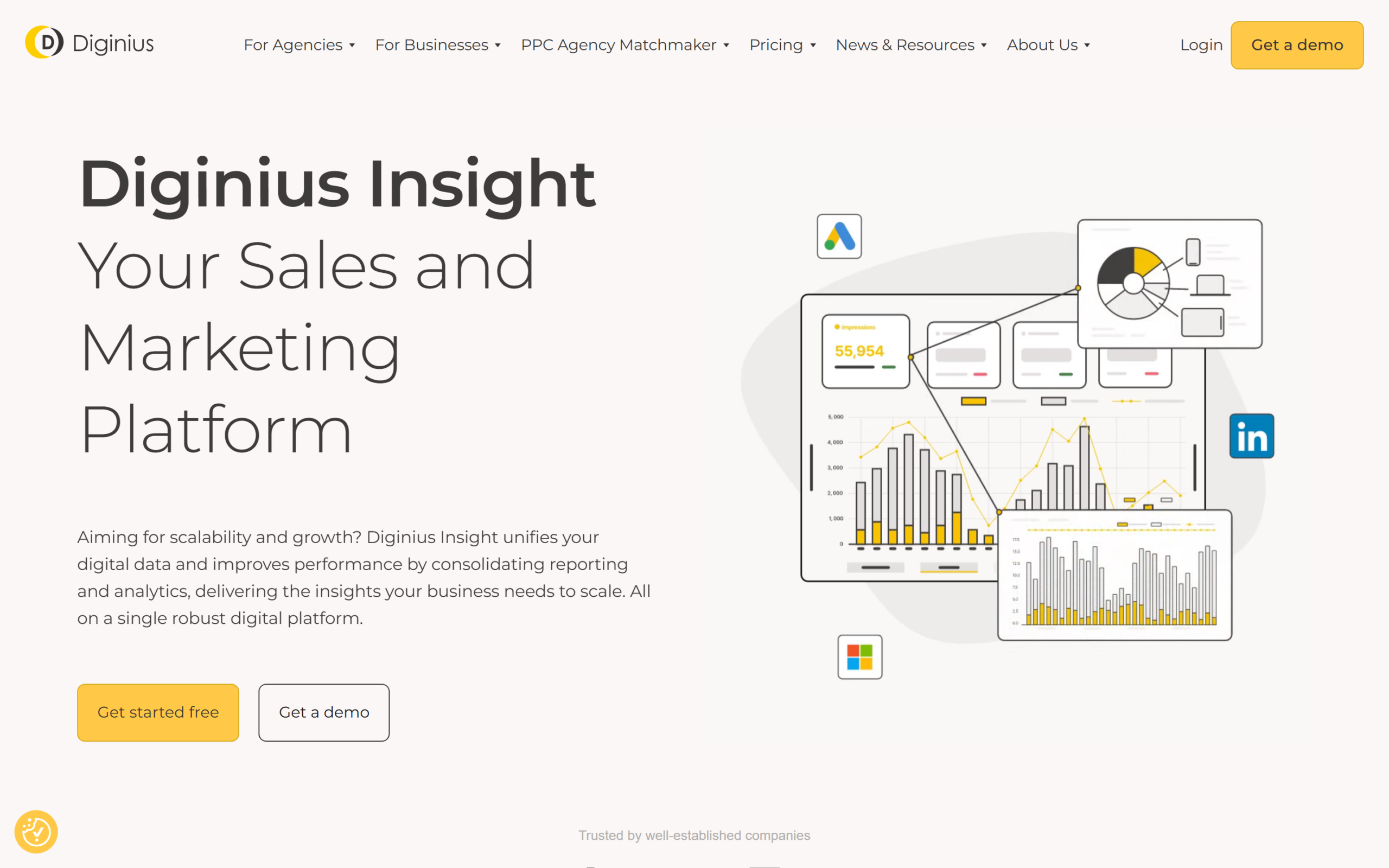
Diginius sells Diginius Insight as “Your Sales and Marketing Platform,” built to consolidate reporting and analytics across advertising channels, SEO, and lead generation into one dashboard rather than juggling separate tools for each. Its own homepage frames the goal directly: “unifies your digital data and improves performance by consolidating reporting and analytics, delivering the insights your business needs to scale.”
The buyer this suits splits into two distinct groups, which is why Diginius runs two separate pricing pages: a business running its own PPC and marketing campaigns that wants unified reporting and lead intelligence in one place, and a digital marketing agency managing several clients’ campaigns that needs white-label reporting, budget pacing and client-fee automation. This Diginius review reads both of Diginius’s pricing pages, its features pages, and one named rival, AgencyAnalytics, for comparison, all on September 16, 2026, checking every number stated on both pricing tracks against what the page itself actually shows.
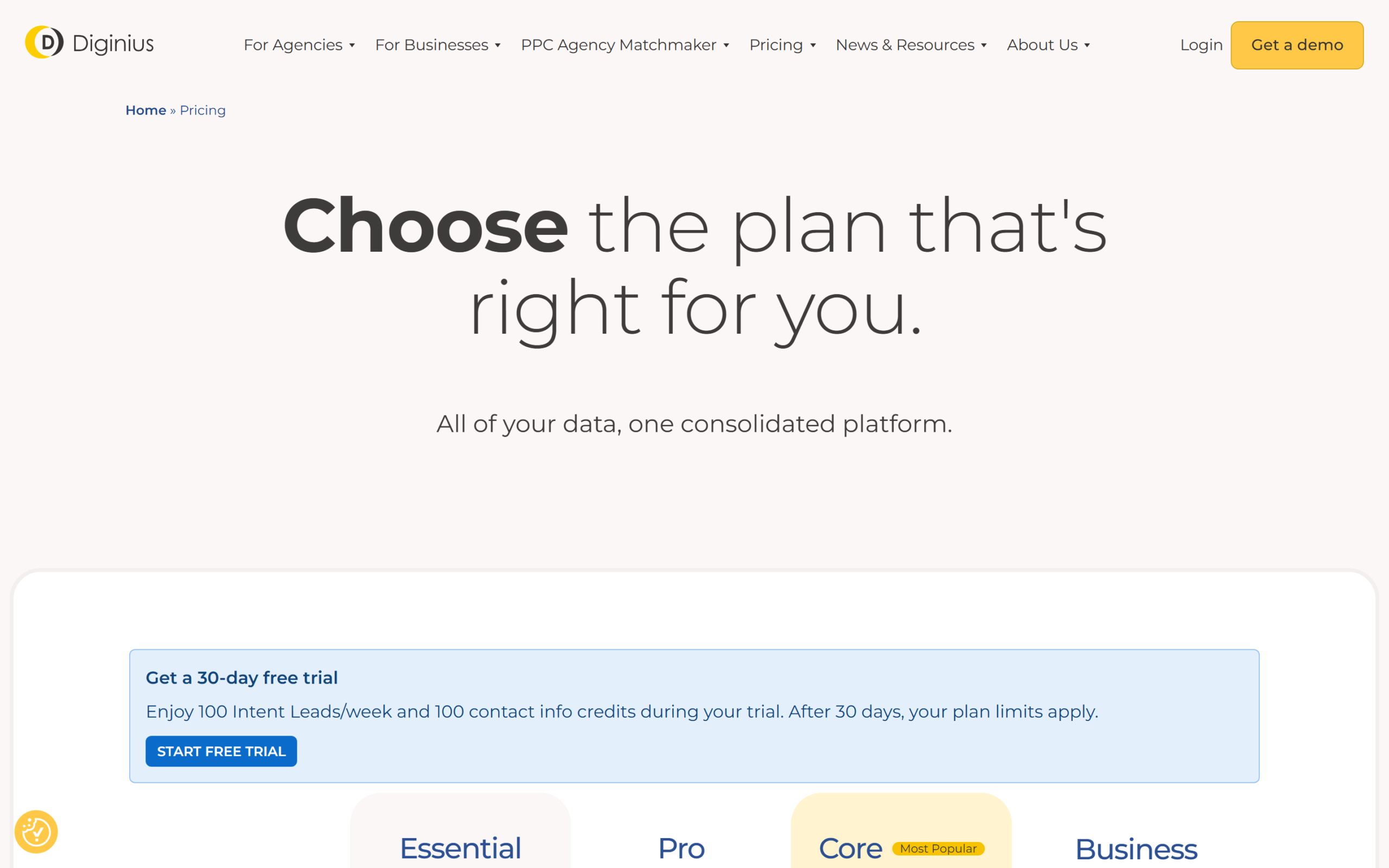
Diginius pricing for businesses: Essential through Business
The business track sells four tiers, each unlocking more SEO keyword and site-page tracking, more lead intelligence volume, and a higher support tier.
| Plan | Price | SEO keywords tracked | Lead Intelligence leads/mo |
|---|---|---|---|
| Essential | $75/mo | 25 | 10 |
| Pro | $250/mo | 500 | 25 |
| Core (Most Popular) | $500/mo | 1,000 | 50 |
| Business | Custom | Custom | Custom |
From Diginius’s Business Pricing page, checked September 16, 2026. All four tiers include unlimited account integrations, multi-channel reporting, and the Microsoft Publisher Network tool. Essential includes email support only; Pro adds a named Customer Success rep; Core keeps email support but at higher usage limits; Business adds a dedicated CS rep and custom limits across every metric, priced by contacting sales rather than shown publicly.
Annual payment is offered separately, described on the pricing page as saving 20 percent against the monthly rates shown above, though the exact annual total per tier is not itemized on the same page as the monthly cards.
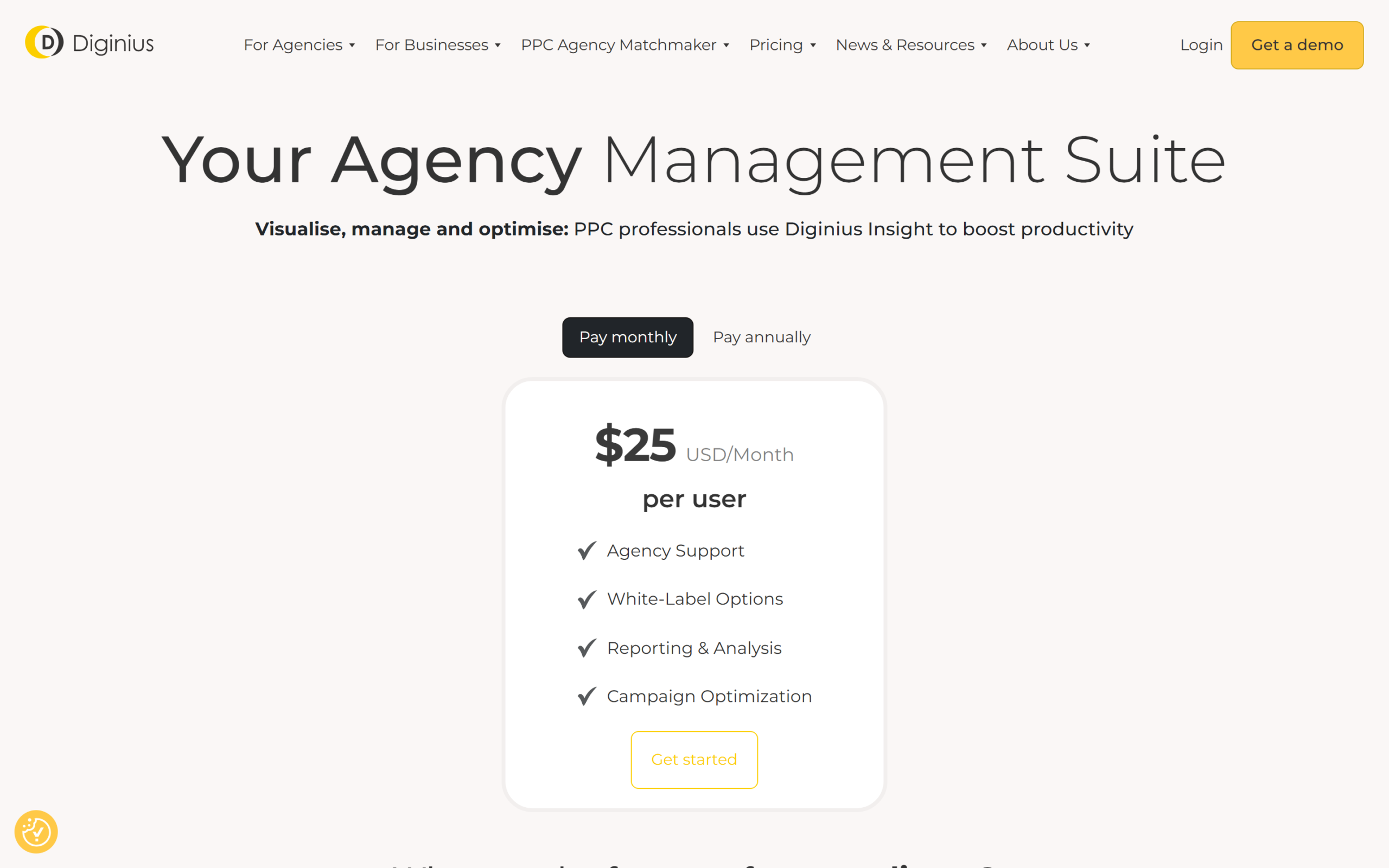
Diginius pricing for agencies: per user, not per client
The agency track is structured entirely differently: a single rate of $25 a month per user, rather than separate named tiers, billed monthly, or $240 per user a year when paid annually, which the page marks as 20% off. That one rate includes agency support, white-label options, reporting and analysis, and campaign optimization tools, with the feature set built specifically around managing several clients rather than one company’s own advertising.
On the client-facing side, the agency plan covers a multichannel dashboard and email reporting, unlimited marketing integrations, ad performance reporting across Google, Microsoft, Meta and LinkedIn, SEO visibility and health tracking, organic keyword and competitor tracking, organic social performance data, and B2B site visitor identification for lead generation. On the agency-management side specifically, it adds the ability to assign clients to individual managers, white-label dashboards with the agency’s own colors and logo, budget pacing reports with custom over- and under-spend alerts, and finance automation that tracks and calculates client fees and pushes them into invoice generation automatically.
Because the agency plan prices per user rather than per client, an agency’s real monthly cost depends on team size, not client count, a meaningfully different math from a per-client pricing model; a five-person agency team pays $125 a month regardless of whether it serves 5 clients or 50. That structure rewards a lean team managing many client accounts and penalizes a large team managing relatively few, the opposite of how a per-client competitor’s pricing behaves, so the two models are not simply different prices for the same thing, they scale in opposite directions as an agency grows.
The bidding engines feature deserves a specific callout: automated, profit-focused bid management for Search and Shopping campaigns is the kind of feature that normally lives in a dedicated PPC management tool rather than a reporting dashboard, and its presence on the agency tier suggests Diginius is positioning itself as more than a passive reporting layer for agencies that want active campaign management folded into the same platform they already use for client reporting.
Reporting, SEO tracking and Lead Intelligence
Diginius groups its core capability into three areas. Advertising Insights aggregates performance across Google, Microsoft, Facebook and LinkedIn into one view, aimed at showing which channels and budget allocations are actually working rather than checking each ad platform’s own dashboard separately. SEO tracking, scaled by plan tier from 25 keywords on Essential up to 1,000 on Core, covers organic keyword position and site-page health.
Lead Intelligence is the feature that separates Diginius from a pure ad-reporting tool: it identifies and attempts to nurture high-value leads from website traffic, paired with “Intent Leads by Bombora,” a named third-party data partnership providing weekly intent-signal leads (10 a week on Essential, 50 on Pro, 100 on Core) alongside monthly Lead Intelligence Credits used to unlock contact information for identified visitors. Diginius’s own resources section publishes case studies and guides on how each feature area is meant to be used in practice, worth reading before assuming a specific number (SEO keywords tracked, leads per week) maps directly onto your own reporting needs.
The three feature areas are not siloed from each other in how Diginius presents them: the platform’s pitch is specifically that advertising performance, organic SEO visibility, and lead identification all live in the same dashboard, so a marketer can see, for example, whether a spike in organic keyword rankings correlates with a spike in identified high-intent website visitors, without exporting data from three separate tools and reconciling it by hand.
The free trial: what it actually includes
Diginius’s own business pricing page advertises “a 30-day free trial,” specifically calling out “100 Intent Leads/week and 100 contact info credits during your trial,” figures that match the Core tier’s own limits and sit well above Essential’s 10 Intent Leads a week and 25 contact credits a month once the trial ends and normal plan limits apply. The Essential plan’s own card now states the same “30 day free trial,” so the 14-day figure this review found on that card in September is gone and the banner and the card agree.
Check Diginius’s current trial terms directly before signing up, since the trial’s lead and credit allowances are the part that changes once plan limits apply.
How Diginius compares with AgencyAnalytics
AgencyAnalytics is a named rival built specifically for agency reporting, and its own pricing page takes the opposite structural approach from Diginius: one plan, priced per client rather than per user.
| Diginius (Agency) | AgencyAnalytics | |
|---|---|---|
| Pricing unit | Per user | Per client |
| Entry price | $25/mo per user | €17/mo per client, billed annually |
| Plan structure | One agency rate | One plan, all features unlocked |
| Enterprise option | Custom (Business tier) | Custom, for 25+ clients |
From Diginius’s agency pricing page and AgencyAnalytics’s own pricing page, checked September 16, 2026; AgencyAnalytics’s price shown in EUR to this session.
The per-user versus per-client split is the real decision point. An agency with a small team serving many clients comes out ahead on Diginius’s per-user model; an agency with a large team serving few clients does better on AgencyAnalytics’s per-client model. AgencyAnalytics states 85-plus integrations and bundles AI insights, benchmarking and MCP access (described as ChatGPT and Claude access) directly into its single plan; Diginius spreads comparable depth, lead intelligence, finance automation, bidding engines, specifically into its agency tier’s own feature list rather than a single universal plan shared with its business-track customers.
AgencyAnalytics also sells optional paid add-ons beyond its base per-client rate, an AI Tracker for monitoring brand visibility across AI engines like ChatGPT and Google AI Overview, and a Rank Tracker for weekly keyword position tracking, both billed separately per credit or keyword bundle rather than bundled into the base price. Diginius’s SEO keyword tracking, by contrast, is included directly in every business-track tier’s base price, scaling from 25 keywords on Essential to 1,000 on Core with no separate add-on purchase required, a structural difference worth weighing alongside the headline per-unit price when comparing the two on SEO tracking specifically rather than agency management features.
Where Diginius is less clear
The trial-length discrepancy this review first found, a 30-day banner against a 14-day Essential card, is resolved: on October 12, 2026 both say 30 days. What remains is that the business track’s per-tier annual pricing is not itemized next to the monthly rate, while the agency page now shows its annual rate outright, $240 per user a year. On the business track there is only a general “Save 20%” claim, so a buyer wanting the precise annual total needs to select annual billing directly rather than calculate it from the page’s own monthly figures.
This overview also did not find Diginius listed with a substantial independent review count on G2 or Capterra at the time of writing, so third-party validation of its reporting accuracy or support quality beyond its own site’s single published testimonial (from a named PPC agency, quoted calling the company “responsive, on the ball and get the job done”) is thin. A single testimonial, however specific and positively worded, is not the same evidence base as dozens or hundreds of independently collected reviews, and a buyer evaluating Diginius against an established rival with a larger public review history should weigh that gap accordingly.
The Business tier’s fully custom pricing is also worth flagging as a limitation of the comparison itself: every other tier on both pricing tracks shows a real number, but Business requires a sales conversation before any price is disclosed, which makes it impossible to include in a direct per-dollar comparison against a competitor’s own top tier without first getting a quote.
Who is Diginius for, and who is it not for?
Scenario one: an in-house marketer managing PPC across several ad platforms
The business track’s Essential or Pro tier covers unified reporting across Google, Microsoft, Meta and LinkedIn without checking each platform separately.
Scenario two: a business that wants lead generation from its own website traffic
Lead Intelligence and the Bombora Intent Leads integration, scaled by tier, are built for exactly this, identifying and providing contact data for high-intent visitors.
Scenario three: a digital marketing agency managing multiple clients
The agency track at $25 a month per user adds white-label branding, budget pacing alerts, and automated client-fee invoicing that the business track does not include.
Who Diginius is not for
A large agency team serving relatively few clients may find AgencyAnalytics’s per-client pricing model cheaper than Diginius’s per-user rate; do the math on your specific team size against client count before choosing either.
Common buying mistakes
Forgetting that the trial’s 100 Intent Leads a week drop to the plan’s own limit, 10 a week on Essential, once the 30 days end. Comparing Diginius’s per-user agency price directly against a per-client competitor’s rate without first converting both to the same unit for your actual team and client counts. Signing up for Core’s $500-a-month tier before confirming Essential or Pro’s lower SEO-tracking and lead-volume limits are not already sufficient for your actual usage. Choosing the business track when your actual work is managing other companies’ campaigns, or the reverse, since the two tracks are built around genuinely different workflows and neither substitutes cleanly for the other.
It is also worth confirming directly with Diginius sales what the Business tier’s custom pricing actually includes for your specific volume before assuming it is simply “Core, but more expensive.” A custom-priced enterprise tier commonly bundles service-level guarantees, onboarding support, or contractual terms that a self-serve monthly plan does not offer at any price, and those differences matter more to some buyers than the raw usage limits shown on the public pricing page.
Diginius pros and cons
Diginius Insight
- Unified reporting across Google, Microsoft, Meta and LinkedIn in one dashboard.
- Two distinct pricing tracks, business and agency, each built around how that buyer actually works.
- Lead Intelligence and Bombora Intent Leads bundle lead generation into the same platform as ad reporting.
- Agency tier’s finance automation pushes client fees into invoice generation automatically.
- After the 30-day trial, Intent Leads drop from 100 a week to the plan’s own limit, 10 a week on Essential.
- Business-track annual pricing is not itemized per tier, only a 20 percent savings claim; the agency rate is the exception at $240 per user a year.
- Per-user agency pricing can cost more than a per-client rival for a large team serving few clients.
- Thin independent review presence found on major review aggregators at the time of this overview.
Frequently asked questions
How much does Diginius cost for a business?
Essential is $75/mo, Pro is $250/mo, Core is $500/mo, and Business is custom priced by contacting sales.
How much does Diginius cost for an agency?
$25 a month per user, or $240 per user a year on annual billing, covering agency support, white-label options, reporting and analysis, and campaign optimization tools.
How long is the free trial?
30 days. The pricing page’s banner and the Essential plan card both state it, with 100 Intent Leads a week and 100 contact info credits during the trial; after 30 days the plan’s own limits apply.
What is Lead Intelligence?
A feature that identifies and nurtures high-value leads from website traffic, paired with Intent Leads by Bombora, a named third-party data partnership, and monthly credits to unlock contact information for identified visitors, scaling by plan tier from 10 leads a week on Essential up to 100 on Core.
Does Diginius offer white-label reporting?
Yes, on the agency track specifically, letting an agency customize dashboards and reports with its own colors and logo rather than Diginius’s own branding for client-facing work.
How does Diginius compare with AgencyAnalytics on price?
Diginius prices its agency tier per user ($25/mo); AgencyAnalytics prices per client (EUR 17/mo billed annually). Which one is actually cheaper for you depends entirely on your team size relative to your client count, not on the headline rate alone.
What platforms does Diginius integrate with?
Google, Microsoft, Meta (Facebook) and LinkedIn are named specifically for advertising reporting, with unlimited account integrations included on every single business-track tier, from Essential all the way up through the custom-priced Business tier.
Does Diginius include bid management, or only reporting?
The agency tier specifically lists bidding engines for Search and Shopping campaigns with profit-focused budgeting, active, profit-focused campaign management rather than passive reporting alone.
Is this Diginius review based on hands-on testing?
No. This Diginius review is built entirely from Diginius’s own business and agency pricing pages, its features pages, and AgencyAnalytics’s own pricing page for comparison, all checked on September 16, 2026.
Is Diginius worth it?
This Diginius review finds a genuinely two-sided platform, a business-focused reporting and lead-generation tool on one pricing track, and a purpose-built agency management suite on the other, both consolidating advertising, SEO and lead data that would otherwise live in separate tools. The agency track’s per-user pricing is a real advantage for a lean team serving many clients, and a real disadvantage for the opposite case, so the math is worth running before committing to either vendor.
Use the 30-day trial to test the reporting on your own accounts, and check Diginius’s current plans against your actual team size or SEO and lead-volume needs before choosing a tier.
7.7 Score
Pros
- Unified reporting across Google, Microsoft, Meta and LinkedIn in one dashboard.
- Two distinct pricing tracks, business and agency, each built around how that buyer actually works.
- Lead Intelligence and Bombora Intent Leads bundle lead generation into the same platform as ad reporting.
- Agency tier's finance automation pushes client fees into invoice generation automatically.
Cons
- After the 30-day trial, Intent Leads drop from 100 a week to the plan's own limit, 10 a week on Essential.
- Business-track annual pricing is not itemized per tier, only a 20 percent savings claim; the agency rate is the exception at $240 per user a year.
- Per-user agency pricing can cost more than a per-client rival for a large team serving few clients.
- Thin independent review presence found on major review aggregators at the time of this overview.
Final Verdict
Diginius splits cleanly into a business track (Essential to Core, $75 to $500 a month) and a purpose-built agency track ($25 a month per user with white-label reporting and finance automation), both consolidating ad, SEO and lead data in one dashboard. Its per-user agency pricing is a real advantage for a lean team serving many clients, the opposite of AgencyAnalytics's per-client model, so run the math for your own team size first. Agencies can pay $240 per user a year on annual billing, and the business track opens with a 30-day free trial on Essential, with 100 Intent Leads a week until the plan's own limits apply.