


Short answer: This RankMath review covers a WordPress SEO plugin active on 4 million-plus websites, rated 4.8 out of 5 from 7,502 reviews on WordPress.org, built around a free tier competitive with paid rivals and a Pro tier that starts at $7.99 a month for unlimited personal sites, rising to $24.99 for 100 client sites and $54.99 for 500. Its closest named rival, Yoast SEO, runs more installs (10 million-plus) and a slightly larger review count, but charges $9.90 a month for a single site with no free multi-site tier at that price. RankMath’s core pitch is schema markup, keyword tracking and Google Search Console data built into one plugin, plus newer AI-facing tools like AI Link Genius and AI Visibility monitoring.
- Start with the free version if you run one or a few WordPress sites and want schema markup, an XML sitemap and on-page analysis without paying anything.
- Upgrade to PRO at $7.99 a month if you want Google Analytics and Search Console data inside WordPress, keyword rank tracking, and unlimited personal sites on one license.
- Upgrade to BUSINESS or AGENCY at $24.99 or $54.99 a month if you manage client sites and need 100 or 500 site licenses under one account.
- Compare against Yoast before paying if you only run one site; Yoast’s single-site price is close to RankMath’s unlimited-site PRO price.
Free tier available. PRO $7.99/mo, BUSINESS $24.99/mo, AGENCY $54.99/mo, all billed annually. RankMath.com, checked September 13, 2026.
Table of contents
What is RankMath and who is it for?
RankMath is a WordPress SEO plugin, sold and marketed as “AI SEO Tools to Dominate SEO Rankings,” that handles on-page optimization, XML sitemaps, schema markup, redirections and, on paid tiers, keyword rank tracking and Google Search Console and Analytics data, all inside the WordPress admin rather than a separate dashboard. Its own WordPress.org listing states “Over 4 million WordPress websites trust Rank Math to grow their organic traffic faster.”
The buyer this suits is anyone running a WordPress site who wants schema markup, sitemaps and on-page SEO guidance without hiring a specialist, from a single blogger to an agency managing dozens of client sites. This RankMath review reads RankMath’s own pricing page, its WordPress.org plugin listing (the most independently checkable source for install counts, ratings and support response times), and Yoast SEO’s equivalent pages for comparison, all on September 13, 2026.
RankMath pricing: free, PRO, BUSINESS and AGENCY
RankMath’s core plugin is free and available directly through the WordPress plugin directory, no purchase required. Three paid tiers sit above it, all billed annually at a discounted introductory rate.
| Plan | Price (first year) | Renews at | Site limit |
|---|---|---|---|
| PRO | €7.99/mo | €8.99/mo | Unlimited personal sites |
| BUSINESS | €24.99/mo | €27.99/mo | 100 client sites |
| AGENCY | €54.99/mo | €64.99/mo | 500 client sites |
From RankMath’s pricing page, prices shown in EUR (ex VAT), checked September 13, 2026. All three plans are billed annually, and RankMath states the listed price is a discount off the renewal price shown alongside it: 15 percent off AGENCY, 10 percent off BUSINESS, 11 percent off PRO.
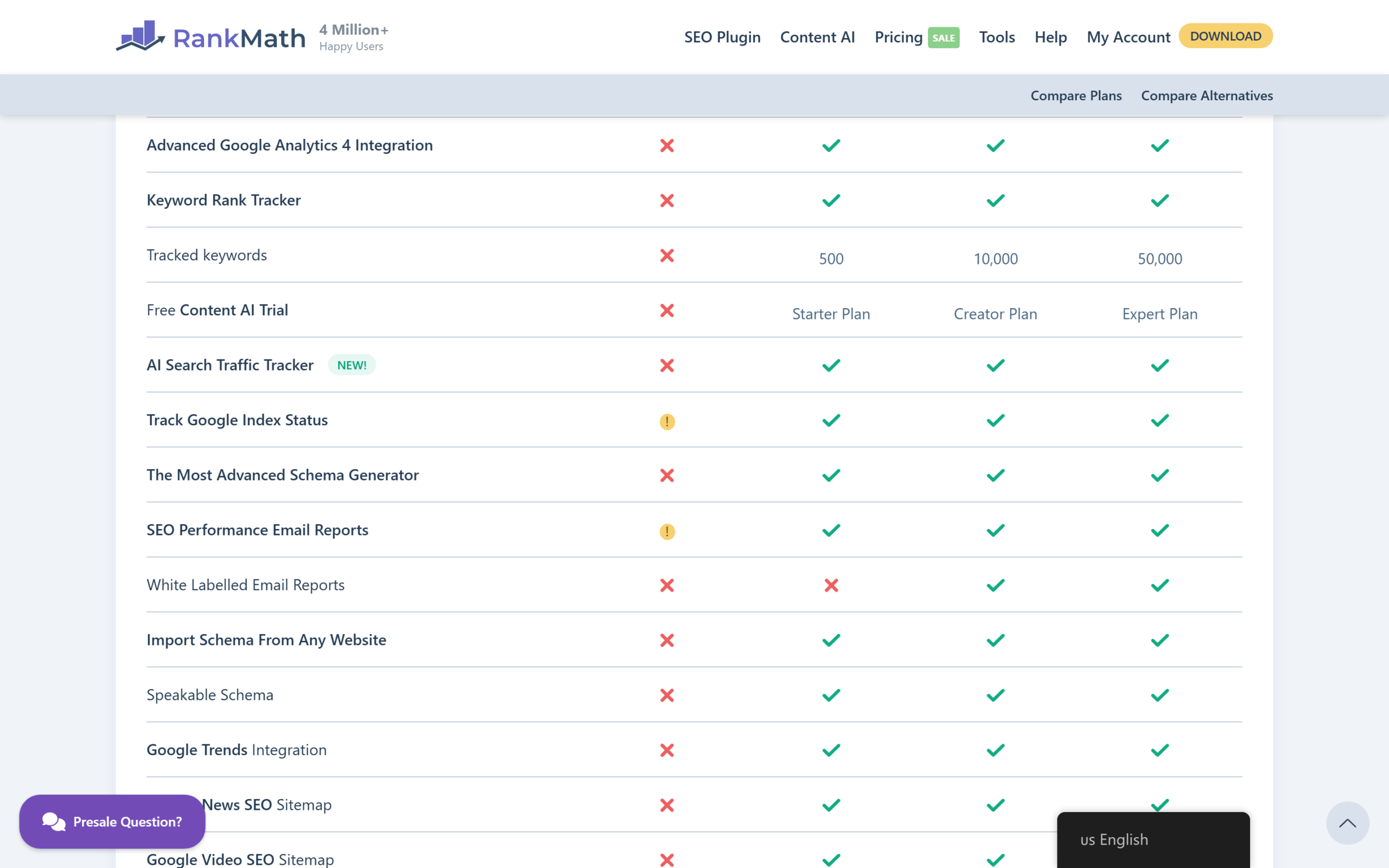
PRO tracks 500 keywords and supports unlimited personal websites on one license, aimed squarely at a blogger, freelancer or solopreneur running their own sites rather than client work. BUSINESS steps up to 100 client websites and 10,000 tracked keywords, aimed at a freelancer or small agency. AGENCY covers 500 client websites and 50,000 tracked keywords, aimed at agencies with real volume. All three paid tiers include the schema generator, a free Content AI trial at a tier-matched level (Starter for PRO, Creator for BUSINESS, Expert for AGENCY), AI Link Genius, a broken link checker, automated keyword linking, the advanced rank tracker, and 24/7 support, with AGENCY specifically naming “24/7 Priority Support.”
Schema, keyword tracking and the new AI tools
RankMath’s stated core feature set includes an “Intuitive Setup Wizard,” 16-plus schema types for rich results, unlimited focus keyword optimization (5 by default, unlimited with a filter), Google Search Console and Analytics integration, LSI keyword suggestions, an XML sitemap with custom post type support, 30-plus one-click SEO tests, a smart redirection manager, a built-in 404 monitor, internal link suggestions, a role manager, and automatic alt text and title tags for images.
Two features are marketed as new as of this review: AI Visibility, which monitors how a brand is mentioned across AI assistants like ChatGPT and tracks sentiment and competitive standing in AI-generated answers, and AI Link Genius, which surfaces every internal and external link on a site from one dashboard, suggests smart links as you write, and flags broken links and redirects automatically. RankMath also lists dedicated modules for WooCommerce SEO (automatic schema and meta tags for products), Elementor and Divi SEO (native page builder integration), Local SEO, Google AMP SEO, and bbPress/BuddyPress SEO with Q&A schema, plus one-click import from Yoast, All in One SEO, SEOPress, All In One Schema and the Redirection plugin. Step-by-step setup instructions for each of these modules live in RankMath’s own knowledge base, which is worth checking before assuming a specific module works a certain way, since a schema type or an import path can change between plugin versions.
Try the free version first with a specific goal in mind, schema markup, an XML sitemap, or the setup wizard, rather than installing it and hoping the paid tools reveal themselves; most of RankMath’s headline AI features and the keyword rank tracker are locked behind PRO or higher, so a fair trial of the free tier means testing only what the free tier actually includes. Install RankMath free and run its setup wizard against one real post before deciding whether the paid tiers are worth it for your site.
Active installs, ratings and support record
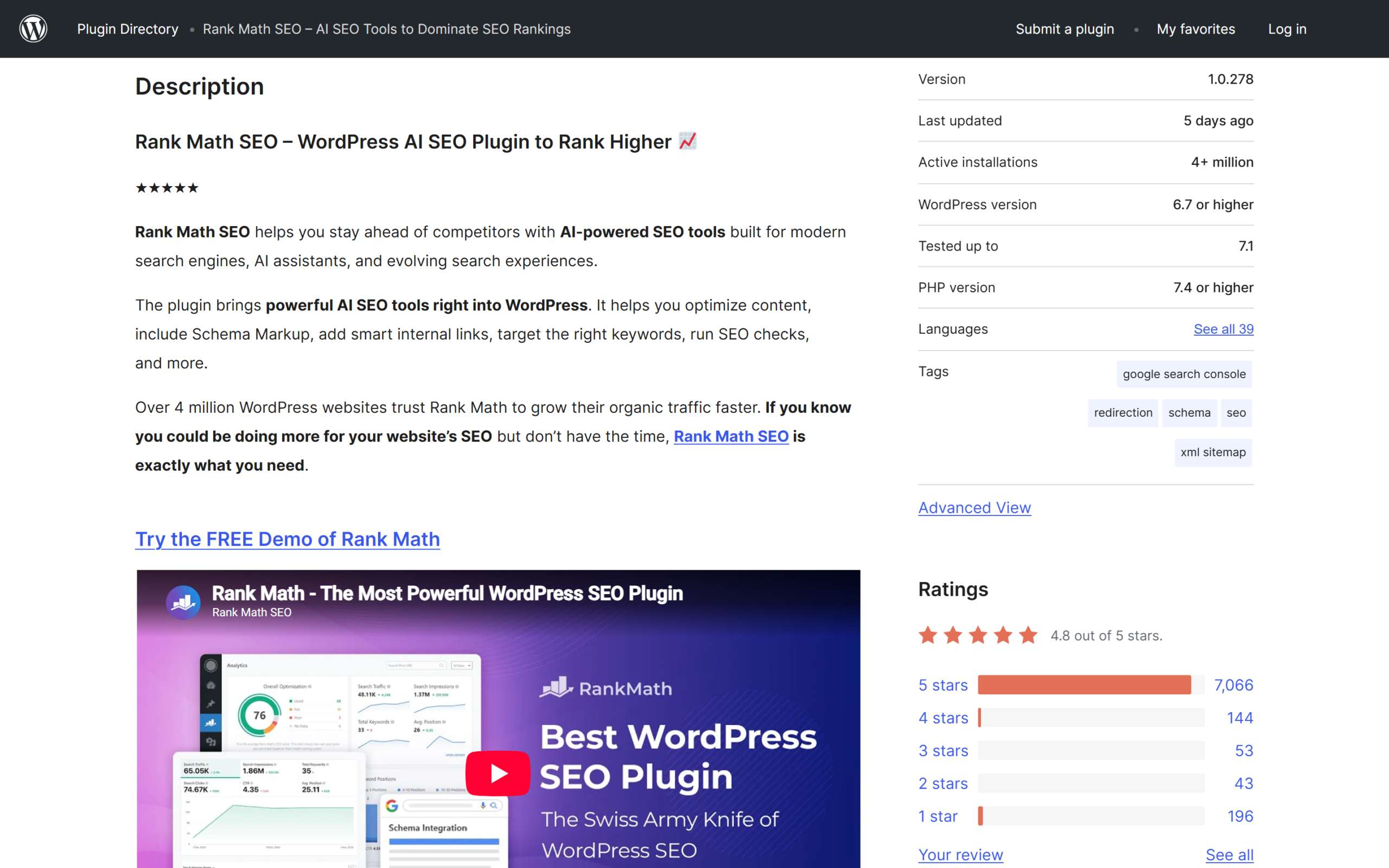
RankMath’s WordPress.org listing is the most independently checkable source for its real-world numbers, since it is maintained by WordPress.org itself rather than RankMath. At the time of this review it shows version 1.0.278, last updated 5 days earlier, 4-plus million active installations, a requirement of WordPress 6.7 or higher and PHP 7.4 or higher, and compatibility tested up to WordPress 7.1.
| Rating | Count |
|---|---|
| 5 stars | 7,066 |
| 4 stars | 144 |
| 3 stars | 53 |
| 2 stars | 43 |
| 1 star | 196 |
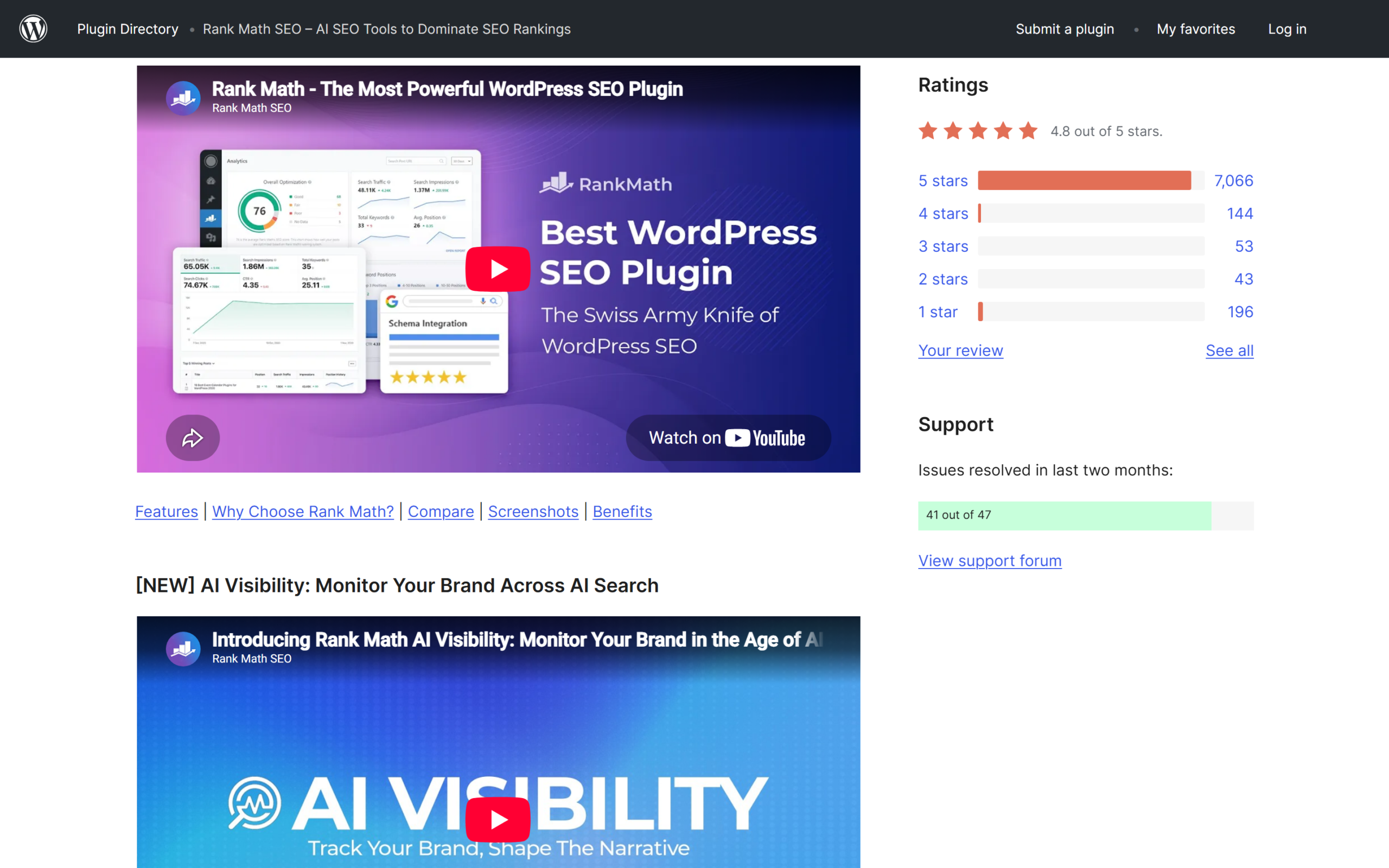
From RankMath’s WordPress.org plugin page, checked September 13, 2026. That totals 7,502 reviews at an average of 4.8 out of 5, with the one-star count (196) actually exceeding the two- and three-star counts combined (96), a pattern common on WordPress.org where a plugin update breaking a specific site tends to draw an immediate one-star review rather than a more measured middle rating. On support, RankMath’s own WordPress.org page states 41 of 47 support forum issues were resolved in the last two months, a response rate worth checking against Yoast’s equivalent figure below.
RankMath vs Yoast SEO
Yoast SEO is the longest-established name in the category, in the market since 2008 according to its own WordPress.org listing, and it is also free at its core with a single paid Premium tier.
| RankMath | Yoast SEO | |
|---|---|---|
| Active installs | 4+ million | 10+ million |
| WordPress.org rating | 4.8 (7,502 reviews) | 4.8 (27,819 reviews) |
| Support issues resolved (last 2 months) | 41 of 47 (87%) | 28 of 32 (88%) |
| Entry paid price | €7.99/mo, unlimited personal sites | €9.90/mo equivalent, one site |
| Multi-site license tiers | Yes, 100 or 500 sites | Not on the core Premium plan |
From both plugins’ WordPress.org listings and pricing pages, checked September 13, 2026.
Both plugins carry an identical 4.8 average rating, and both resolve roughly 87 to 88 percent of support forum issues in a two-month window, close enough that neither number alone decides between them. Yoast runs on more than double RankMath’s active installs and has roughly 3.7 times RankMath’s review count, a real difference in how battle-tested the plugin is at scale. The clearer split is pricing structure: RankMath’s PRO tier covers unlimited personal websites on one license for €7.99 a month, while Yoast SEO Premium is priced per site at €9.90 a month (€118.80 billed annually), with no equivalent unlimited-site personal tier on its own pricing page. A user running several of their own sites gets meaningfully more from RankMath’s PRO license structure; a user running exactly one site is paying roughly comparable prices either way and should decide on feature fit instead.
Feature-wise, Yoast’s Premium tier leans on AI-generated titles and meta descriptions, a content planner, a redirect manager with CSV bulk tools, a bot blocker for AI crawlers like GPTBot and CCBot, and a Google Docs add-on for pre-publish analysis outside WordPress. RankMath’s PRO and above lean on its schema depth (16-plus types free, more on paid tiers), AI Link Genius’s internal-linking automation, and the newer AI Visibility brand-monitoring tool. Neither plugin’s feature set is strictly a superset of the other’s, so a straight side-by-side feature count is less useful than matching each plugin’s strengths against what a specific site actually needs.
Switching costs matter too, in both directions. RankMath advertises one-click import from Yoast, and Yoast’s own migration tools work the other way, so neither company makes leaving particularly hard on paper. In practice, a site with years of Yoast-generated redirects, custom schema and meta history is the kind of migration worth testing on a staging copy first, regardless of which plugin ends up winning the comparison, since an SEO plugin swap that goes wrong can cost more in lost rankings than either plugin’s subscription price for a year.
Where RankMath is less clear
The pricing page shows a “Previously” price crossed out next to every current price, framing the current rate as a limited-time discount; since this RankMath review checked the page on a single date, it cannot confirm whether that discount is genuinely temporary or a permanent fixture of RankMath’s pricing page that never actually reverts. A buyer who wants price certainty should screenshot the pricing page on the day they subscribe and treat the “renews at” figure as the real long-term price to budget for, not the discounted headline number.
The 196 one-star reviews on WordPress.org, while a small share of 7,502 total, are worth reading directly before a major site migration to RankMath, since plugin-conflict and update-related complaints are a known pattern for any SEO plugin this deeply integrated into a site’s structure, touching permalinks, meta tags and structured data across every post. A one-star review on a plugin this widely installed is not automatically representative of a typical install, but the specific failure modes named in those reviews, whatever they turn out to be on a given week, are worth reading before a migration on a business-critical site rather than after.
Finally, RankMath’s AI-facing features (AI Visibility, AI Link Genius, Content AI) are new enough that this review could not independently verify their real-world accuracy against a live site; treat the specific AI feature claims, brand sentiment tracking across AI assistants in particular, as vendor-stated until tested on your own content and your own brand. An AI Visibility score is only as useful as the sample of AI responses it is drawn from, and RankMath’s own listing does not disclose that sample size or methodology in the description text read for this review.
Who is RankMath for, and who is it not for?
Scenario one: a single blogger or small business site
The free version alone covers schema markup, an XML sitemap and on-page analysis; PRO at $7.99 a month is worth it mainly for Search Console and Analytics data inside WordPress and keyword rank tracking.
Scenario two: a freelancer or small agency managing client sites
BUSINESS at $24.99 a month covers up to 100 client sites on one license, cheaper per site than buying 100 separate PRO-equivalent single-site licenses from most competitors.
Scenario three: an agency with real scale
AGENCY at $54.99 a month covers up to 500 client sites and the highest keyword-tracking ceiling, 50,000 keywords.
Who RankMath is not for
A user already deeply invested in Yoast’s specific AI content-planning workflow or its Google Docs add-on, with no complaints about Yoast’s per-site pricing, has little reason to migrate purely on RankMath’s price advantage for multi-site users. A site on a very old WordPress or PHP version is also worth checking first: RankMath’s own listing requires WordPress 6.7 or higher and PHP 7.4 or higher, so a site running an older stack needs a core update before RankMath is even installable, regardless of which plugin otherwise looks like the better fit.
Common evaluation mistakes
Comparing RankMath’s discounted first-year price against Yoast’s flat price without checking RankMath’s own “renews at” figure for the true ongoing cost. Assuming the free tier includes keyword rank tracking or Search Console data, both of which sit behind PRO. Migrating a large, business-critical site straight from Yoast to RankMath without reading a sample of the 196 one-star reviews first, or without a staging-site test of the specific schema types and redirects the site actually relies on.
RankMath pros and cons
RankMath
- Free tier includes schema markup, XML sitemaps and on-page analysis with no cost.
- PRO covers unlimited personal websites on one $7.99/mo license, unlike Yoast’s per-site Premium pricing.
- 4.8 rating from 7,502 WordPress.org reviews and 4+ million active installs.
- Multi-site license tiers (100 or 500 sites) built specifically for agencies.
- Every advertised price is shown as a discount off a higher “renews at” rate.
- Fewer total installs and reviews than Yoast SEO, its main rival.
- Newer AI features (AI Visibility, AI Link Genius) have limited independent track record so far.
- 196 one-star WordPress.org reviews worth reading before a major migration.
Frequently asked questions
Is RankMath free?
Yes, the core plugin is free with no site limit stated on the free tier. Paid tiers (PRO, BUSINESS, AGENCY) add keyword tracking, Analytics and Search Console integration, and multi-site licensing.
How much does RankMath PRO cost?
€7.99 a month billed annually (renews at €8.99), covering unlimited personal websites and tracking 500 keywords.
Is RankMath better than Yoast SEO?
Both rate 4.8 on WordPress.org. Yoast has more installs and reviews, over double RankMath’s install count; RankMath’s PRO tier is priced for unlimited personal sites rather than per site, which favors a user running several of their own websites rather than exactly one.
How many websites does RankMath’s PRO plan cover?
Unlimited personal websites on one PRO license, according to RankMath’s own pricing page.
Does RankMath offer a money-back guarantee?
RankMath’s pricing page states a 30 day money-back guarantee alongside its plans, and separately notes that a plan can be upgraded or canceled at any time.
What is AI Link Genius?
A RankMath PRO-and-above feature that shows every internal and external link on a site from one dashboard, suggests smart links while writing, and flags broken links and redirects automatically, aimed at sites too large to audit internal links by hand.
Is this RankMath review based on hands-on testing?
No. It is built from RankMath’s own pricing page, its WordPress.org plugin listing, and Yoast SEO’s equivalent WordPress.org and pricing pages, all checked on September 13, 2026.
Is RankMath worth it?
This RankMath review finds a WordPress SEO plugin with a genuinely capable free tier and a paid PRO tier priced in a way that favors anyone running more than one of their own websites, at $7.99 a month for unlimited personal sites against Yoast’s roughly comparable per-site price for exactly one. Its 4.8 rating from 7,502 WordPress.org reviews and 4-plus million installs are independently checkable, not just self-reported marketing numbers, and its multi-site BUSINESS and AGENCY tiers are built specifically for freelancers and agencies rather than bolted onto a single-site product.
Yoast remains the safer default only for a user already deep in its specific AI or Google Docs workflow, or who simply runs one site and has no complaints about its current plugin. For everyone else, especially anyone running more than one WordPress site, RankMath’s free tier is a reasonable place to start before deciding whether PRO’s extra tools are worth the monthly price.
8.3 Score
Pros
- Free tier includes schema markup, XML sitemaps and on-page analysis with no cost.
- PRO covers unlimited personal websites on one $7.99/mo license, unlike Yoast's per-site Premium pricing.
- 4.8 rating from 7,502 WordPress.org reviews and 4+ million active installs.
- Multi-site license tiers (100 or 500 sites) built specifically for agencies.
Cons
- Every advertised price is shown as a discount off a higher renewal rate.
- Fewer total installs and reviews than Yoast SEO, its main rival.
- Newer AI features have limited independent track record so far.
- 196 one-star WordPress.org reviews worth reading before a major migration.
Final Verdict
RankMath's free tier is a genuinely capable starting point, and its PRO pricing structure, unlimited personal sites for $7.99 a month, favors anyone running more than one WordPress site over Yoast's per-site pricing at a similar rate. Both plugins carry an identical 4.8 WordPress.org rating, though Yoast leads on raw install and review count. RankMath's multi-site BUSINESS and AGENCY tiers are a real advantage for freelancers and agencies managing client sites. Worth trying free first, and worth PRO once Search Console data and keyword tracking inside WordPress matter.