


Short answer: In the Deel vs Remote decision, Deel is the better buy for a small team whose spend is mostly employees hired abroad, because its Employer of Record fee is $100 a month lower per person, its country list is longer and its HR, payroll and IT menu goes further; Remote is the better buy for a team made mostly of contractors, and for a founder who cannot park one or more months of payroll as a deposit for every new hire.
- Pick Deel if you are hiring one or more full-time employees in countries where you have no company, and you expect to add HR, payroll or device management on the same account later.
- Pick Remote if contractors outnumber your employees by more than five to one, or if cash in the bank matters more than the monthly fee and you want to avoid a standard deposit per hire.
- Skip both if you only pay two or three freelancers a few times a year; a bank transfer and a written contract cost less than any per-worker subscription.
Deel: EOR $599, Contractors $49, Contractor of Record $325, Global Payroll $29, US PEO $125, all per worker per month, month to month. Remote: EOR $699, Contractor Management $29 (Plus $99), Contractor of Record from $325, Payroll $29, PEO from $99, per worker per month. Free plan: no, both sell through a demo. Prices checked October 11, 2026.
Table of contents
How do Deel and Remote compare at a glance?
Deel and Remote sell the same five things to the same buyers: an Employer of Record service for hiring employees in countries where you have no company, a contractor platform for paying freelancers abroad, a Contractor of Record service for contractors you want someone else to carry the legal risk for, multi-country payroll for companies that already own foreign entities, and a US PEO. Both price per worker per month, both publish those prices, and both put a “Book a demo” button where a checkout would be. The headline prices differ by a few dollars here and a hundred there, and which way the difference cuts depends on whether your team is mostly employees or mostly contractors.
What the pricing pages do not show is where most of the real difference sits: how much cash each company holds back from you as a deposit or reserve, how severance is collected, and what you pay to move money across currencies. Our Deel review walked through what each Deel product does. This Deel vs Remote comparison does something narrower. It takes a small team, five to fifteen people spread across two to six countries, and works out what the first year costs on each platform, using only the two vendors’ own pricing pages and help centre articles, read on October 11, 2026. Where a figure depends on your salaries, we show the method rather than inventing a number.
| Deel | Remote | |
|---|---|---|
| Employer of Record, per employee per month | $599 | $699 |
| Contractor management, per contractor per month | $49 | $29, or $99 for Plus with indemnity |
| Stated EOR reach | 130+ countries on one tab, 150+ on another | 90+ countries, entities owned directly |
| Deposit for each EOR hire | Standard: 1 to 1.5 months of all monthly charges | Not by default; a reserve in set cases |
| Statutory severance | Accrued monthly on the invoice in listed countries | No monthly accrual; reserve for guaranteed severance |
| HR software | Core HR $5, Advanced $19, Elite $29 per employee | HR Core included with employment and payroll products |
| Contract length | Month to month, per its pricing FAQ | No minimum headcount, per its pricing FAQ |
| Best for | Employee-heavy teams that want one wide platform | Contractor-heavy teams and cash-tight founders |
What does each one charge per worker, product by product?
Deel is cheaper on employees and Remote is cheaper on contractors; on payroll for your own entities the two are level. Every price below is the list price per worker per month as each vendor printed it on October 11, 2026, in US dollars.
| Product | Deel | Remote | Difference per worker per year |
|---|---|---|---|
| Employer of Record | $599 | $699 | Deel $1,200 cheaper |
| Contractor management | $49 | $29 | Remote $240 cheaper |
| Contractor management with indemnity | No middle tier | $99 (Plus), up to $100,000 cover per contractor | Not comparable |
| Contractor of Record | $325 | From $325 | Level at the entry price |
| Global payroll for your own entities | $29 | $29, plus implementation and delivery fees | Level on the headline |
| US PEO | $125 | From $99 | Remote up to $312 cheaper |
| HR system | From $5 per employee | HR Core included as standard | Depends on what you need |
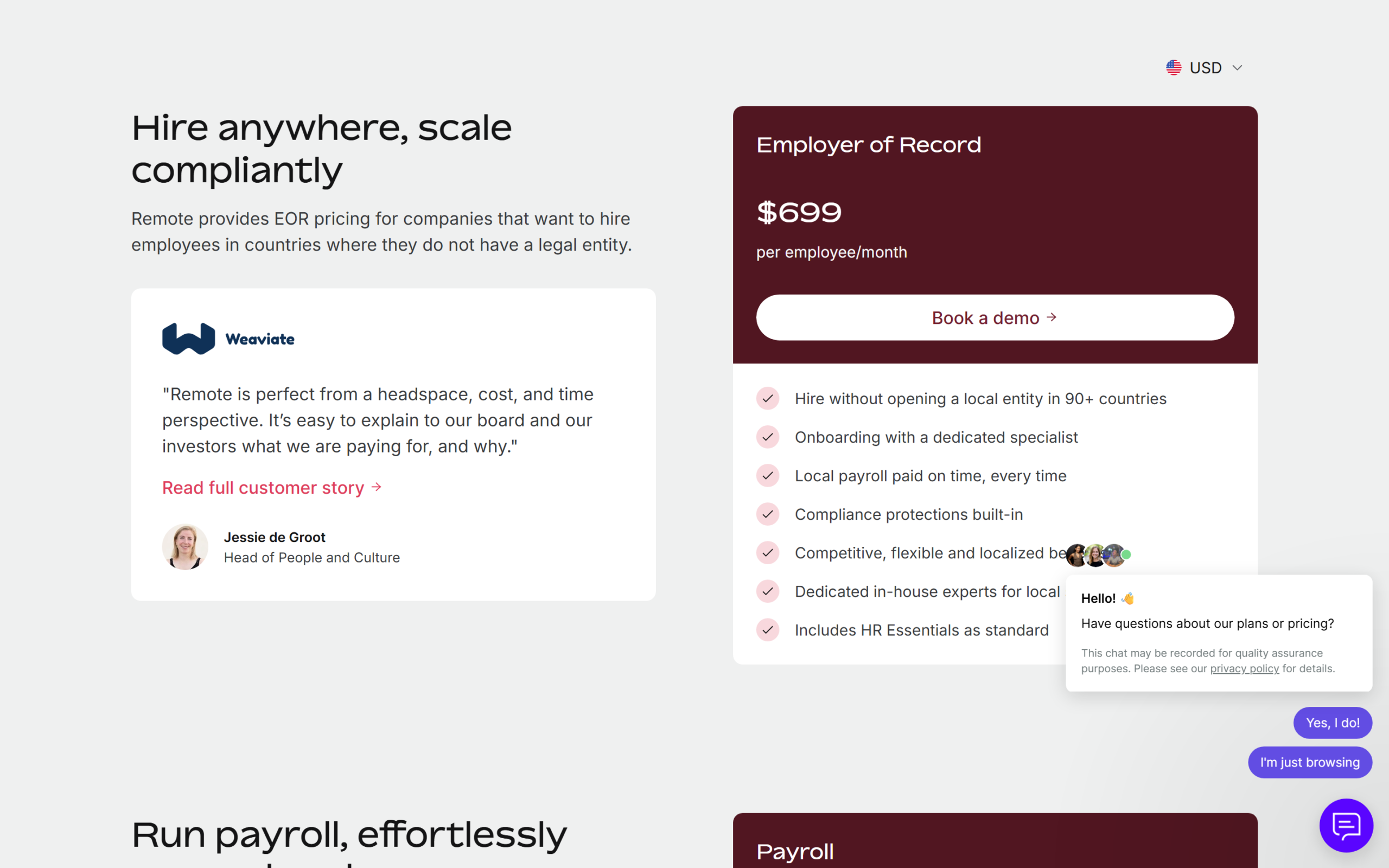
Employer of Record: $599 against $699
The single biggest line on a small team’s invoice is the EOR fee, and Deel’s is $100 a month lower. Over a year that is $7,188 per employee on Deel against $8,388 on Remote, a gap of $1,200 per head. Both fees are flat: they do not change with the salary, so the percentage you pay on top of a junior salary in a low-cost country is much higher than on a senior engineer’s pay, on either platform. Deel’s EOR card lists onboarding, benefits enrollment, managed payroll and tax filings, on-demand HR and legal expertise, and 24/7 support. Remote’s card lists onboarding with a dedicated specialist, local payroll, built-in compliance protections, localized benefits, in-house local experts and its HR Essentials tools as standard.
Contractors: $49 against $29, and the $99 middle tier
For contractors the order flips. Deel charges $49 per contractor a month and Remote $29, so each contractor costs $240 a year more on Deel. Remote also sells a tier Deel does not: Contractor Management Plus at $99, which adds indemnity cover of up to $100,000 per contractor for penalties. Deel’s ladder goes straight from $49 for self-managed contractors to $325 for Contractor of Record, where Deel engages the contractor itself. Remote’s pricing page adds that you only pay for contractors you actively work with, which matters to agencies whose freelancer bench is bigger than any month’s actual roster.
Payroll, PEO and the HR layer
Both list global payroll for companies that own their entities at $29 per employee. Remote’s pricing FAQ says that payroll customers also pay an implementation fee to set up their entities and a recurring payroll delivery fee, without printing either amount, so the real comparison needs a quote from Remote. For the US PEO, Remote starts at $99 and Deel lists $125, and Remote notes that its PEO is billed in US dollars and needs a US bank account. Deel sells its HR system separately, from $5 per employee for Core up to $29 for Elite, while Remote includes HR Core with every employment and payroll product and sells a richer Remote HRIS on top without a printed price.
Which one is cheaper for your mix of employees and contractors?
The fee arithmetic reduces to one rule: every EOR employee saves you $100 a month on Deel, and every contractor costs you $20 a month more on Deel, so the two platforms break even when you have five contractors for every employee. Below that ratio Deel’s fees are lower, above it Remote’s are. The table applies the list prices to five team shapes that small companies actually have.
| Team | Deel per month | Remote per month | Cheaper on fees | Gap per year |
|---|---|---|---|---|
| 1 EOR employee | $599 | $699 | Deel | $1,200 |
| 3 EOR employees | $1,797 | $2,097 | Deel | $3,600 |
| 2 EOR employees and 6 contractors | $1,492 | $1,572 | Deel | $960 |
| 1 EOR employee and 10 contractors | $1,089 | $989 | Remote | $1,200 |
| 10 contractors, no employees | $490 | $290 | Remote | $2,400 |
Two things change the picture. The first is indemnity: if you would buy Remote’s Plus tier at $99 for contractors who work full-time for you, each of those contractors costs $50 a month more on Remote than on Deel’s $49 plan, so the five-to-one rule only holds for the standard $29 plan. The second is that fees are not the whole bill. The next two sections show where Remote takes less of your cash early and where Deel spreads costs out, and for a founder watching runway those can matter more than $100 a month. If your team is employee-heavy and the Deel vs Remote fee gap is what decides it, book a Deel demo and ask for a quote on your exact countries, because the list price is per head and does not reflect volume discounts either vendor may offer at larger sizes.
What the fee does not include
On both platforms the per-worker fee sits on top of the actual cost of employment: the gross salary, employer social security and taxes, mandatory benefits and any allowances. Deel’s help centre describes its EOR invoice as gross salary, employer contributions, bonuses, commissions, expense reimbursements and benefits processed through Deel, with severance accruals and deposits billed separately. That is why neither vendor can show you a total on its pricing page, why Remote links to an employee cost calculator and why both send you to a demo for a quote: employer costs in one country can be a modest addition and in another a large share of salary.
How much cash do you hand over before the first payslip?
Deel takes a deposit for every EOR employee as standard; Remote takes a reserve only in defined cases. For a small company hiring its first two or three people abroad, this is the difference most likely to show up in the bank account, and it is nowhere on either pricing page.
Deel’s EOR deposit
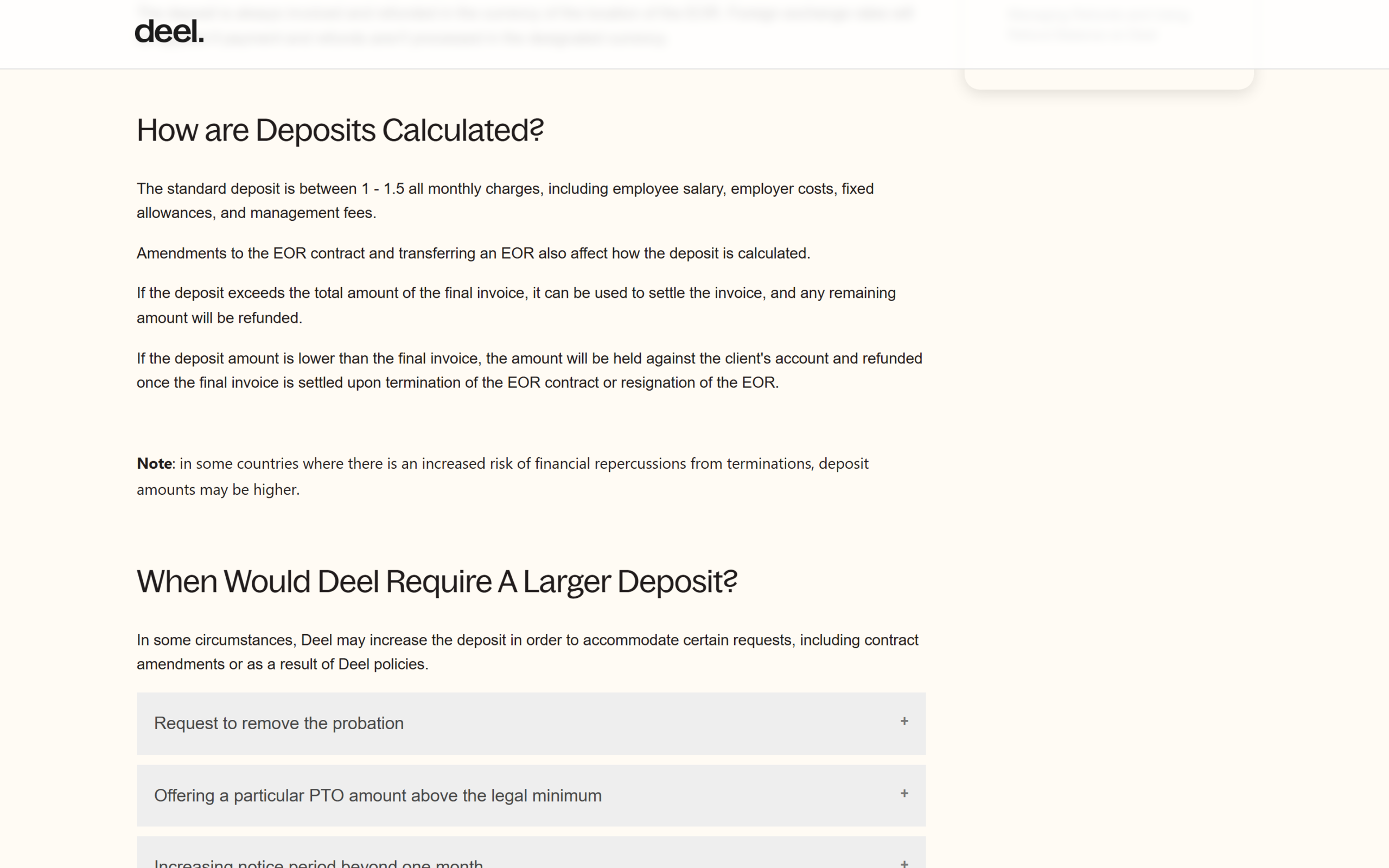
Deel’s help article on how EOR deposits are calculated says it charges a deposit for each EOR hire, and that the standard deposit is between 1 and 1.5 times all monthly charges, including salary, employer costs, fixed allowances and management fees. The deposit is invoiced and refunded in the currency of the employee’s location. It grows when you ask for terms above the legal minimum: removing probation costs a two-month deposit, offering paid time off more than 8 days above the legal minimum also means two months, and each month of notice period beyond one adds another month of deposit, so a three-month notice period means a three-month deposit. Deel adds that the deposit can be higher in countries with a greater financial risk on termination, and that where a client makes several changes the deposit is normally capped at two months, with exceptions for incentive plans, variable pay and longer notice.
To make that concrete with round numbers rather than a real quote: if one hire costs $8,000 a month in salary, employer costs and the Deel fee together, a deposit of 1 to 1.5 months is $8,000 to $12,000, paid before the person starts. Three such hires tie up $24,000 to $36,000. Deel refunds the deposit when the employment ends and the final invoice is settled, and it can be netted against that final invoice, so it is cash you lend rather than money you lose. For a funded company that is a footnote. For a bootstrapped team it can decide whether the third hire happens this quarter.
Remote’s reserve payment
Remote’s pricing FAQ says it collects reserve payments only in rare, high risk circumstances, and that unlike other EOR providers it does not charge extra deposits for paid time off above the legal minimum, removing probation periods, incentive plans or monthly severance accruals. Its help centre fills in when a reserve does apply. According to Remote’s support article on how much a reserve payment is, choosing 30-day invoice payment terms means a one-month reserve for all employees, and extended notice periods, guaranteed severance, seniority recognition and non-compete clauses each require a reserve covering that specific obligation. Remote lists the factors it weighs as the financial exposure of the account, the countries you hire in, a move from 14-day to 30-day payment terms, non-standard contract terms, and a history of late payment.
In practice, then, a small company that pays Remote’s invoices on the standard 14-day terms and hires on standard local contracts may pay no reserve at all, where the same hires on Deel would each carry a deposit of one month or more. The trade is not free: Remote’s EOR fee is $100 a month higher, so over a year one employee costs $1,200 more in fees on Remote. Put plainly, Deel asks for more cash up front and less money over time; Remote asks for less cash up front and more money over time. Which is cheaper for you depends on how long you keep the hire and what your cash is worth to you.
Who gets the money back, and when
Both return the money at the end. Deel refunds the deposit after the employee resigns or the contract is terminated and outstanding invoices are settled, and for a resignation it asks for a signed resignation letter and payment of the final invoice. If the deposit is larger than the final invoice it can be used to settle that invoice, with the remainder refunded. Remote says that once a team member leaves and all termination costs are settled, any remaining reserve balance is credited or refunded, and that if onboarding is never completed the full reserve comes back. Remote also notes that reserves apply only to EOR employees and Contractor of Record contractors, not to Global Payroll or its two contractor management plans.
What happens to severance and the final invoice?
Deel collects statutory severance a little each month in countries that require it; Remote does not run a monthly severance accrual and instead asks for a reserve when a contract guarantees severance. In both cases the severance itself is owed under local law, so this is about when you pay it, not whether.
Deel’s help article on severance accrual explains that in many countries employees are entitled to statutory severance tied to their length of service, and that Deel adds a monthly severance accrual charge to the client invoice to build up that amount over the life of the contract. The accrual is separate from the EOR deposit. Deel gives two worked examples: where an employee earns one month of severance per year of service, the client is invoiced one twelfth of a month’s salary each month in the first year; where an employee is entitled to a fixed four months after probation, Deel collects a third of a month’s salary each month during the first year. The accrual is reviewed on each anniversary, any surplus is refunded if the employee resigns, and any shortfall is invoiced at the end. Deel’s list of countries with this accrual includes Argentina, Brazil, Canada, France, Germany, India, Mexico, the Netherlands, the Philippines, Poland, Spain and South Africa, among many others.
The effect on a small team is a higher monthly invoice on Deel in those countries, and a smaller final bill when someone leaves. Remote’s approach is a lower running invoice and, when an employment ends, a final invoice that includes whatever severance local law requires at that moment. Neither is cheaper in total for a straightforward statutory entitlement. What changes is predictability: Deel’s model spreads the cost, Remote’s keeps your cash until the day it is due. If you hire in Brazil, India or Spain and expect some turnover in the first year, ask each vendor for a quote that shows the severance line separately, so you compare like with like.
Offboarding is where small teams get caught out
Ending an EOR employment is not like cancelling a software seat. Deel’s own pricing FAQ says you can cancel at any time, but that for EOR employees local labour law applies to notice and severance. Remote’s reserve articles say the same thing in a different way. On either platform, the final invoice includes the final salary, unused holiday, any severance and outstanding fees, and on Deel it is settled against the deposit where the deposit is large enough. Budget for that final invoice from the day you hire, whichever platform you pick.
How do currency conversion and payment fees compare?
Deel lets you avoid conversion by paying each invoice in its own currency and lists its payment method fees; Remote converts at its own published “Remote FX rate” and shows the rate on every invoice line. Neither publishes a percentage markup on its pricing page.
Deel’s help article on exchange rates and fees says it uses a forward rate from its banking partners at the time of payment, and that if you pay an invoice in the currency it is issued in, no FX conversion applies. It also lists what each funding method costs: cards domiciled in the US or EU cost 2.9% plus $0.30, cards from elsewhere 3.9% plus $0.30, and ACH, SEPA, BACS, bank wire, Wise, Mercury and Coinbase payments cost $5 or the local equivalent, with PAD and BECS at 10 Canadian or Australian dollars. On a $10,000 invoice, paying by US card adds $290.30, while a bank transfer adds $5, so on Deel the cheapest habit is to fund by transfer in the invoice currency.
Remote’s pricing FAQ says employees are paid in the currency of their employment agreement, and if that differs from your billing currency it converts at the Remote FX rate, which it says takes into account the risk of holding different currencies, Remote’s own costs and industry benchmarks. The rate used for each line is shown in the invoice breakdown each month. You choose one billing currency at onboarding from twelve: Australian, Canadian, New Zealand and US dollars, euros, pounds sterling, Danish, Norwegian and Swedish kronor, Swiss francs, Singapore dollars and Japanese yen. For a team paid in several currencies, ask both vendors for a sample invoice with the FX line visible; that line, not the headline fee, is where the two can differ most on a large payroll.
Which one fits your situation?
The right pick depends on your team shape, your cash and how much of the wider platform you will use. Here are five common small-company situations, with the pick and the reason.
A seed-stage startup hiring its first two engineers in Portugal and Poland. Deel, on fees: $1,198 a month against $1,398, which is $2,400 a year saved. But check the deposit first. If two months of payroll held as deposits would stretch your runway, Remote’s lower cash requirement on standard terms may be worth the extra $200 a month for the first year.
A design agency paying twelve freelancers in seven countries, with no employees abroad. Remote. Twelve contractors cost $348 a month on Remote and $588 on Deel, a difference of $2,880 a year, and Remote only bills for contractors you actively work with. If two of those freelancers work full-time for you and you want liability cover, Remote’s $99 Plus tier for those two still leaves you cheaper overall than Deel’s flat $49.
A 12-person company with four employees abroad and eight contractors. Deel, narrowly. Four EOR employees and eight contractors come to $2,788 a month on Deel and $3,028 on Remote, so Deel is $240 a month cheaper, because the ratio is two contractors per employee, well under five to one. Deel’s Core HR at $5 per employee would add $20 a month if you want it.
A US company of eight that needs a PEO for its American staff and one hire in Canada. On the published prices Remote’s PEO from $99 undercuts Deel’s $125 by up to $26 per US employee a month, while Deel’s EOR fee for the Canadian hire is $100 lower. With seven US employees on PEO and one Canadian on EOR, Remote’s list prices come out lower, but Remote’s PEO is a “from” price, so get both quotes. Deel’s PEO page also advertised three months of free platform fees for new PEO order forms with a minimum two-year term signed by the end of 2026, which is real money if you are sure you will stay two years, and a repayment obligation if you are not.
A company that wants HR, payroll, laptops and immigration in one place. Deel. Its pricing page sells an HR system from $5 to $29 per employee, a US HR and payroll bundle from $22, device and IT management from $49 per user, and an immigration service, all on one account. Remote covers HR and payroll well and includes HR Core as standard, but Deel’s menu goes further, and for a growing team that is the main reason to start on Deel and add modules as you grow rather than move platforms later.
Where does each one fall short?
Deel
Deel’s weaknesses are cash and clarity. The standard EOR deposit of 1 to 1.5 months of all charges, plus more for generous contract terms, is a real cost of capital for a small team, and it is explained in the help centre rather than on the pricing page. Its contractor plan is the dearer of the two by $20 a month, and it has no tier between $49 self-managed contractors and $325 Contractor of Record. Its country count reads 130+ on one tab and 150+ on another, so coverage has to be checked country by country. And the breadth of the menu means a demo can drift into HR, IT and recruiting products you did not come for.
- Pros: EOR $100 a month cheaper per employee, the widest stated country coverage of the two, month-to-month terms, the broadest add-on menu (HR, IT, immigration, benefits administration), a clear list of payment method fees and a way to avoid FX by paying in the invoice currency.
- Cons: a deposit of at least one month of charges per EOR hire as standard, monthly severance accruals that raise the running invoice in many countries, contractors $20 a month dearer than Remote, and no middle contractor tier with indemnity.
Remote
Remote’s weaknesses are price and reach. Its EOR fee is $100 a month higher per employee, which is the line that dominates any employee-heavy invoice. It lists 90+ EOR countries against Deel’s 130+, although it stresses that it owns all of its legal entities directly rather than relying on third parties. Its Global Payroll adds an implementation fee and a recurring delivery fee without printing either, and its PEO and Contractor of Record prices are “from” figures. And because conversion runs at Remote’s own FX rate, you cannot sidestep it the way Deel lets you by paying in the invoice currency, unless your billing currency matches your payroll currency.
- Pros: contractors at $29 and billed only when active, a $99 Plus tier with up to $100,000 of indemnity per contractor, no reserve by default on standard 14-day terms, no monthly severance accrual, HR Core included as standard, PEO from $99, and entities owned directly.
- Cons: EOR at $699, 90+ countries against Deel’s larger list, unpublished payroll implementation and delivery fees, a one-month reserve for every employee if you choose 30-day payment terms, and a smaller add-on menu.
Common buying mistakes
The first mistake is comparing only the headline fee. A $100 monthly gap on EOR is $1,200 a year per person, but a deposit of $8,000 or more per hire is a much larger number in month one, and severance accruals change the running invoice. The second is choosing a contractor plan for someone who works for you full-time and exclusively; both vendors sell Contractor of Record and EOR because misclassification fines land on you, not the platform. The third is forgetting the exit: on both platforms, ending an employment triggers notice, unused holiday and severance under local law, and that final invoice can be larger than several months of fees.
Frequently asked questions
Is Deel or Remote cheaper?
It depends on your team. Deel’s Employer of Record fee is $599 per employee a month against Remote’s $699, so employee-heavy teams pay less on Deel. Remote’s contractor plan is $29 against Deel’s $49, so contractor-heavy teams pay less on Remote. The two break even at about five contractors per EOR employee. Deposits and reserves then shift the cash picture in Remote’s favour early on.
Does Deel charge a deposit for EOR employees?
Yes. Deel’s help centre says it charges a deposit for each EOR hire, normally 1 to 1.5 times all monthly charges including salary, employer costs and the management fee. Removing probation, offering paid time off well above the legal minimum or a longer notice period raises it. The deposit is refunded, or netted against the final invoice, when the employment ends.
Does Remote charge a deposit?
Not as standard. Remote says it collects reserve payments only in rare, high risk circumstances. Its help centre lists the cases: a one-month reserve for all employees if you move to 30-day payment terms, and reserves for extended notice periods, guaranteed severance, seniority recognition and non-compete clauses. Reserves apply to EOR employees and Contractor of Record contractors only.
Which covers more countries, Deel or Remote?
Deel lists more. Its pricing page describes EOR in 130+ countries on one tab and 150+ on another, while Remote lists 90+ countries for EOR and says it owns all of its legal entities directly. Coverage claims change, so confirm the specific countries you hire in with both vendors before you sign.
Which is better for paying freelancers?
Remote, on price. Its Contractor Management plan is $29 per contractor a month against Deel’s $49, and it bills only for contractors you actively work with. Remote also sells a $99 Plus tier with up to $100,000 of indemnity cover per contractor. Deel’s contractor plan pays out in 120+ currencies, per its pricing page, and steps up to Contractor of Record at $325.
Can I cancel Deel or Remote at any time?
Deel’s pricing FAQ says it is month to month with no long-term commitment, and that you can cancel at any time, with local labour law governing notice and severance for EOR employees. Remote says it has no minimum number of employees or contractors. On both, ending an EOR employment means paying the final salary, unused holiday and any severance due.
Do Deel and Remote include HR software?
Remote includes HR Core, with employee records, documents, time off, org charts and workflows, with every employment and payroll product. Deel sells its HR system separately, from $5 per employee a month for Core to $29 for Elite with compensation and headcount planning, and also sells US payroll and HR bundles from $22 per employee.
Are there setup fees?
Remote says there are no platform, onboarding or setup fees for its HR, EOR and contractor products, but its Global Payroll has an implementation fee and a recurring payroll delivery fee. Deel’s pricing FAQ says there are no surprise fees and that local compliance, payroll and benefits administration are included in the quoted price.
Deel vs Remote: which should you choose?
For a small team that is hiring employees abroad, Deel wins the Deel vs Remote comparison on what you pay over a year: $100 less per employee every month, a longer list of countries and an add-on menu that can take you from your first EOR hire to running HR, payroll and laptops on one account. Remote wins for teams built mainly on contractors, where its $29 plan and the five-to-one rule make it cheaper, and for founders who cannot spare one month or more of payroll as a deposit for each new hire.
Do not choose Deel if your cash is tight and your first hires would each lock up a month or more of salary and costs as a deposit; ask Remote for a quote on standard 14-day terms first. Do not choose Remote if you will have more employees than a fifth of your contractor count, because the $1,200 a year per employee adds up quickly. If Deel fits your mix, get a Deel quote for the countries you are hiring in and ask for the deposit and severance accrual lines in writing before you sign.
8.3 Score
Pros
- Employer of Record at $599 per employee a month, $100 below Remote's $699.
- Longer stated EOR country list: 130+ to 150+ against Remote's 90+.
- Month-to-month terms and a wide menu of HR, payroll, IT and immigration add-ons on one account.
- Paying an invoice in its own currency avoids FX conversion, and payment method fees are listed.
Cons
- A standard deposit of 1 to 1.5 months of all charges for every EOR hire.
- Contractors cost $49 a month against Remote's $29, with no middle tier for indemnity.
- Monthly severance accruals raise the running invoice in many countries.
- Deposit and accrual rules live in the help centre, not on the pricing page.
Final Verdict
Deel wins for small teams hiring employees abroad: its Employer of Record fee is $100 a month lower than Remote's, it lists more countries and its add-on menu covers HR, payroll and IT on one account. Remote is the better pick for contractor-heavy teams, where its $29 plan is cheaper past five contractors per employee, and for cash-tight founders, because it takes no reserve by default on standard terms while Deel deposits one month or more per hire.