


Short answer: This Nouswise review covers an AI research assistant that answers questions from the sources you give it, files, links, books and scholarly material, and turns them into reports, flashcards, quizzes, mind maps, slide decks and spoken audio recaps with citations you can trace. It has a free Starter plan, Essential at $19.99 a month and Pro at $49.99 a month, and an enterprise side with on-premises deployment. It is a capable tool for students, researchers and teams who live in documents, but its marketing overreaches: “100% verifiable” answers that reduce “fact fabrication to zero” is not something any AI system can promise, its security certifications are stated without a public report on the pages checked, and this review found no independent ratings to lean on.
- Start free on Starter: unlimited projects, 100 sources, and 8 generated activities a day.
- Pick Essential at $19.99 a month for 300 sources, larger files and 25 activities a day.
- Pick Pro at $49.99 a month for unlimited sources, 2 GB files, 120 activities a day, web search and MCP tools.
- Check the citations: grounding in your sources reduces errors, but you still need to read what is cited.
Starter: $0. Essential: $19.99/mo. Pro: $49.99/mo. Enterprise: custom. A yearly toggle advertises 17% off. Nouswise.com, checked October 18, 2026.
Table of contents
What is Nouswise?
Nouswise describes itself as an “autonomous thinking partner” and, on its pricing page, as “an AI-powered research agent that delivers trustworthy, precise responses drawn from a carefully curated library.” In practice it is a workspace where you collect sources, documents, links, videos, audio, books and scholarly material, and then ask questions answered from those sources with citations, or turn them into study and presentation material.
The company, Nouswise, Inc., lists a CEO and co-founder, Reza Yazdanfar, a CTO and co-founder, Ali Moezzi, and a small board on its About page, and its footer copyright runs from 2023 to 2026. Its messaging pulls in two directions at once. The pricing page markets a free plan as “perfect for students” and paid plans for individuals and teams, while much of the homepage and About page speaks to institutions: governments, policy organisations and enterprises that want AI answers grounded in their own vetted material. Its headline case study is AVA, which it describes as an interface giving policymakers direct access to the World Bank Group’s expertise.
This Nouswise review reads the homepage, features page, pricing page and FAQ, the About page, the help centre and the API documentation, all on October 18, 2026. It focuses on what an individual or small team gets for the money, and on which of the company’s bolder claims hold up.
How it works: projects, sources and chat
The unit of work is a project. Nouswise’s help centre explains that a source is “a file or link used as evidence for project chat and generation.” You open a project, attach files from your computer or your library, and the chat answers questions grounded in whatever is attached. The help centre’s own advice is practical: attach only the sources a task needs, remove unrelated sources before precise questions, and reuse library content across projects.
Discovery is a distinctive touch. The source picker has tabs for My library, Books and Scholars, so you can pull in reusable material rather than uploading everything yourself, and the help centre describes public and featured projects that you can browse. The homepage lists the kinds of input it accepts as files, links, videos and audio, and the features page says search covers “text, tables, graphs, images, scanned PDFs, and structured data.”
The homepage frames the product around four modes. Ask gives “clear cited answers, ideas, and guidance through conversation.” Research analyses and synthesises information from connectors, documents, data and websites into outputs such as a podcast, video, report or infographic. Automate carries out “multi-step digital tasks on your behalf.” Build creates websites, dashboards and documents. The first two are the core of what an individual will use; the last two are newer and closer to the general direction of AI agents.
Activities: reports, flashcards, audio and slides
Activities are where Nouswise earns its place for students and anyone who has to absorb a lot of material. The pricing table lists reports, flashcards, quizzes, mind maps, data tables, infographics and slide decks, all generated from your project’s sources, plus custom activities on paid plans and watermark removal.
Audio Recap is the standout. The help article on generating an audio overview explains that it creates a spoken summary from your project context, with a custom prompt, a choice of style such as Deep dive, Brief, Critique or Debate, and a length slider. You can download both the audio file and a subtitle file, and the subtitles can include inline source references, “so listeners can trace statements back to source evidence.” The features page also describes a Visual Recap, a short video of “two AIs talking through the main insights” from your content.
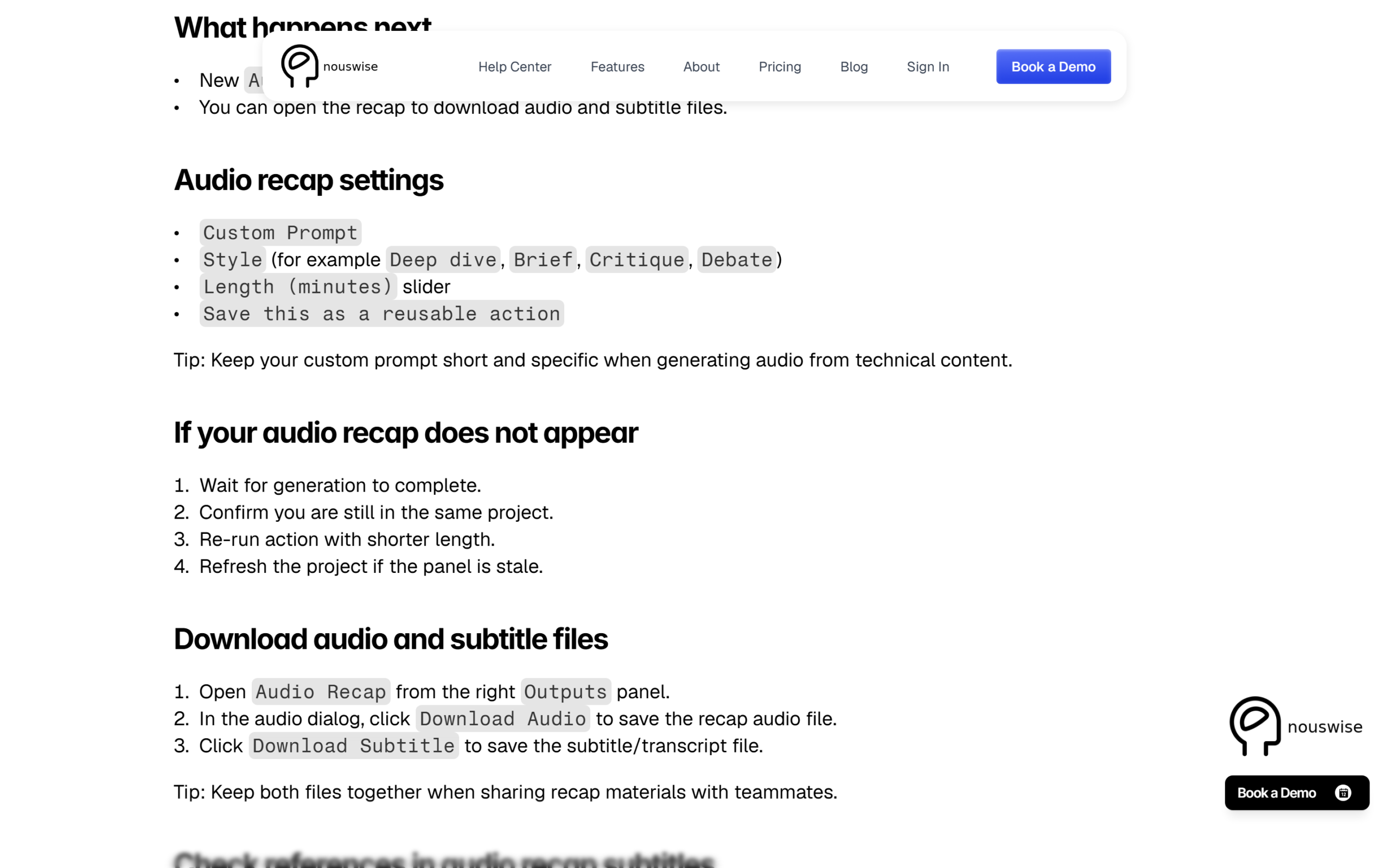
That citation detail matters. Plenty of tools generate a podcast-style summary; fewer let you check which source each line came from afterwards. For someone revising for an exam or preparing a briefing, being able to scrub through a recap and see the reference behind a claim turns an entertaining summary into something you can actually rely on, provided you look.
Agentic search, MCP and the API
Under the hood, Nouswise says it uses agentic search: “multiple expert agents that cross-check sources, fill in gaps, and resolve conflicts” over “an interconnected knowledge graph.” It supports the Model Context Protocol (MCP), which the features page says reduces custom integrations and makes the platform easier to extend. The pricing table is clear that MCP tools, web search and the shared Workspace are Pro and Enterprise features; Starter and Essential do not include them.
Developers get a documented API. The documentation site offers a quickstart, an API reference and a changelog, and the features page pitches the API as a way to plug Nouswise’s search, reasoning and summarisation into existing tools and content platforms. The company also publishes separate API terms of use. For organisations that want to embed source-grounded answers in their own site or app, which is what the World Bank’s AVA does, this is the part of the product that matters most.
Nouswise pricing and limits
Nouswise sells four plans. Limits are set per day for generated activities and audio recaps, and the pricing page notes that “limits are accumulative.”
| Plan feature | Starter | Essential | Pro | Enterprise |
|---|---|---|---|---|
| Price | $0 | $19.99/mo | $49.99/mo | Custom |
| Positioned for | Students | Individuals or small teams | Scaling companies | Organisations |
| Projects | Unlimited | Unlimited | Unlimited | Unlimited |
| Sources | 100 | 300 | Unlimited | Unlimited |
| File size | 100 MB | 300 MB | 2 GB | Unlimited |
| MCP tools, web search and Workspace | No | No | Yes | Yes |
| Audio Recap | 5 a day | 20 a day | 120 a day | Unlimited |
| Each activity (reports, quizzes, slides and more) | 8 a day | 25 a day | 120 a day | Unlimited |
| Support | Discord | Discord and email | Discord and email | SLA via Slack, Teams or email |
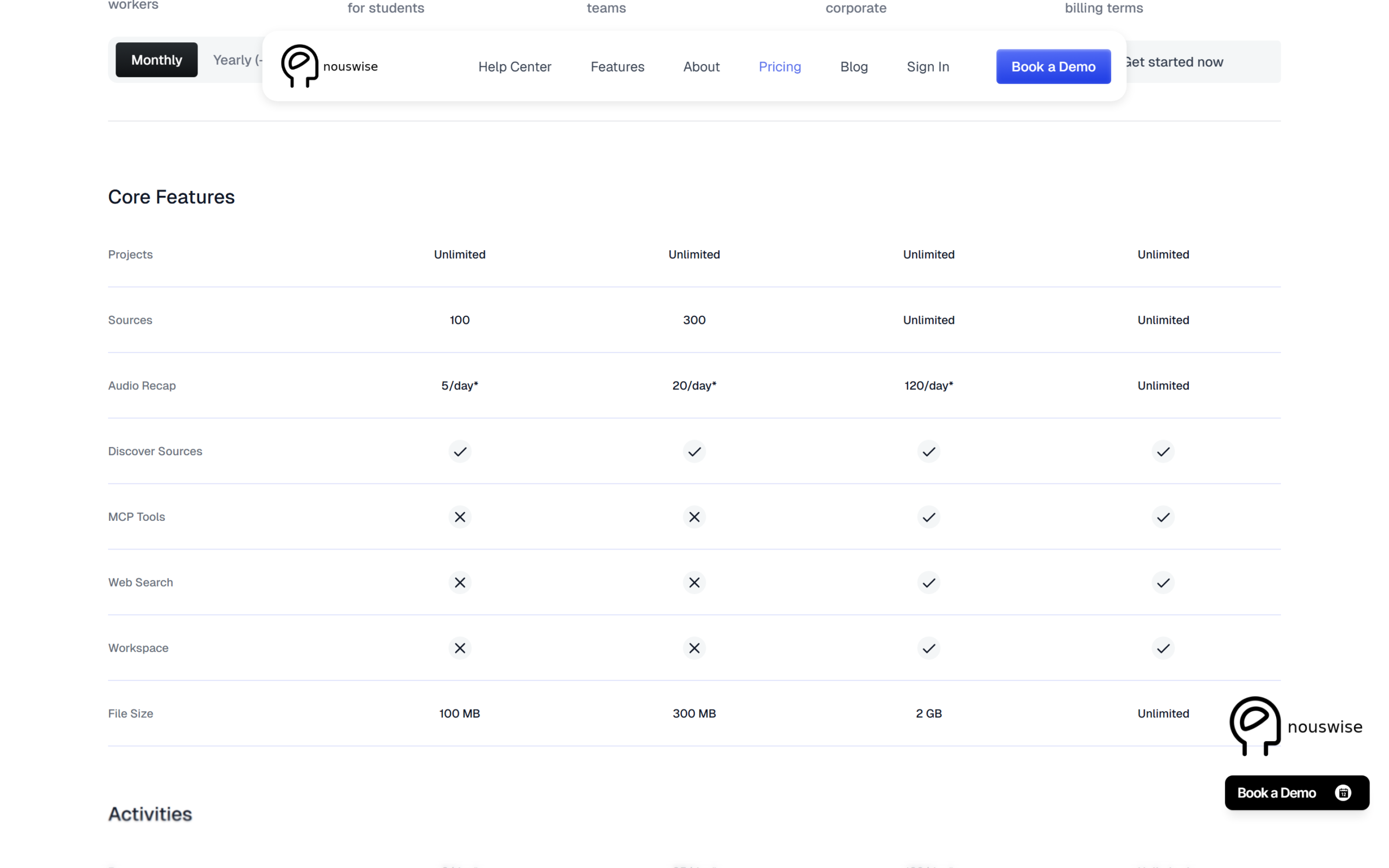
The free plan is genuinely usable: unlimited projects, 100 sources and eight of each activity a day is plenty to judge whether the answers are good. Essential’s main gains are tripled sources, larger files and roughly three times the daily activities, which suits someone using Nouswise daily for study or writing, though it still lacks web search, MCP tools and the Workspace. Pro is for heavy use, with unlimited sources, 2 GB files and those three features. The pricing page shows a yearly toggle labelled with a 17 percent discount, but on the day this review was checked the cards still displayed the monthly figures after switching, so confirm the yearly total at checkout. The page also advertises a free 30-day trial of the Enterprise plan for organisations that book a demo. If the limits fit your workload, start on Nouswise’s free plan before choosing a paid tier.
Which plan fits which user
The limits make more sense when you map them to real routines. The table below matches each plan to a typical user, based on the pricing page’s limits.
| User | Typical routine | Plan that fits | Why |
|---|---|---|---|
| Student revising for exams | One project per course, a few quizzes and recaps a day | Starter ($0) | 100 sources and 8 of each activity a day cover a course’s readings |
| Writer or consultant | Daily briefs, reports and slide decks from client documents | Essential ($19.99/mo) | 300 sources, 300 MB files and 25 activities a day |
| Research team lead | Large document sets, frequent audio recaps for the team | Pro ($49.99/mo) | Unlimited sources, 2 GB files, 120 activities a day, plus web search, MCP and Workspace |
| Policy body or enterprise | A public or internal assistant over a vetted library | Enterprise (custom) | Access management, connectors, analytics, on-premises option |
The step from Essential to Pro is the one to think about. Pro costs two and a half times as much, so it is worth it mainly when you hit the 300-source ceiling, need files larger than 300 MB, such as long recordings or very large PDFs, or need web search, MCP tools or a shared Workspace. Daily activity limits alone rarely justify it for one person, since 25 of each activity a day is a lot of output for a single researcher or writer.
A quick test for any source-grounded AI
Because the core promise is accuracy from your own documents, the best way to judge Nouswise, or any tool like it, is a short test you design yourself. Pick five to ten documents you know well, a set of course readings, a contract bundle or a report you wrote. Upload them to a single project on the free plan.
Then ask three kinds of question. First, factual questions whose answers sit in one place in one document, to check the citation lands on the right passage. Second, questions that need two documents combined, to see whether the answer merges them correctly or blends them into something neither says. Third, a question whose answer is not in the documents at all, to see whether the tool admits it cannot answer from the sources or fills the gap from general knowledge.
Finally, generate an Audio Recap and a quiz, and check a handful of the cited lines in the subtitles against the originals. If the citations hold up across all of that, Nouswise has earned a place in your workflow; if they slip, you will have found out for free, before relying on it for anything that matters.
Enterprise, security and data location
For organisations, Nouswise’s FAQ answers the questions that usually block AI adoption. It says data is encrypted in transit and at rest on cloud infrastructure “hosted in servers located within Europe and the United States,” that customers with strict jurisdictional rules can have data stored in dedicated data centres in a chosen region, and that the platform can be “installed and managed entirely on-premises” for highly confidential data. Enterprise plans add access management, custom data sources, connectors, a dashboard with analytics and what the pricing page calls knowledge gap analysis.
The homepage adds a compliance claim: “SOC 1 / SOC 2, Type I/II compliant.” A SOC report is something a company can share under NDA, and an enterprise buyer should ask for it. On the pages checked for this review, no report, auditor or trust centre was linked, so treat the claim as a starting point for due diligence rather than a settled fact.
Claims to read carefully
Nouswise’s strongest marketing line is “100% Verifiable AI Answers,” followed by: “The answers are solely drawn from the provided sources, reducing any fact fabrication to zero.” Grounding answers in your sources, with citations, does reduce invented facts substantially, and it is the right design for research. But no current AI system can guarantee zero fabrication; models can still misread a source, merge two claims or cite a passage that does not quite say what the answer says. The responsible way to use Nouswise is the way its own audio recap is designed: check the citation behind anything that matters.
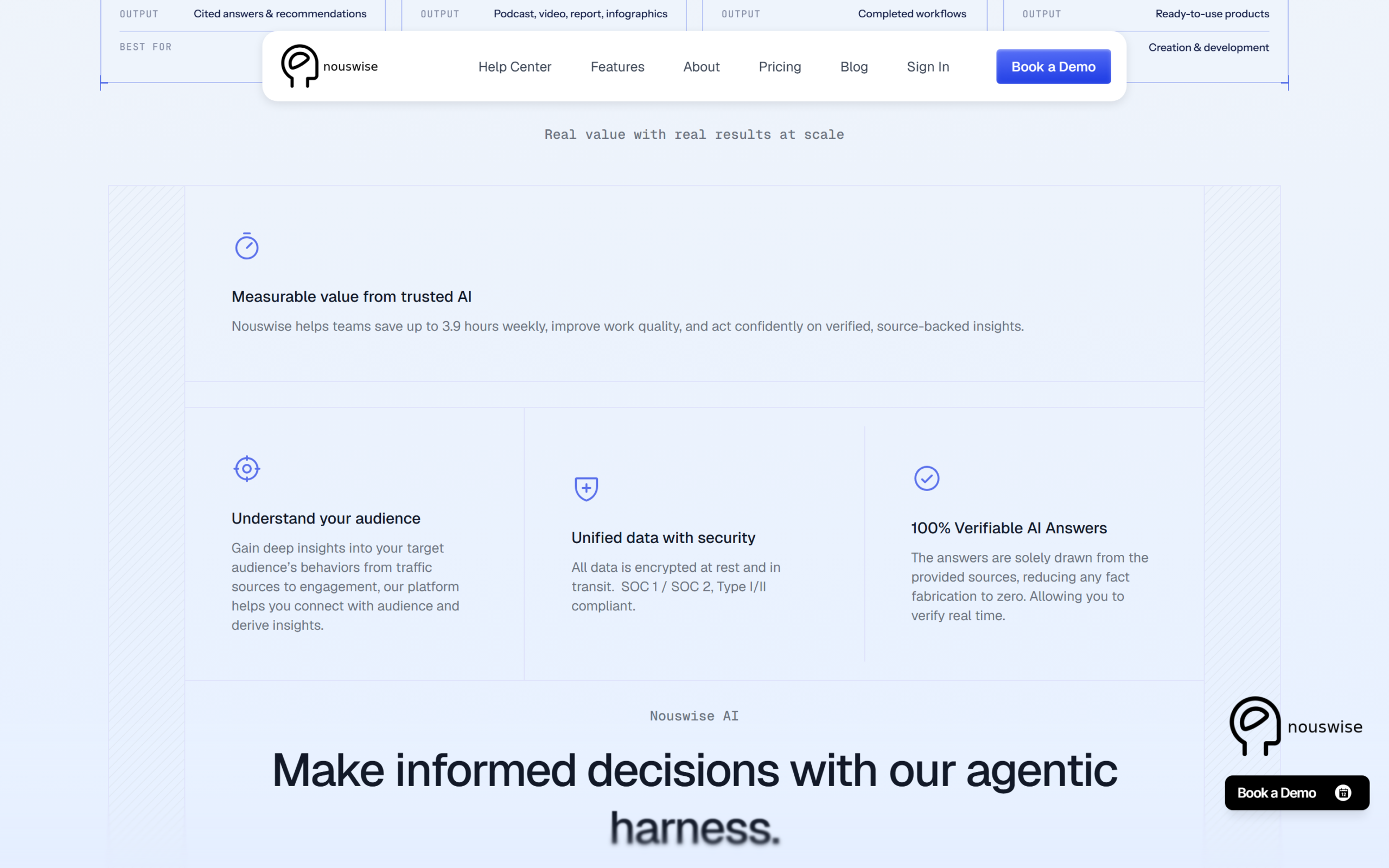
The homepage also cites big round numbers without sources: that executives and teams spend a quarter of the workweek searching for information, that the Fortune 500 loses 2.4 billion hours a year to it, and that Nouswise helps teams “save up to 3.9 hours weekly.” None of these is footnoted on the page, so this Nouswise review gives them no weight.
Finally, the features page shows counters for verifiability, documents and languages that rendered as “0.00%” and “0+” when this review loaded the page, which looks like an animation that did not run rather than real figures. It is a small thing, but on a product whose pitch is trust, numbers that do not display are worth noticing.
What independent data shows
This review looked for independent ratings and found little it could use. Product Hunt blocked automated access, and no Nouswise app listing turned up on Google Play under the name checked; the help centre says mobile access information “may be shared through Nouswise support and community channels.” The company’s own blog is active, with posts dated as recently as October 2026, and its documentation and help centre are maintained, which are signs of a working product rather than evidence of quality.
The fairest independent test is your own. Because Starter is free and generous, you can upload a set of documents you know well, ask questions whose answers you can check, and see how often the citations hold up. If you are comparing privacy-first AI assistants for general use rather than source-grounded research, our Proton Lumo review covers a different approach to the same trust problem.
Who Nouswise is for
Nouswise suits students revising from a defined set of readings, researchers and analysts who need answers tied to sources, writers who want to turn research into outlines, slide decks or audio summaries, and small teams building a shared library. It also suits organisations, such as policy bodies, regulators or large companies, that want to put a source-grounded assistant in front of their own audience, with on-premises or regional hosting if needed.
It is a weaker fit for someone who wants a general chatbot for open-ended questions, a buyer who needs published compliance reports before signing, or anyone who needs a polished mobile app today. Free-plan users should also expect community support through Discord rather than email, which is fine for questions but slow for urgent problems.
Nouswise pros and cons
In this Nouswise review the clearest strengths are source-grounded answers with citations, a wide set of generated activities, Audio Recap with downloadable subtitles that keep source references, the Books and Scholars source tabs, MCP support and a documented API, unlimited projects on every plan including Free, and enterprise options for on-premises or regional hosting.
Against that: marketing that promises “zero” fabrication, security certifications stated without a visible report, daily limits on activities, a yearly discount that did not display clearly, Discord-only support on the free plan, an unclear mobile story and no independent ratings found.
Frequently asked questions
Is Nouswise free?
Yes. Starter costs nothing and includes unlimited projects, 100 sources, 100 MB files, five audio recaps and eight of each activity a day.
How much does Nouswise cost?
Essential is $19.99 a month and Pro is $49.99 a month, with Enterprise priced on request. The pricing page advertises 17 percent off on yearly billing.
Does Nouswise cite its sources?
Yes. Answers are grounded in the sources attached to a project, and audio recap subtitles can include inline source references.
Can Nouswise make audio summaries?
Yes. Audio Recap creates a spoken summary with styles such as Deep dive, Brief, Critique or Debate, and you can download the audio and subtitles.
Does Nouswise have an API?
Yes. It publishes API documentation with a quickstart, a reference and a changelog. MCP tools are listed on the Pro and Enterprise plans.
Can Nouswise run on-premises?
Its FAQ says yes for organisations with highly confidential data, and that cloud data is hosted in Europe and the United States.
Is Nouswise worth it?
This Nouswise review finds a capable source-grounded research assistant with a generous free plan, an unusually useful audio recap that keeps its citations, and real enterprise options. Its weaknesses are mostly in what it says rather than what it does: “zero fabrication” overpromises, compliance claims come without a visible report, and there are no independent ratings yet to confirm the experience at scale.
For students, researchers and teams who work from documents, try Nouswise free, test it on material you know well, and upgrade only once the citations have earned your trust.
7.3 Score
Pros
- Answers grounded in your own sources, with citations you can trace.
- Audio Recap with downloadable subtitles that keep inline source references.
- Generous free plan with unlimited projects, 100 sources and daily activities.
- MCP support, a documented API and on-premises or regional hosting for organisations.
Cons
- Claims '100% verifiable' answers and zero fabrication, which no AI system can guarantee.
- SOC 1 and SOC 2 compliance stated without a linked report on the pages checked.
- Daily limits on activities, and Discord-only support on the free plan.
- No independent ratings found, and the mobile app story is unclear.
Final Verdict
Nouswise is a capable source-grounded research assistant with a generous free plan, a useful audio recap that keeps its citations, and real enterprise options including on-premises hosting. Its weak points are in its claims: zero fabrication overpromises, compliance is stated without a visible report, and there are no independent ratings yet. Worth a free trial on documents you know well.