


Short answer: This Amplemarket review reaches a firm conclusion about who it is for: Amplemarket is an AI-first outbound platform that replaces a data provider, a sequencer, a dialer and a deliverability stack with one login and an AI agent called Duo, priced from $600 a month on an annual term for two users, which makes it a serious upgrade for a funded startup or a mid-size sales team consolidating Apollo, Outreach or ZoomInfo, and the wrong purchase for a solo founder or a two-person agency, who can get most of the mechanics for a tenth of the price elsewhere.
- Pick Amplemarket Startup if two to four sellers need verified data, multichannel sequences, intent signals, warmup and a dialer in one tool, and $7,200 a year is a line item rather than a decision.
- Pick Growth or Elite if you are replacing two or three enterprise tools, want a dedicated customer success manager, AI voice messages and AI-drafted replies, and can negotiate a custom quote.
- Skip it if you are a one-person operation, if you only need a sender for lists you already own, or if you need a published price for a team of ten, which the site does not give.
From $600 per month on an annual term for 2 users; Growth and Elite are quoted · Free plan: no, a free trial on every plan · Prices checked September 4, 2026.
Table of contents
What is Amplemarket and what does it replace?
Amplemarket is an all-in-one outbound sales platform built around an AI agent named Duo. The product page groups it into four layers: Intelligence, which is Duo in its several forms; Lead Generation and Signals, a B2B contact and company database with intent signals, job change alerts and enrichment; Multichannel Engagement, meaning sequences across email, LinkedIn and calls with a unified inbox and workflow automation; and Deliverability Optimization, a domain health centre, mailbox warmup, a spam checker and mailbox recommendations. The pricing page’s own social proof is a wall of migrations: customers who moved off Apollo, off Outreach, and off ZoomInfo plus Outreach, with a director quoted saying consolidation cut tooling costs by about 56 percent.
That is the buying frame. Amplemarket is not competing with a $47 sender; it is competing with the stack a growth-stage sales team assembles from a data vendor, a sequencer, a dialer and a warmup tool, and it prices accordingly. G2 lists it at 4.6 out of 5 from 666 reviews as of September 4, 2026, in the sales engagement category, with reviewers who are SDRs and account executives rather than founders. An Amplemarket review therefore has to answer a narrower question than most: for a team that already spends four figures a month on outbound tooling, is Duo and the consolidation worth the switch, and where does the entry price stop making sense?

How much does Amplemarket cost, and what do the credits buy?
For this Amplemarket review we read the pricing page and its comparison table on September 4, 2026. There are three plans, and only the first has a published price. Startup is $600 a month on an annual term, $7,200 a year, with two users included and additional users available to purchase. Growth, marked popular, and Elite are custom-priced, with four and ten users included respectively. Every plan includes a free trial. The page does not print per-user add-on prices, monthly billing, or the Growth and Elite figures, so anyone above two seats is talking to sales.
| Plan | Price | Users included | Contacts | Email credits per user per year | Phone credits per user per year | Mailboxes per user (from) | Job change alerts | Custom data requests |
|---|---|---|---|---|---|---|---|---|
| Startup | $600 a month, annual term | 2 | 27,000 | 13,500 | 600 | 2 | 500 contacts | 0 |
| Growth | Custom | 4 | 140,000 | 35,000 | 5,000 | 4 | 1,000 contacts | 4 |
| Elite | Custom | 10 | 400,000 | 40,000 | 9,600 | 8 | 2,000 contacts | 12 |
From the Amplemarket pricing page and comparison table on September 4, 2026.
What the credits mean
Email credits reveal verified addresses and phone credits reveal mobile numbers from what the page calls 200 million real-time verified numbers. On Startup, two users get 13,500 email credits and 600 phone credits each per year, which is a lot of emails and not many phones: 50 a month per rep. Growth’s 5,000 phone credits per user per year, about 400 a month, is the tier where a calling-led team stops rationing. The “contacts” figure per plan, 27,000 to 400,000, is the pool you can hold and work in the platform. Custom data requests, technologies, hubs or events you ask the vendor to source, are zero on Startup, four on Growth and twelve on Elite.
The per-seat arithmetic
$7,200 a year for two seats is $300 per user per month, and every feature on the Startup card is included at that price. Additional Startup seats are sold but not priced on the page. That is the number to hold against the alternatives, because the tools Amplemarket replaces are cheap individually and expensive together. Amplemarket’s pricing page is where the Growth and Elite conversations start.
What separates Startup, Growth and Elite?
Startup includes the core of the platform: contact and company search with 30-plus filters, multichannel sequences, AI intent signals, Duo Copilot, the outbound dialer, data enrichment, calendar enrichment, real-time email validation, integrations, workflows, analytics, the domain health centre, deliverability booster, spam checker and mailbox recommendations, two mailboxes per user, and a scaled customer success team with community onboarding through weekly expert sessions.
Growth changes the support model and adds a channel: a dedicated customer success manager, personalised onboarding at your team’s pace, Duo Voice for AI voice messages at scale, four mailboxes per user, five times the phone credits, four custom data requests and a much larger contact pool. Elite adds Duo Inbox, which drafts a reply to every prospect email automatically, eight mailboxes per user, twelve custom data requests, single sign-on, and 400,000 contacts. The comparison table also lists Duo Copywriter for personalised first touches, Duo Competitive Intelligence for monitoring competitors’ digital footprints, Duo Signals for intent, an MCP server for prospecting and taking action from Claude or ChatGPT, and AI Agents to find buyers, research prospects and personalise outreach; the table marks MCP as an add-on.

What does the Duo AI agent actually do?
Duo is the reason to consider Amplemarket over a cheaper stack, and the homepage describes it concretely rather than abstractly. Duo collects sales signals in the accounts you care about: a closed-lost opportunity whose notes say circle back in a few months, a decision maker visiting your website or LinkedIn profile, someone evaluating a competitor or asking for recommendations in a Slack group, a person reviewing a competitor and complaining, someone following your company or commenting on a post. From those signals it builds a model of who to contact and when, and the Copilot turns that into suggested outreach a rep approves. Duo Copywriter drafts the personalised first touch; Duo Voice, on Growth and above, records AI voice messages at scale; Duo Inbox, on Elite, drafts replies to every inbound prospect email.
What reviewers say it gets wrong
The G2 dislikes are specific and moderate. One reviewer notes Duo cannot detect profiles marked open to work, so job seekers end up in sequences, and that Copilot’s generated messages sometimes need review. Another, connecting US companies with Latin American talent, finds signal configuration tricky and the “hiring remotely” signal too blunt for their case. A third praises the platform but wants more frequent training. The consistent theme is that Duo is powerful and its prompts and signals take tuning, which is what a dedicated CSM on Growth is for.
How good are the data, the sequences and the deliverability tools?
The data layer is the vendor’s own database with search, enrichment, job change alerts and the phone credit pool, and it is where the sharpest criticism lands. One G2 reviewer says accuracy is generally reliable but occasionally outdated when someone has recently changed companies or roles, so outreach lands on the wrong desk; another mentions not finding an email or phone for some prospects. A revenue operations lead whose primary channel is cold calling reports Amplemarket supplies around 60 percent of the phone numbers they want, which is a useful real-world figure. Job change alerts, 500 to 2,000 followed contacts by plan, are the answer to the staleness problem for your top accounts.
Sequences and the inbox
Sequences are multichannel, email, LinkedIn and calls, with conditional branching and A/B messaging that reviewers single out, an outbound dialer on every plan, workflows that automate follow-ups from events and conditions, and a Unibox that centralises email and LinkedIn conversations. A global SDR manager at Cabify is quoted replacing seven tools with it; a senior BD manager credits multi-touch sequences as the upgrade over previous tools. The learning curve is the recurring caveat: two reviewers say advanced workflows take time to set up before the platform becomes fast.
Deliverability
This is the layer most all-in-one platforms treat as an afterthought and Amplemarket treats as a product area: a domain health centre across all mailboxes and domains, warmup through the deliverability booster, an email spam checker, and mailbox recommendation that picks the mailbox most likely to land in the inbox for a given send. Mailboxes per user start at two on Startup and rise to eight on Elite, which is the mechanism for scaling volume without burning a domain.
What do onboarding, support and the knowledge base look like?
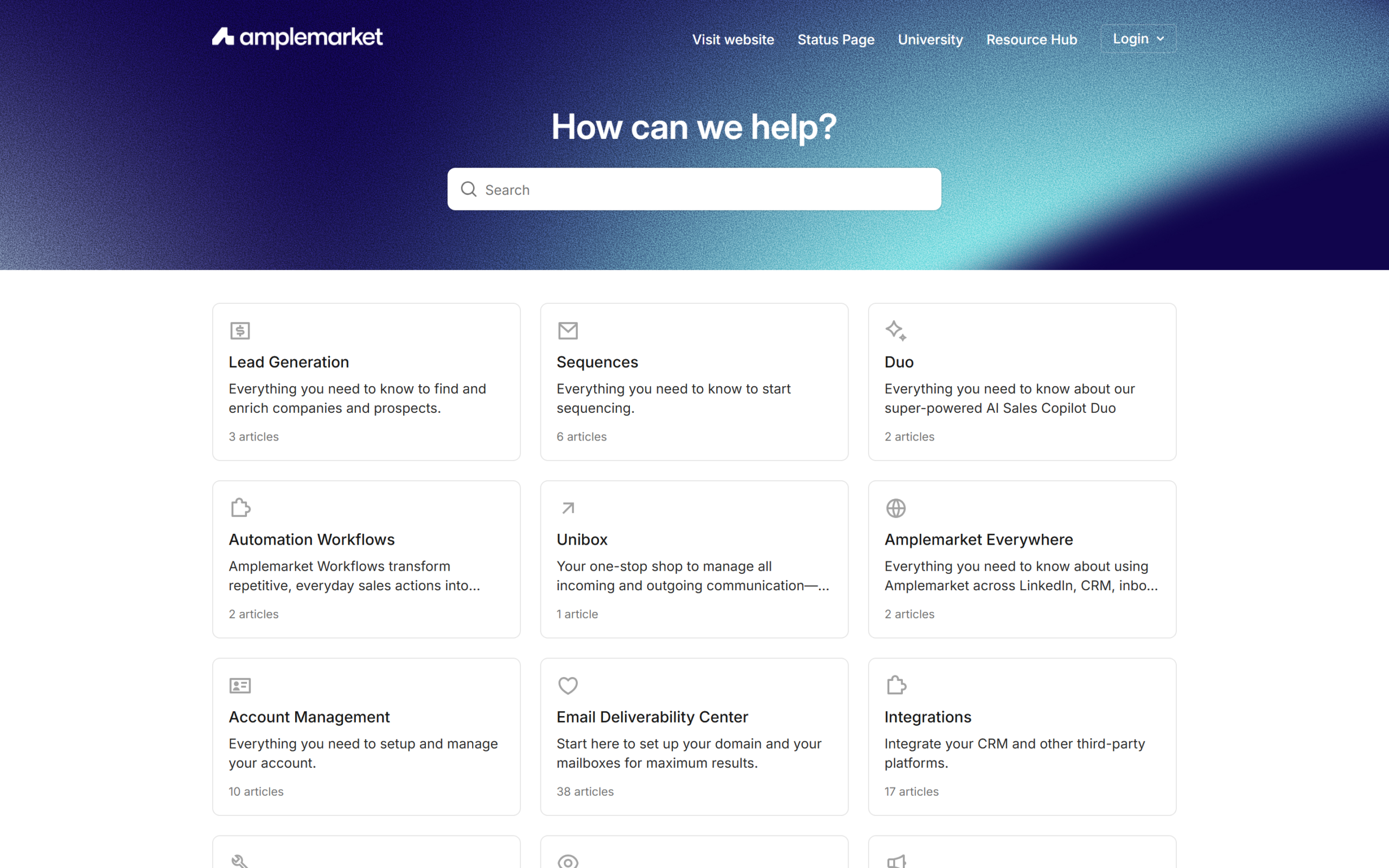
Support is tiered by plan and the page is explicit about it. Startup gets a scaled customer success team, community onboarding through weekly expert sessions, email support and the help centre. Growth and Elite get a dedicated CSM and personalised onboarding with a custom training plan. The knowledge base at knowledge.amplemarket.com is organised by product area, lead generation, sequences, Duo, workflows, Unibox and the browser extension, alongside a university of tips and a GTM skills library. One G2 reviewer rates support as not as good as expected and wants more trainings; several others praise it. Read that as a Startup-tier experience versus a Growth-tier one.
How does Amplemarket compare with Apollo, Instantly and lemlist?
The comparison most people reading an Amplemarket review are making is against the platforms that publish their prices, so the table puts the entry economics side by side for a two-seat team.
| Platform | Entry price for 2 users | Data included | Sending | AI layer | Best fit |
|---|---|---|---|---|---|
| Amplemarket Startup | $7,200 a year ($600 a month, annual term) | 27,000 contacts; 13,500 email and 600 phone credits per user per year; intent signals; job change alerts | Multichannel sequences, dialer, 2 mailboxes per user, warmup and domain health | Duo Copilot, Copywriter, Signals; Voice and Inbox on higher tiers | Funded startups and mid-size teams consolidating tools |
| Apollo Professional | $1,896 a year ($79 per seat per month, annual) | 240M-plus database; 48,000 credits per seat per year (email 1, phone 8) | Unlimited Google and Microsoft mailboxes plus 5 SMTP, unlimited sends, A/Z testing | AI research, lead scoring, assistant | Small teams that need data and sequences on a budget |
| Instantly Hypergrowth | $1,164 a year ($97 a month) | 25,000 uploaded contacts; leads sold separately | 125,000 emails a month, unlimited mailboxes and warmup | Basic | Teams that own their lists and need volume |
| lemlist Multichannel | $2,088 a year ($87 per user per month, yearly) | 650M-plus database; finder at 5 credits ($0.05) per email, 20 per phone | Unlimited emails, LinkedIn and SMS automation, 5 senders per user | lemAgent, MCP | Multichannel outbound with pay-per-success data |
Prices from each vendor’s pricing page on September 4, 2026; Apollo, Instantly and lemlist figures are from our earlier reviews of those tools.
The gap is not subtle. Two Apollo Professional seats cost about a quarter of two Amplemarket Startup seats and include far more data credits and unlimited mailboxes. What Apollo does not have is Duo: signal capture across web visits, competitor reviews and community posts, an agent that models who to contact, AI voice, AI-drafted replies, or a deliverability suite that recommends the mailbox per send. Instantly and lemlist are senders with data bolted on. Amplemarket’s argument is the one its customer quote makes: if you are paying for Apollo or ZoomInfo plus Outreach or Salesloft plus a warmup tool plus a dialer, consolidating can cost less than the sum, and the AI layer is the bonus. If you are paying for one $79 seat, it cannot.
Where does Amplemarket fall short?
The gaps this Amplemarket review found are mostly about price transparency and scale.
Only one published price
Startup is $600 a month on an annual term. Growth and Elite are custom, extra seats are unpriced, and there is no monthly option on the page. For a buyer who needs a budget number for six seats, the site does not provide one.
Expensive below four seats
$300 per user per month for two users is the highest entry price in its peer group by a wide margin. The value case depends on consolidation; a team that is not replacing three tools is overpaying.
Phone credits are thin on Startup
600 phone credits per user per year is 50 numbers a month. A calling-led rep will exhaust that in a week and be on Growth’s 5,000 or buying more.
Data freshness and Duo tuning
Reviewers report occasionally outdated contacts after job changes, prospects without an email or number, an inability to detect open-to-work profiles, and signals that need careful prompting. None is unusual for the category; all are the reasons the dedicated CSM exists on higher tiers.
Learning curve and support variance
Two reviewers describe a real learning curve on advanced workflows, and one finds support and training thinner than expected. Startup’s scaled support model is where that shows.
Who should buy Amplemarket, and who should not?
Amplemarket fits a sales team of two to fifty that runs outbound as a system and is already paying for several tools to do it. Three cases show the line.
Scenario one: a seed-stage startup with two SDRs
The founders want the reps prospecting from signals, not scraping lists, and are spending on Apollo, a warmup tool and a dialer. Startup at $600 a month replaces all three, adds Duo Copilot and intent signals, and comes with weekly onboarding sessions. The trade is 600 phone credits a year per rep; if calling is the main channel, that pushes to Growth. This is the case where the Amplemarket Startup plan is a defensible line item.
Scenario two: a 12-person sales org on ZoomInfo and Outreach
The pricing page’s migration wall is written for this team. Elite with ten users included, 400,000 contacts, 9,600 phone credits per user, eight mailboxes each, Duo Inbox drafting replies, SSO and a dedicated CSM is the pitch, and the quote will be measured against two enterprise contracts. Run a paid pilot with two reps before the migration.
Scenario three: a solo consultant sending 200 emails a week
This is not an Amplemarket customer. Instantly or lemlist for sending, Apollo’s free or Basic tier for data, and the money saved goes to a better list.
Who should not buy
Do not buy Amplemarket for one seat, for a team that already owns its lists and only needs volume, if you need a published price before a sales call, or if cold calling is your primary channel and you are not prepared for Growth-tier phone credits.
Common buying mistakes
Comparing Startup’s $600 to a sender’s $47 rather than to the stack it replaces. Assuming Growth costs a little more than Startup without asking. Running out of phone credits in month one. Skipping the weekly onboarding sessions and blaming Duo for generic messages. Migrating a whole org before piloting two reps.
Amplemarket pros and cons
Amplemarket
- One platform for data, intent signals, multichannel sequences, a dialer, a unified inbox, workflows and a full deliverability suite, replacing three or four tools.
- Duo captures signals from website visits, competitor reviews, community posts and closed-lost notes, and drafts first touches, voice messages and, on Elite, replies.
- Deliverability is a product area: domain health centre, warmup, spam checker and per-send mailbox recommendation, with two to eight mailboxes per user by plan.
- G2 4.6 from 666 reviews, a free trial on every plan, an MCP server, and a knowledge base, university and skills library.
- Dedicated customer success and personalised onboarding on Growth and Elite, and SSO on Elite.
- Only Startup is priced, at $600 a month on an annual term for two users; Growth, Elite and extra seats are quoted.
- $300 per user per month at entry, four times Apollo Professional, so the value depends entirely on consolidation.
- Startup’s 600 phone credits per user per year is 50 numbers a month.
- Reviewers report occasionally stale data after job changes, missing emails or numbers, and signals and Duo prompts that need tuning.
- A learning curve on advanced workflows and support that one reviewer finds thinner than expected on the scaled tier.
Frequently asked questions
How much does Amplemarket cost?
The Startup plan is $600 a month on an annual term, $7,200 a year, with two users included. Growth, with four users, and Elite, with ten, are custom-priced. Additional users can be purchased on every plan but are not priced on the page. Every plan includes a free trial.
Is there a free plan?
No. There is a free trial on every plan, and no published free tier. The Startup plan is the lowest entry point.
What is Duo?
Duo is Amplemarket’s AI sales agent. It captures signals such as website or profile visits, competitor evaluations, community posts, closed-lost follow-up dates and social engagement, models which accounts to contact, and drafts outreach through Duo Copilot and Copywriter. Duo Voice sends AI voice messages on Growth and above; Duo Inbox drafts replies to prospect emails on Elite.
How many credits do I get?
Per user per year: Startup 13,500 email and 600 phone credits with 2 mailboxes; Growth 35,000 email and 5,000 phone with 4 mailboxes; Elite 40,000 email and 9,600 phone with 8 mailboxes. Contact pools are 27,000, 140,000 and 400,000, and job change alerts cover 500, 1,000 and 2,000 contacts.
Does Amplemarket include a dialer and warmup?
Yes, on every plan. The outbound dialer calls verified numbers with one click, and the deliverability layer includes a domain health centre, warmup through the deliverability booster, an email spam checker and mailbox recommendation.
Is Amplemarket better than Apollo?
It does more and costs far more. Amplemarket adds Duo’s signal capture, AI voice and replies, and a full deliverability suite; Apollo Professional costs about a quarter as much for two seats and includes more data credits and unlimited mailboxes. Amplemarket wins when it consolidates several tools; Apollo wins on price for a small team.
What do reviewers dislike?
On G2, where Amplemarket scores 4.6 from 666 reviews, the recurring dislikes are a learning curve on advanced workflows, occasionally outdated contact data after job changes, signals and Duo prompts that need tuning, no detection of open-to-work profiles, and, from one reviewer, support and training that fell short of expectations.
Does this Amplemarket review cover Growth and Elite pricing?
Only what the page states: both are custom. Growth includes four users, 140,000 contacts, Duo Voice and a dedicated CSM; Elite includes ten users, 400,000 contacts, Duo Inbox and SSO. Ask for a quote with your seat count, phone credit needs and mailbox count, and pilot with two reps first.
Which should you choose?
The conclusion of this Amplemarket review: choose it if you run outbound with a team, already pay for a data provider, a sequencer, a dialer or a warmup tool, and want an AI agent that finds the moment to reach out rather than a list to blast. Start on Startup for two to four sellers, move to Growth when calling volume or a dedicated CSM matters, and negotiate Elite when you are replacing enterprise contracts. Use the trial on your real accounts, and judge Duo by the signals it catches, not by the copy it drafts.
Do not choose it as a solo operator or for a team that only needs sending volume, where Apollo, Instantly and lemlist cost a fraction and do the job. For the growth-stage sales org tired of stitching tools together, Amplemarket is one of the few platforms that genuinely replaces the stack, and the consolidation maths is the whole case.
8.2 Score
Pros
- One platform for data, intent signals, multichannel sequences, a dialer, a unified inbox, workflows and a full deliverability suite, replacing three or four tools.
- Duo captures signals from website visits, competitor reviews, community posts and closed-lost notes, and drafts first touches, voice messages and, on Elite, replies.
- Deliverability is a product area: domain health, warmup, spam checker and per-send mailbox recommendation, with two to eight mailboxes per user by plan.
- G2 4.6 from 666 reviews, a free trial on every plan, an MCP server, and dedicated customer success on Growth and Elite.
Cons
- Only Startup is priced, at $600 a month on an annual term for two users; Growth, Elite and extra seats are quoted.
- $300 per user per month at entry, about four times Apollo Professional, so the value depends on consolidation.
- Startup's 600 phone credits per user per year is 50 numbers a month.
- Reviewers report occasionally stale data, missing emails or numbers, and signals and Duo prompts that need tuning.
Final Verdict
Amplemarket is the consolidation play for outbound teams: data, intent signals, sequences, a dialer, a unified inbox and a real deliverability suite in one platform, with an AI agent, Duo, that finds the moment to reach out and drafts the message. At $600 a month for two users on an annual term it is four times Apollo's price, only the first tier is published, and phone credits are thin at entry. Buy it to replace a stack, pilot it with two reps, skip it if you only need a sender.