


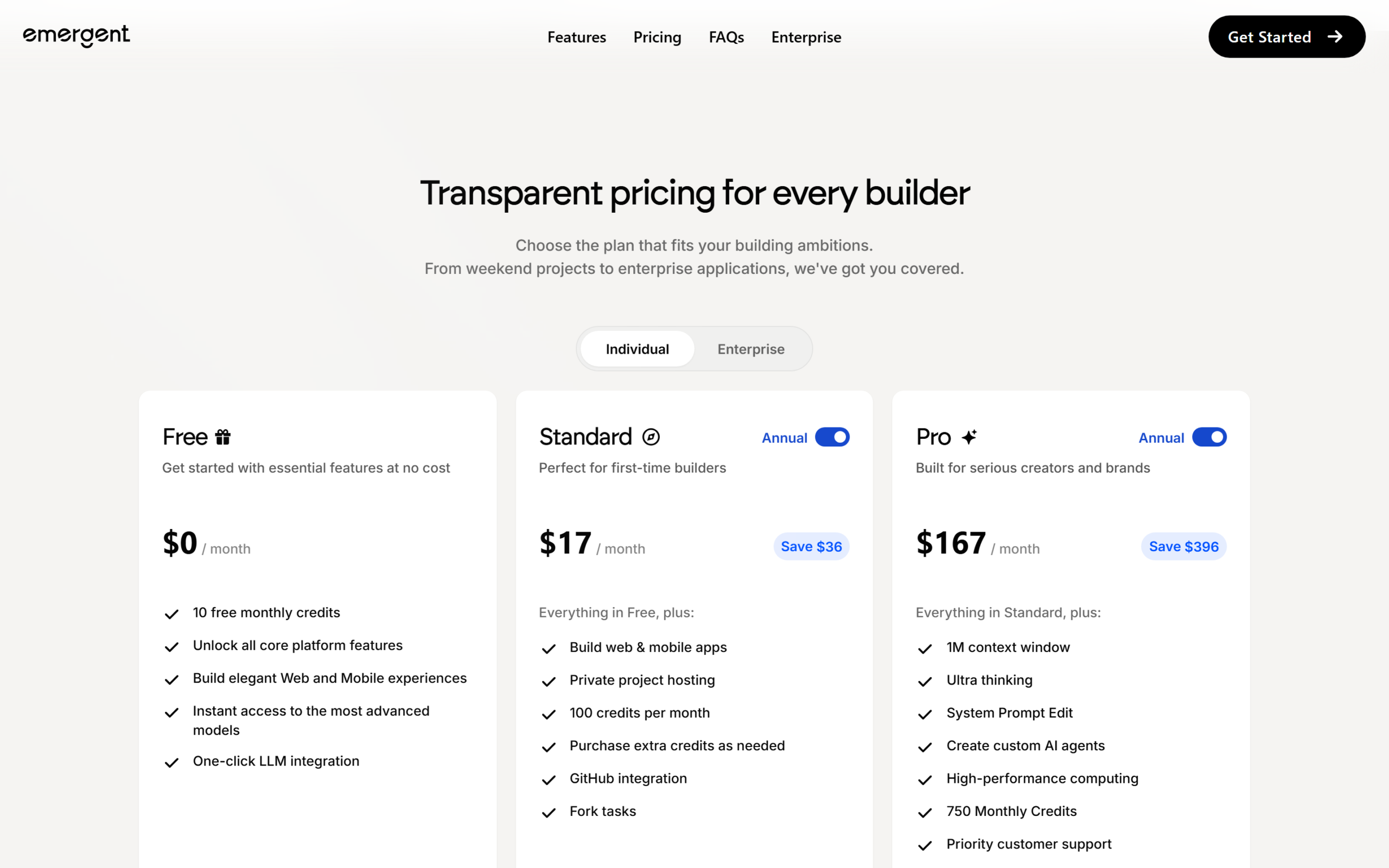
Short answer: This Emergent review covers an AI app builder, a Y Combinator S24 company, that turns a natural-language description into a production-ready web or mobile app, with GitHub, Stripe and Supabase integrations, and code you own and can export. It runs on a credit system: Free at $0 a month with 10 credits, Standard at $20 a month (or $17 a month billed annually) with 100 credits, and Pro at $200 a month (or $167 a month billed annually) with 750 credits, 1M context, Ultra Thinking Mode and custom agent creation. Emergent states 10 million-plus users worldwide and 10,000-plus custom agents built by its own users, and its pricing undercuts Replit’s Pro tier while its Standard tier lands close to Replit’s Core plan.
- Start on Free to test whether Emergent’s conversational build flow actually produces an app you would ship, before paying anything.
- Pick Standard at $17 to $20 a month if you are one builder shipping an MVP or a small production app.
- Pick Pro at $167 to $200 a month if you need the 1M context window, custom agents, or are running several deployed apps at 50 credits a month each.
- Budget for deployments separately; every live app costs 50 credits a month on top of what building it used.
Free $0/mo. Standard $20/mo ($17/mo annual). Pro $200/mo ($167/mo annual). Emergent.sh, checked September 16, 2026.
Table of contents
What is Emergent and who is it for?
Emergent describes itself as “the world’s first truly agentic vibe coding platform,” built to go “from prompt to production-ready full-stack apps in an hour, on both web and mobile.” It is a Y Combinator S24 company, and its own homepage states “10M+ users worldwide building and launching real applications in minutes.” The pitch is direct: describe what you want in plain language, and Emergent’s AI agents design, code, test and deploy it, frontend to backend, without setting up a development environment first.
The buyer this suits is a founder, product manager or small team that wants a real, working app, not a prototype, without hiring a developer for the first version, plus developers who want an AI agent to handle the boilerplate around a specific integration or workflow. This Emergent review reads Emergent’s own pricing page, its full help center documentation on plans and credits, and two named rivals, Replit and Lovable, for comparison, all on September 16, 2026.

Emergent pricing: Free, Standard, Pro and Enterprise
Emergent sells three individual tiers plus a custom Enterprise plan, each built around a monthly credit allowance.
| Plan | Monthly billing | Annual billing | Monthly credits |
|---|---|---|---|
| Free | $0 | $0 | 10 |
| Standard | $20/mo | $17/mo | 100 |
| Pro | $200/mo | $167/mo | 750 |
| Enterprise | Custom | Custom | Custom |
From Emergent’s pricing page and its help center’s plan comparison table, checked September 16, 2026. Standard is described as “perfect for solo developers or small projects,” including mobile app development and private apps. Pro adds a 1M token context window for extended reasoning, an “Ultra Thinking Mode” for complex builds, system prompt editing, custom AI agent creation, mobile app development through Expo and React Native, a machine described as twice the performance tier of Standard, and priority support. Enterprise is not priced publicly; it is a “Contact sales” tier for teams needing custom seat limits and security controls.
Annual billing is available on both Standard and Pro, saving $3 a month on Standard ($36 a year) and $33 a month on Pro, and is the source of the $17 and $167 headline figures shown on the marketing pricing page; the plain monthly rate without an annual commitment is $20 and $200.
How credits actually work
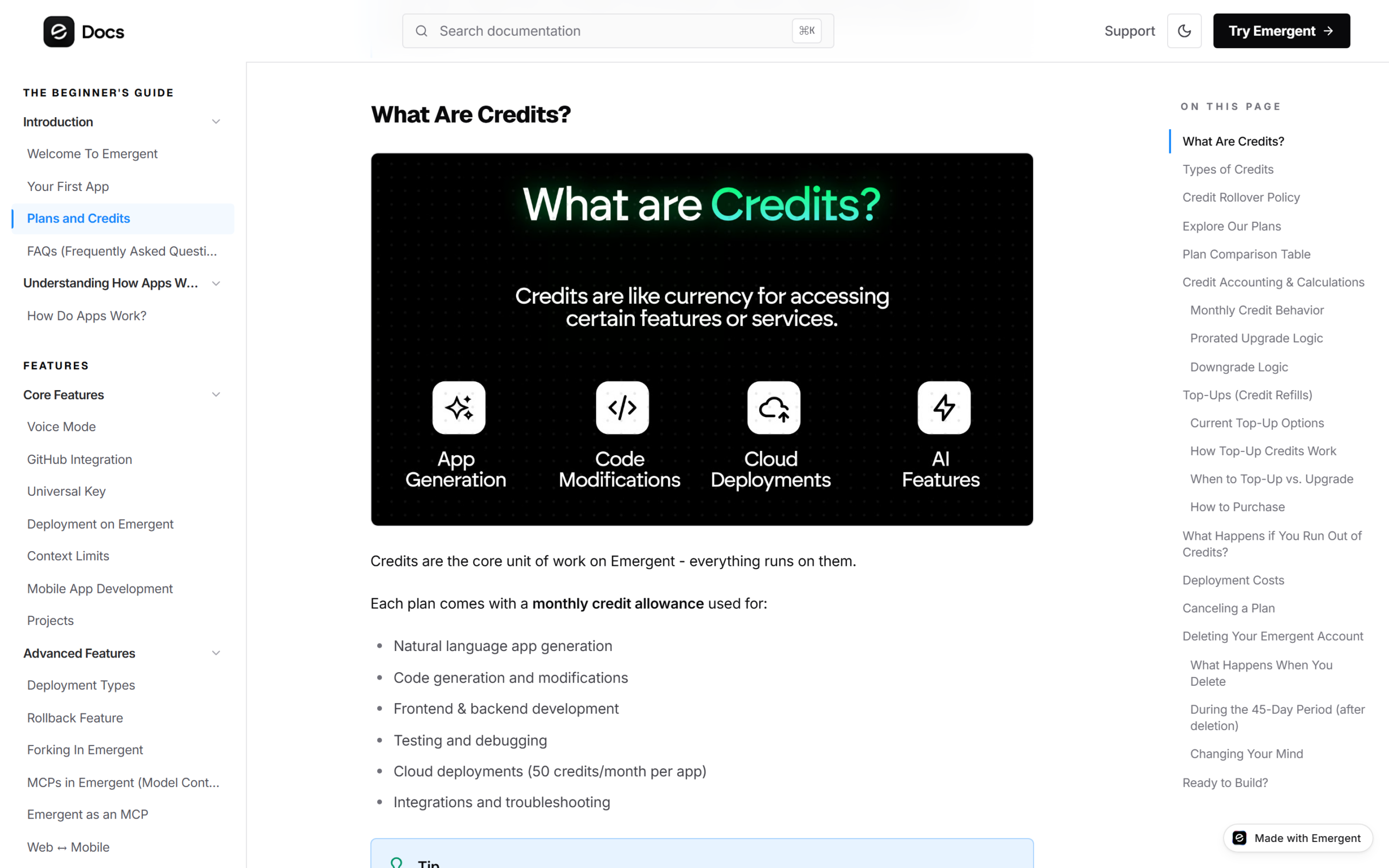
Credits are Emergent’s unit of work, spent on natural language app generation, code generation and modification, frontend and backend development, testing and debugging, integrations, and troubleshooting. A default run consumes 5 credits, adjustable up to a 1000-credit per-task limit, and Emergent’s documentation is explicit that “everything, from chat prompts to full app generation, consumes credits,” pausing development if the balance hits zero until renewal or a top-up.
One cost is easy to miss when comparing the headline plan prices: deployments cost 50 credits a month per app, charged on top of whatever credits building the app used. A Standard plan’s 100 monthly credits covers two live deployed apps’ hosting alone before any building work is done that month, which matters for anyone planning to keep several apps running rather than building one and moving on. Top-up credits, bought separately at $10 for 50 credits, never expire and are used only after that month’s subscription credits run out.
Check Emergent’s current plans and credit allowances against how many apps you actually plan to keep deployed, not just how many you plan to build, since the ongoing hosting cost is the part a headline plan price does not show.
Emergent’s documentation also spells out its upgrade and downgrade math in detail. Upgrading mid-cycle is prorated: its own worked example shows a Standard subscriber upgrading to Pro on day 15 of a 30-day cycle paying $90 immediately (the $100 new-plan cost for the remaining 15 days, minus a $10 credit for the unused Standard days), and receiving the full credit difference (690 credits in that example) instantly rather than waiting for the next cycle. Downgrading, by contrast, takes effect only at the next billing cycle, with current credits staying active until then.
Custom agents, integrations and who owns the code
Beyond app generation, Emergent lets users build custom AI agents for specific, repeated jobs. Its own site states “10k+ custom agents created by users to power research, analytics, automation, content generation, and more,” naming a Research Agent (“scans the web, compiles insights, and generates professional reports”), a Data Analyst Agent (“analyzes trends, models data, and visualizes it with clear dashboards”), and an Automation Engineer (“connects APIs, automates workflows, and handles scheduled tasks”) as examples. Custom agent creation itself is a Pro-tier feature; Free and Standard users can use agents but not build new ones from scratch.
Integrations are built around GitHub for version control, plus Stripe and Supabase named specifically in Emergent’s own documentation for payments and backend data, connected “in minutes” rather than through custom API work. On ownership, Emergent’s FAQ states plainly: “You own all the code Emergent generates,” with GitHub integration for version control and the freedom to “download, modify, or host your applications anywhere you choose,” a meaningful distinction from a closed platform that keeps your app locked to its own hosting.
Emergent’s own help center goes well beyond a typical FAQ page: dedicated sections cover getting started end to end, individual platform features like MCP support, testing and deployments, step by step integration guides for GitHub, Stripe and Supabase, prompt engineering technique, troubleshooting, and a full breakdown of how custom agents are built and managed. For a tool this new, that level of documented detail is itself a signal of how seriously the underlying credit and billing mechanics have been thought through, not just the marketing page’s headline numbers.
How Emergent compares with Replit and Lovable
Replit and Lovable are the two most recognized names in the same AI-app-building category, each with its own credit-based pricing structure.
| Entry paid tier | Mid/Pro tier | Currency | |
|---|---|---|---|
| Emergent | $20/mo ($17 annual) | $200/mo ($167 annual) | USD |
| Replit | $20/mo ($18 annual) | $100/mo ($90 annual) | USD |
| Lovable | €25/mo | €50/mo | EUR |
From each vendor’s own pricing page, checked September 16, 2026; Lovable’s prices displayed in EUR to this session, noted rather than converted.
Emergent and Replit start at an identical $20 a month for their entry paid tier, though Replit’s annual discount is smaller in absolute terms ($2 a month against Emergent’s $3). The real split shows up at the top: Emergent’s Pro tier is $200 a month against Replit’s $100, twice the price for what Emergent frames as its power-user tier, credits, context window and custom agents included. Lovable’s structure looks cheapest on the surface at €25 and €50 a month, but its published credit allowances (100 monthly credits at both its Pro and Business tiers) are not directly comparable to Emergent’s or Replit’s without knowing each platform’s own credit-to-output ratio, which none of the three vendors states in a way that lets a buyer convert credits to a fair cross-platform price per app.
Feature-wise, Emergent’s specific claims, a 1M context window on Pro, named integrations with Stripe and Supabase, and a “10k+ custom agents” user-generated ecosystem, are not matched item for item on either rival’s own pricing page in the same language, so a buyer choosing on a specific named feature should verify it directly on whichever platform they are leaning toward rather than assume feature parity.
Replit’s own pricing page frames its Pro tier around “10 parallel agents” and “$100 towards most powerful models” as spendable model credit, plus database rollback reaching back 28 days, a data-recovery feature neither Emergent’s nor Lovable’s pricing page states in the same terms. Lovable, for its part, leans on design-focused language across its tiers, unlimited collaborators even on its free plan, custom domains from Pro, and a dedicated “Business” tier built around team workspaces and role-based access rather than a raw compute or context-window upgrade, a different axis of differentiation from either Emergent’s or Replit’s power-user tier. None of the three vendors publishes a side by side benchmark of how many working apps a given monthly credit allowance actually produces, so any specific number quoted by any of them, including this review’s own credit-math examples above, should be treated as a planning estimate rather than a guarantee.
Where Emergent is less clear
The “10M+ users worldwide” and “10k+ custom agents” figures are both Emergent’s own homepage claims, not independently audited numbers; this Emergent review treats them as vendor-stated marketing claims worth noting rather than verified totals. The ongoing 50-credits-per-app deployment cost is easy to underestimate when comparing plans by their monthly credit allowance alone, since it silently eats into the same pool used for actual building work; a Standard user running three live apps spends 150 credits a month on hosting before writing a single new feature.
This review also did not find Emergent listed with reviews on G2 at the time of writing. A search under the name “EMERGENT” does return a G2 listing, but for an unrelated technology consulting company specialized in Adobe solutions, not this AI app builder; that listing shows no reviews and no pricing information of its own, and should not be confused with Emergent Labs Inc. Third-party review volume to weigh against the vendor’s own “10M+ users” claim is thin as a result, since the most obvious aggregator search does not surface an independent score for the actual company reviewed here.
Who should buy it, and who should not?
Scenario one: a non-technical founder validating an idea
The Free tier’s 10 credits are enough to test whether the conversational build flow produces something usable before committing to a paid plan, and Emergent’s own pricing card lists no minimum commitment for it, unlike the paid tiers’ monthly or annual billing choice.
Scenario two: a solo developer or small team shipping one production app
Standard at $17 to $20 a month, with 100 monthly credits and private project hosting, is built for exactly this, per Emergent’s own plan description.
Scenario three: a team building multiple apps or custom AI agents
Pro at $167 to $200 a month is the tier with custom agent creation and the 1M context window; budget for 50 credits a month per deployed app on top of whatever tier you land on.
Who should not buy
A team that has already standardized on Replit’s lower-priced Pro tier for the same class of work, or that needs a specific integration Emergent does not name (GitHub, Stripe and Supabase are confirmed; anything else should be checked directly), may not have a clear reason to switch.
Common buying mistakes
Comparing Emergent’s monthly credit allowance to a rival’s without subtracting each platform’s own deployment or hosting cost first. Assuming the $17 or $167 headline price applies without committing to annual billing; the plain monthly rate is $20 and $200. Building a custom agent expecting it on Standard, when custom agent creation is a Pro-only feature. Downgrading a plan expecting an immediate credit refund; per Emergent’s own documentation, a downgrade only takes effect at the next billing cycle, unlike an upgrade, which applies and adds credits immediately.
Also worth planning around: the default 5-credit-per-run allocation is adjustable up to a 1000-credit per-task ceiling, so a single complex build task can consume a meaningful share of a Standard plan’s 100 monthly credits in one go if left at a high setting. Reading Emergent’s own credit documentation before a first real build, rather than after running low mid-project, avoids the surprise of development pausing partway through.
Emergent pros and cons
Emergent
- Free tier and a $20/mo (or $17/mo annual) Standard tier make it easy to test before committing.
- You own the generated code, with GitHub integration and freedom to host anywhere.
- Named integrations with GitHub, Stripe and Supabase connect in minutes, per the vendor.
- Detailed, transparent documentation on exactly how credits, upgrades and downgrades are calculated.
- Pro tier at $200/mo ($167 annual) is double Replit’s comparable tier.
- Deployments cost 50 credits a month per app, an ongoing cost easy to miss when comparing plans.
- The “10M+ users” and “10k+ custom agents” figures are vendor-stated, not independently audited.
- Not listed on G2 at the time of this review, limiting independent review volume.
Frequently asked questions
How much does Emergent cost?
Free is $0/mo. Standard is $20/mo billed monthly or $17/mo billed annually. Pro is $200/mo billed monthly or $167/mo billed annually. Enterprise is custom priced.
Do I need to know how to code to use Emergent?
No. Emergent’s own FAQ states it is “designed for everyone, from complete beginners to experienced developers,” working through natural language description rather than a coding interface.
Do I own the code Emergent generates?
Yes, per Emergent’s own FAQ: “You own all the code Emergent generates,” with the full ability to download, modify or host it anywhere at all you choose.
What happens if I run out of credits?
Development pauses entirely until your subscription renews or you buy a top-up, at $10 for 50 credits; top-up credits never expire and are used only after that cycle’s subscription credits are fully gone.
How much does hosting a finished app cost?
50 credits a month per deployed app, charged on top of whatever credits building it originally used, per Emergent’s own published credit documentation.
How does Emergent compare with Replit?
Their entry paid tiers are both $20 a month. Emergent’s Pro tier is $200 a month against Replit’s $100, so Replit is the cheaper option at the top tier if you do not specifically need Emergent’s named Pro features.
Can I build mobile apps, not just websites?
Yes, from the Standard tier up, through Expo and React Native specifically on the Pro tier, per Emergent’s own plan comparison table and Pro plan description on its help center.
What integrations does Emergent support?
GitHub, Stripe and Supabase are named specifically in Emergent’s help center, described as connecting “in minutes,” alongside broader, more general support for external APIs the help center covers under its own dedicated Integrations section.
Is this Emergent review based on hands-on testing?
No. It is built from Emergent’s own pricing page, its help center documentation on plans and credits, and Replit’s and Lovable’s own pricing pages for comparison, all checked on September 16, 2026.
Is Emergent worth it?
This Emergent review finds a well-documented, credit-based AI app builder that is genuinely easy to start on for free and reasonably priced at its Standard tier, matching Replit’s entry price exactly while adding code ownership, named GitHub, Stripe and Supabase integrations, and unusually transparent credit-accounting documentation. The Pro tier’s $200 a month, twice Replit’s comparable tier, is the harder sell unless the 1M context window or custom agent creation specifically matter to your build.
Start on the Free tier to test the actual build quality on your own idea before paying anything, and once you know your real deployment count, budget the 50-credits-per-app hosting cost into whichever tier you pick. Try Emergent free and compare its output directly against Replit or Lovable before committing to an annual plan.
8.0 Score
Pros
- Free tier and a $20/mo (or $17/mo annual) Standard tier make it easy to test before committing.
- You own the generated code, with GitHub integration and freedom to host anywhere.
- Named integrations with GitHub, Stripe and Supabase connect in minutes, per the vendor.
- Detailed, transparent documentation on exactly how credits, upgrades and downgrades are calculated.
Cons
- Pro tier at $200/mo ($167 annual) is double Replit's comparable tier.
- Deployments cost 50 credits a month per app, an ongoing cost easy to miss when comparing plans.
- The 10M+ users and 10k+ custom agents figures are vendor-stated, not independently audited.
- Not listed on G2 at the time of this review, limiting independent review volume.
Final Verdict
Emergent matches Replit's entry price exactly at $20 a month while adding code ownership and named GitHub, Stripe and Supabase integrations, backed by unusually transparent credit-accounting documentation. Its Pro tier at $200 a month is double Replit's comparable tier, and the 50-credits-per-app monthly deployment cost is easy to miss when comparing plans by credit allowance alone. A strong, low-risk way to test whether AI app building fits your workflow, with Standard the realistic tier for most solo builders.