


Short answer: This Rank Prompt review covers an AI visibility platform that tracks how a brand is mentioned across six AI engines, ChatGPT, Perplexity, Google AI Mode, Claude, Gemini and Grok, then adds content generation, citation outreach and an AI agent on top, all metered through a shared monthly credit pool rather than separate per-feature pricing. Every account starts with one full free report and no credit card, paid plans run from $39 a month (billed annually) for 150 credits up to $239 a month for an agency suite with white-label client portals, and the same data is exposed through a REST API, an MCP server and webhooks for teams that want to build on it directly.
- Start with the free report: no credit card, one full AI visibility report across three engines, ChatGPT, Claude and Google AI Mode, up to 3 brands.
- Pick Starter at $39 a month (annual) if you are a solo founder tracking one brand across the six engines with room for a handful of AI articles.
- Pick Agency or Agency Plus if you run AI visibility for multiple client brands and need white-label reports and a client portal.
- Run the 7-day trial before committing annually; it needs a card on file, but you are not charged until it ends.
Free: $0. Starter: $39/mo annual ($49/mo monthly). Pro: $71/mo annual ($89/mo monthly). Agency: $119/mo annual ($149/mo monthly). Agency Plus: $239/mo annual ($299/mo monthly). Rankprompt.com, checked October 12, 2026.
Table of contents
What is Rank Prompt and who is it for?
Rank Prompt tracks a brand’s visibility inside AI-generated answers rather than classic search rankings: it runs a set of prompts against ChatGPT, Perplexity, Google AI Mode, Claude, Gemini and Grok, then reports a visibility score and a per-engine breakdown of which prompts actually trigger a recommendation. The platform frames this as “AEO” and “GEO,” answer engine optimization and generative engine optimization, the AI-answer equivalent of classic SEO rank tracking, and layers three more tools on top of the tracking itself: an AI content studio that writes articles aimed at getting cited, an outreach tool for building the citations AI engines actually trust, and “Agent Mode,” a conversational assistant that answers questions like “why did my visibility drop this week” in plain language.
The buyer this suits ranges from a solo founder checking whether ChatGPT recommends their product, up through a marketing team tracking several competitors, to an agency running the same tracking across many client brands under its own brand. This Rank Prompt review reads the homepage, the pricing page and the developer platform page, all on September 16, 2026, checking every number against what the page itself states.
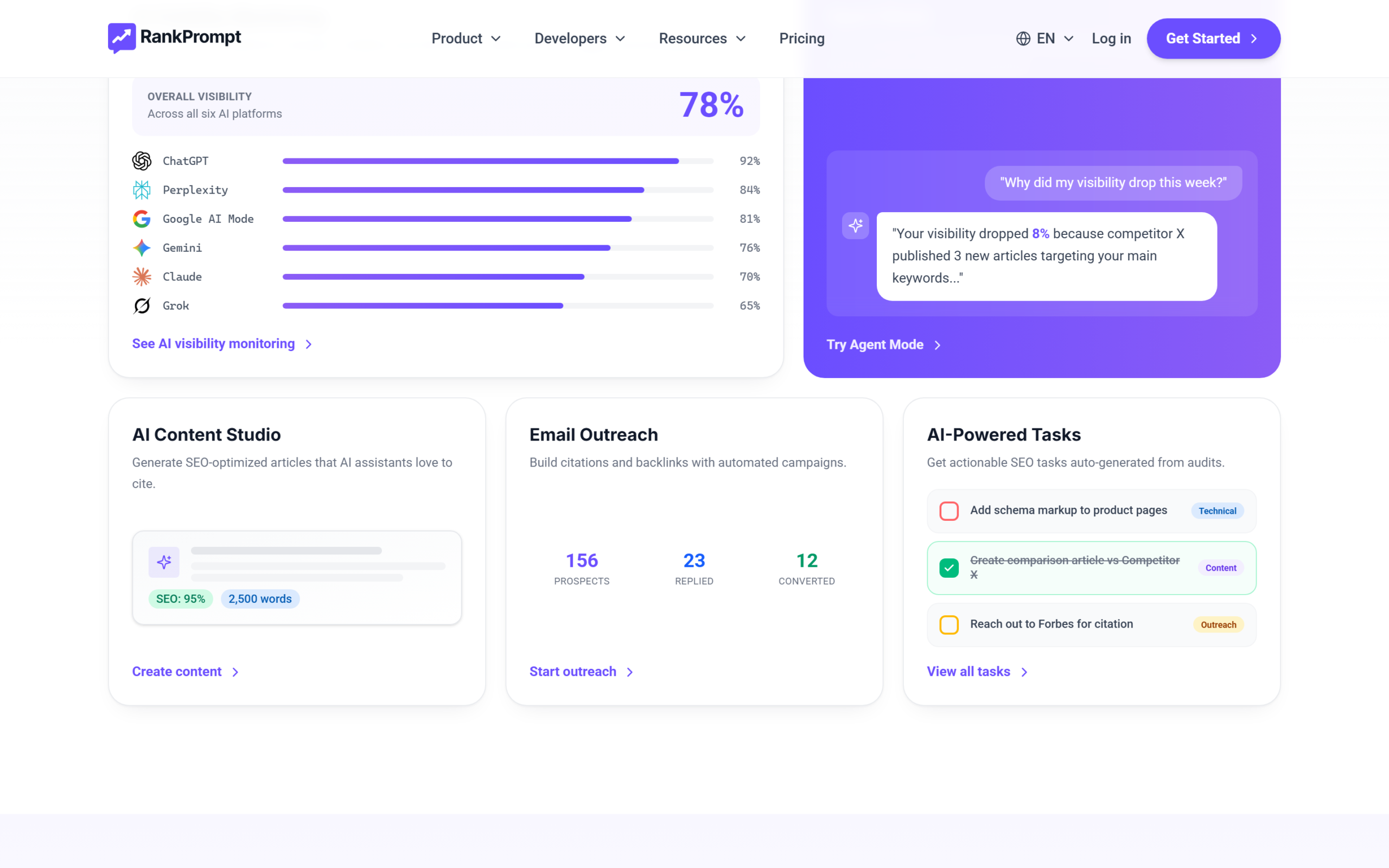
Rank Prompt states its dashboard covers six AI engines total, all six on every plan and none locked to a tier: one prompt across up to three engines costs 1 credit and across four to six costs 2, with ChatGPT, Claude and Google AI Mode running by default. It also lists “5.0/5 reviews on G2” and names Mastercard, P&G and 7-Eleven as brands it says it works with, claims this review could not independently verify against G2 or those companies directly as part of its fact-check.
Rank Prompt pricing: credits, not per-feature add-ons
Rank Prompt’s plans are built around a single monthly credit pool rather than separate limits for tracking, articles and audits, so the same allowance covers whichever mix of work a team actually does that month.
| Plan | Price (annual) | Price (monthly) | Credits/mo | Brands |
|---|---|---|---|---|
| Free | $0 | $0 | 1 free report | 3 |
| Starter | $39/mo ($470/yr) | $49/mo | 150 | 10 |
| Pro | $71/mo ($855/yr) | $89/mo | 500 | 100 |
| Agency | $119/mo ($1,430/yr) | $149/mo | 1,000 | 500 |
| Agency Plus | $239/mo ($2,870/yr) | $299/mo | 2,000 | 1,000 |
Annual billing runs about 20 percent cheaper than paying monthly on every paid tier; the page states the saving per tier, for example Pro at $71 a month billed annually at $855, which it says saves $213 against twelve months at $89. Team seats start on Pro (2 seats), white-label branded reports and a client portal start on Agency, and Agency Plus adds a fully white-labeled app on the agency’s own domain plus client logins, aimed squarely at an agency reselling AI visibility tracking as a service.
How the credit system actually works
A credit maps to one prompt run against up to three engines, or one page speed audit, while an AI article costs 10, and Rank Prompt’s own pricing page runs a calculator to translate a team’s actual usage into a credit number rather than leaving the buyer to guess. Its own worked example: 25 prompts, checked against up to three engines, run monthly, comes to 25 credits a month (25 prompts times 1 credit, since up to three engines together cost 1 credit per prompt, not 3), which the page says the 150-credit Starter plan “covers with room to grow.”
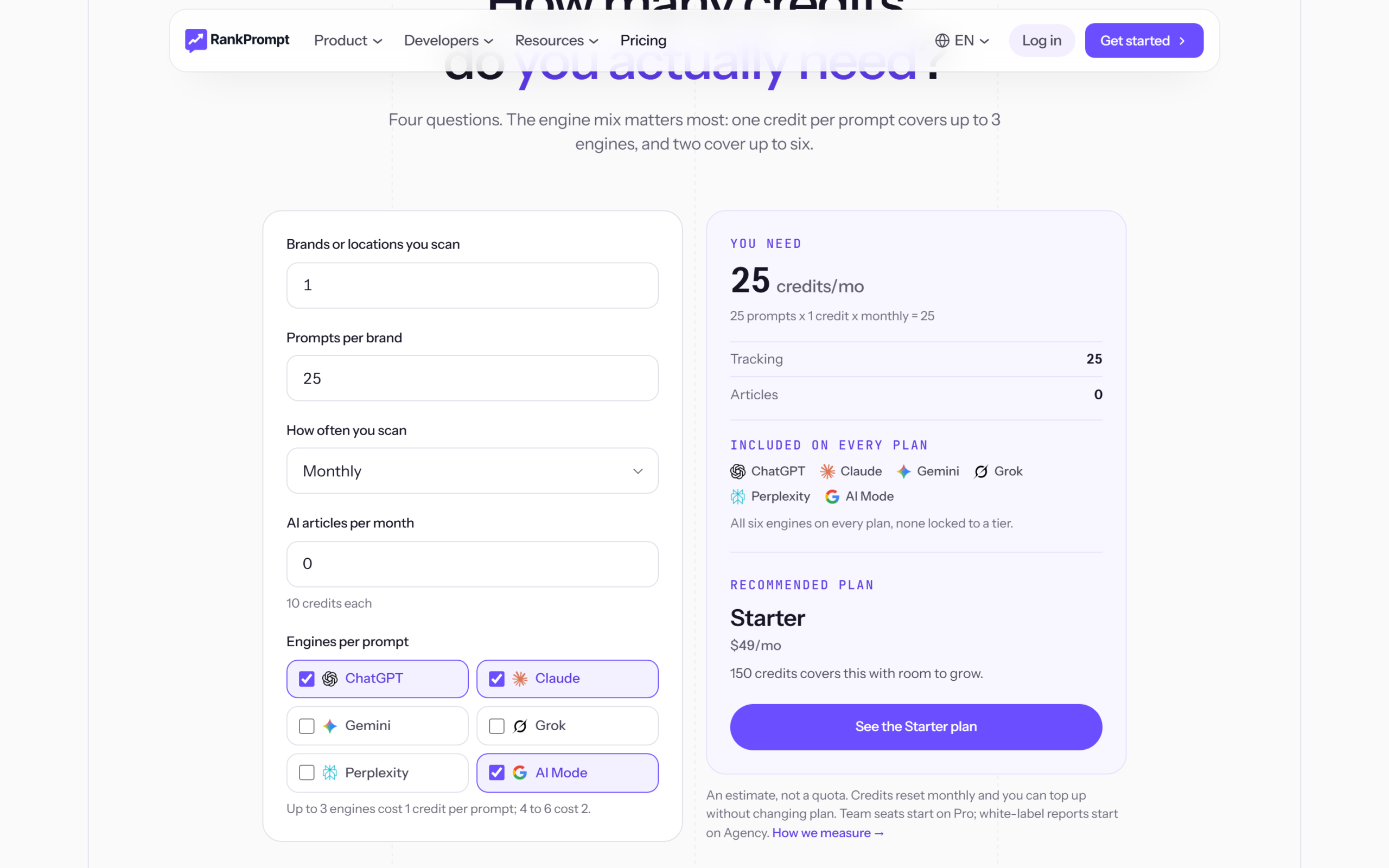
Running a prompt on four, five or all six engines costs 2 credits instead of 1, and running prompts weekly instead of monthly multiplies the credit cost roughly fourfold for the same prompt list. Unused credits do not carry into the next month, but a team that needs a one-off burst can buy a top-up of 50, 100 or 200 credits, at $18, $35 or $65, that never expires and stacks on top of the plan’s monthly allotment, which is a meaningfully different model from a rival that hard-caps usage per feature.
What that credit pool actually buys scales with the plan, not just the headline price, and the table below also shows the small separate monthly budget set aside for Agent Mode, which draws from its own allowance rather than the tracking credit pool.
| Plan | Monthly credits | Example use | Agent Mode AI budget |
|---|---|---|---|
| Starter | 150 | 150 prompts, or 15 articles | $5/mo |
| Pro | 500 | 500 prompts, or 50 articles | $10/mo |
| Agency | 1,000 | 1,000 prompts, or 100 articles | $15/mo |
| Agency Plus | 2,000 | 2,000 prompts, or 200 articles | $25/mo |
Read literally, an AI article costs the same 10 credits on every tier, so the plans do not offer a volume discount on content generation the way some per-seat software discounts a heavier user; what actually changes tier to tier is brand count, team seats, white-label options and API request ceilings, not the underlying credit-to-output ratio.
Agent Mode, Content Studio and outreach
Agent Mode is pitched as a conversational layer over the tracking data: the homepage’s own example has it answering “why did my visibility drop this week” with a specific, sourced explanation, “your visibility dropped 8% because competitor X published 3 new articles targeting your main keywords.” The AI Content Studio generates full articles aimed at getting cited by AI engines rather than just ranking in classic search, and the outreach tool runs citation and backlink campaigns, with the homepage’s own dashboard mockup showing 156 prospects, 23 replied, 12 converted as an example funnel.
All three sit on top of the same credit pool: an AI article costs 10 credits, and Agent Mode draws from a separate small monthly AI budget baked into each plan, $5 a month on Starter up to $25 a month on Agency Plus, rather than spending tracking credits directly.
The API, MCP server and webhooks
For a team that wants to pull this data into its own stack, Rank Prompt exposes the same information three ways: a REST API under /v1, documented with an OpenAPI 3.1 spec and scoped, brand-restricted keys; an MCP server that plugs the same data into Claude Code, Cursor or Claude Desktop over OAuth with 41 read and write tools; and outbound webhooks that push signed events, report.completed, report.failed, schedule.run.completed, the moment a report finishes rather than requiring a polling loop.
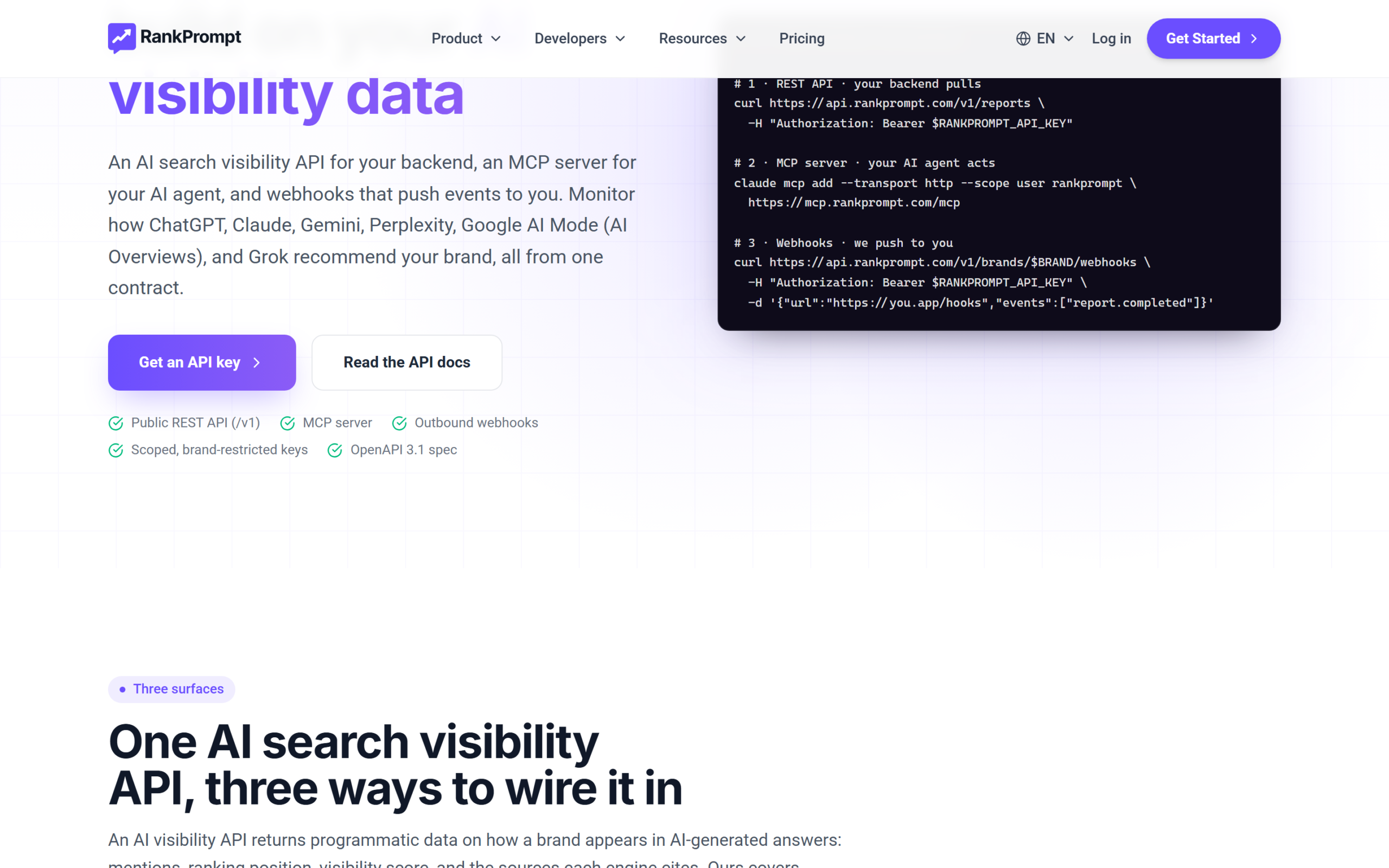
Not all of it is live yet: the developer page itself marks brand management, AI visibility reports, and citation and source tracking as “Available” today, while scheduled reports, brand audit and perception, AI-optimized content generation through the API, and technical SEO audits through the API are marked “Coming soon.” The full interactive reference for what is live sits at Rank Prompt’s own API documentation, worth checking directly before building against a specific endpoint.
What Rank Prompt’s own case studies show
Rank Prompt publishes named case studies with dated, market-by-market numbers rather than only aggregate testimonials, which this review reads as a genuinely stronger evidence standard than most SaaS case study pages offer, while still noting these are self-published by the vendor rather than independently audited. Humand, described as a B2B HR software platform, is credited with going “from 0% to 18% AI visibility in a brand new market” in the US after twenty-two weekly reports, with its Argentina visibility separately climbing from 24% to 48% and Argentina citation share from 4.0% to 11.3% over the same stretch.
A second case study, an Arlington and Fort Worth used car dealership called Owings Auto, is credited with taking its Fort Worth AI visibility from 13.3% to 54.2% and its local ranking from 12th of 247 to 2nd over 141 days, with the count of tracked answers naming the dealership rising from 16 of 120 to 65 of 120 over the same period. Both case studies name specific actions taken between measurement points, new articles published, a location page rebuilt, Reddit comments made live, rather than presenting the improvement as unexplained.
Three shorter case studies on the same page follow the same pattern at a smaller scale: an e-commerce leather goods brand reports climbing to a #2 citation rank behind only YouTube after site optimizations and targeted listicles; a Nashville and Miami coworking operator reports a 51% visibility score and the #1 citation rank ahead of WeWork and Venture X; and a direct-to-consumer food storage brand reports becoming the most-cited source in its category, ahead of Amazon, with a 59% visibility score and 14.3% citation share. None of the five case studies on the page identify the client by a verifiable public business name beyond what is shown, so this review treats the specific percentages as vendor-published rather than independently reproduced.
The trial, credit rollover and refunds, in plain terms
Rank Prompt’s own FAQ spells out three details worth reading before signing up rather than assuming. On the trial: “Every new account gets a full AI visibility report on your own prompts, with no credit card. All paid plans… then include a 7-day free trial with 50 free credits; a credit card is required to start the trial, but you won’t be charged until it ends, and you can cancel anytime before then.” Start that trial on Rank Prompt’s pricing page once the free report has shown whether the tracking is worth paying for.
On credit rollover: “credits reset at the start of each billing cycle and don’t roll over to the next month,” though one-time top-ups purchased separately “never expire and stack with your monthly allocation.” On refunds: cancelling during the 7-day trial means never being charged at all, but for an already-paid subscription, “contact support within 24 hours of a charge and we will review a full refund; after that we don’t refund,” and annual plans are not prorated on cancellation. Credit top-ups themselves are stated as non-refundable outright, trial or not, which is worth knowing before buying one to cover a short-term spike in usage.
Where Rank Prompt is still building
Several features that sound core to the product are explicitly marked as not yet shipped on Rank Prompt’s own developer page: scheduled reports, automated brand audit and perception tracking, AI-optimized content generation, and technical SEO audits are all listed “Coming soon” for API access as of this review, meaning a team building an integration around one of those specifically should confirm current status before committing engineering time. The 24-hour refund window is also narrow compared with the 7-day or 14-day windows some SaaS competitors offer on a first paid charge.
Because credits meter tracking, articles and audits from the same pool, a team that leans heavily into AI article generation (10 credits each) will have noticeably less left over for prompt tracking in the same month, which is a genuine trade-off of the unified-credit model against a tool that prices tracking and content separately.
Who Rank Prompt is for, and who it is not
Rank Prompt fits a marketing team or founder who already accepts that AI answers, not just Google’s ten blue links, now influence whether a buyer ever hears a brand’s name, and wants one dashboard across all six major AI engines rather than checking each manually. It particularly fits an agency: the Agency and Agency Plus tiers bundle a white-label client portal, branded automated reporting and a prospecting tool built specifically to pitch AI visibility work with the prospect’s own data already attached.
It is a weaker fit for a team that wants scheduled, hands-off reporting today through the API specifically, since that endpoint is still “Coming soon,” or for a team whose primary need is deep classic technical SEO auditing rather than AI-answer visibility, since the page-speed and Lighthouse-style checks sit alongside the AI tracking rather than replacing a dedicated SEO audit tool.
Rank Prompt pros and cons
The clearest advantage is genuinely broad engine coverage, six AI platforms in one dashboard with up to three engines per prompt costing a single credit, plus a free first report that needs no credit card at all before anyone commits to a trial. The unified credit pool is flexible by design, and the published case studies name specific, dated, market-level numbers rather than vague aggregate claims.
Set against that: several developer-facing features are not live yet, the 7-day trial requires a card on file despite the free report not needing one, credits do not roll over between months, and the refund window on a paid charge is a tight 24 hours. None of these rule Rank Prompt out on their own, but they are worth weighing against a slower-moving rival before committing to an annual plan.
Frequently asked questions
Does Rank Prompt have a free plan?
Yes: one full AI visibility report with no credit card, tracking up to 3 brands across three AI engines, ChatGPT, Claude and Google AI Mode, permanently free, not a trial.
Is there a free trial on paid plans?
Yes, 7 days with 50 free credits included; a card is required to start it, but nothing is charged until the trial ends, and cancelling before then means no charge at all.
Do unused Rank Prompt credits roll over?
No, credits reset every billing cycle. One-time top-ups (50, 100 or 200 credits, at $18, $35 or $65) can be purchased separately, never expire, and stack on top of the plan’s monthly allowance.
How much does Rank Prompt cost?
Free for one report, then $39 to $239 a month billed annually across four paid tiers (Starter, Pro, Agency, Agency Plus), or $49 to $299 a month on monthly billing, plus custom Enterprise pricing for large multi-brand programs.
Does Rank Prompt have an API?
Yes, a REST API under /v1 with an OpenAPI 3.1 spec, plus an MCP server for AI agents and outbound webhooks, though several planned endpoints are still marked “Coming soon” as of this Rank Prompt review.
What is Rank Prompt used for?
Tracking how often and how favorably a brand is named inside AI-generated answers across ChatGPT, Perplexity, Google AI Mode, Claude, Gemini and Grok, then acting on the gap with AI-written content and citation outreach.
Is Rank Prompt worth it?
This Rank Prompt review finds a genuinely broad AI-visibility tracker, six engines in one dashboard, a free first report with no card, and a credit model flexible enough to cover tracking, content and audits from one pool, backed by case studies that name real, dated, market-level numbers instead of vague claims. The trade-offs are a handful of developer-facing features still marked “Coming soon,” a narrow 24-hour refund window on paid charges, and credits that do not roll over month to month.
For a marketing team or agency that wants one place to watch how AI engines answer for their brand, check Rank Prompt’s current plans against how many prompts and brands you actually need to track before choosing a tier.
7.6 Score
Pros
- Tracks six AI engines in one dashboard on every plan, with up to three engines per prompt costing a single credit.
- Free first report with no credit card, ahead of any trial or subscription.
- REST API, MCP server and webhooks all read the same data layer for developer-side integration.
- Published case studies name specific, dated, market-level visibility numbers, not vague claims.
Cons
- Several developer-facing features (scheduled reports, brand audit, AI content via API) are 'Coming soon'.
- Credits reset every billing cycle and do not roll over, only paid top-ups do.
- The 7-day trial requires a credit card, unlike the fully free first report.
- Refund window on a paid charge is a narrow 24 hours, and annual plans are not prorated.
Final Verdict
Rank Prompt tracks brand visibility across six AI engines from one dashboard and one shared credit pool that covers tracking, AI content and outreach, backed by a free first report and case studies with real, dated numbers. Several developer-facing features are still 'Coming soon' and the refund window is a tight 24 hours, worth weighing before committing to an annual plan. For a marketing team or agency that wants one place to watch how AI engines answer for their brand, it is worth testing on the free report first.