


Short answer: This Flippa review covers the online marketplace where people buy and sell websites, ecommerce stores, SaaS products, apps and other digital businesses, and the plain finding is that what you pay depends almost entirely on your asking price. Sellers under $100,000 list themselves from a $29 package and then pay a success fee of 10 percent when the business sells, while sellers above that can hire a Flippa broker for a flat upfront fee of $399 to $1,499 plus a success fee that falls from 10 percent to 5 percent as the price climbs. Buyers browse listings for free, and Flippa says its team reviews the financials of every asset listed above $50,000.
- Sell yourself if your asking price is under $100,000 and you can handle buyer questions, since packages start at $29 and $49.
- Use a broker if you are asking $100,000 or more and want negotiation, a data room and buyer matching handled for you.
- Buy on Flippa if you want a large, searchable pool of small online businesses with verified financials on the bigger listings.
- Do the sums first: a 10 percent success fee is a large cut of a small deal, so price it against your realistic sale figure before you list.
Listing packages: from $29 (asking under $10K). Broker-led: from $399 upfront. Success fee: 10% down to 5% by asking price. Flippa.com, checked September 21, 2026.
Table of contents
What is Flippa and how does it work?
Flippa calls itself the number one global platform to buy and sell online businesses and digital assets. Its About page says it was founded in 2009, describes ecommerce stores, blogs, SaaS companies, mobile apps, social media accounts, newsletters and other online businesses as the things that change hands, and quotes 450,000 entrepreneurs and investors and 3,000,000 users worldwide. The company is based in Melbourne, Austin and Amsterdam. A seller creates a listing, a buyer finds it, and the two negotiate, agree a price and move the asset through a payment and transfer process that Flippa supports with escrow, contracts and verification.
Nothing about that is unusual in itself. What sets a marketplace apart is how much of the deal it does for you, and Flippa has widened the answer over time. It now sells two distinct ways to sell: a self-service route where you write and manage the listing yourself, and a broker-led route where a Flippa M&A broker runs the sale end to end, supported by what the site calls BrokerAI. This Flippa review reads the homepage, the pricing page, the search page, the trust and verification page, the About page, a help centre article on fees and the vendor’s own comparison with Acquire.com, all on September 21, 2026, and it checks the numbers against those pages.
The rest of this piece is organised around a question most people ask first: what does it actually cost, and what do you get for it? The answer turns out to be a table with ten rows, because Flippa prices by asking price rather than by plan name.
What buyers see: listings, filters and verification badges
On the buyer side Flippa is a searchable catalogue. The search page is titled “Browse 5,000+ Listings” and offers three tabs, Buy, Off-Market and Invest, a filter panel, sorting by most relevant, most active, lowest price, highest price, most recent, ending soonest or most profitable, and a Create Alert button for new matches. Each listing card summarises the business in a consistent way: its type, industry and monetisation model, site age, monthly net profit and asking price, plus a “View insights on multiples” link that shows the price as a multiple of profit and of revenue.
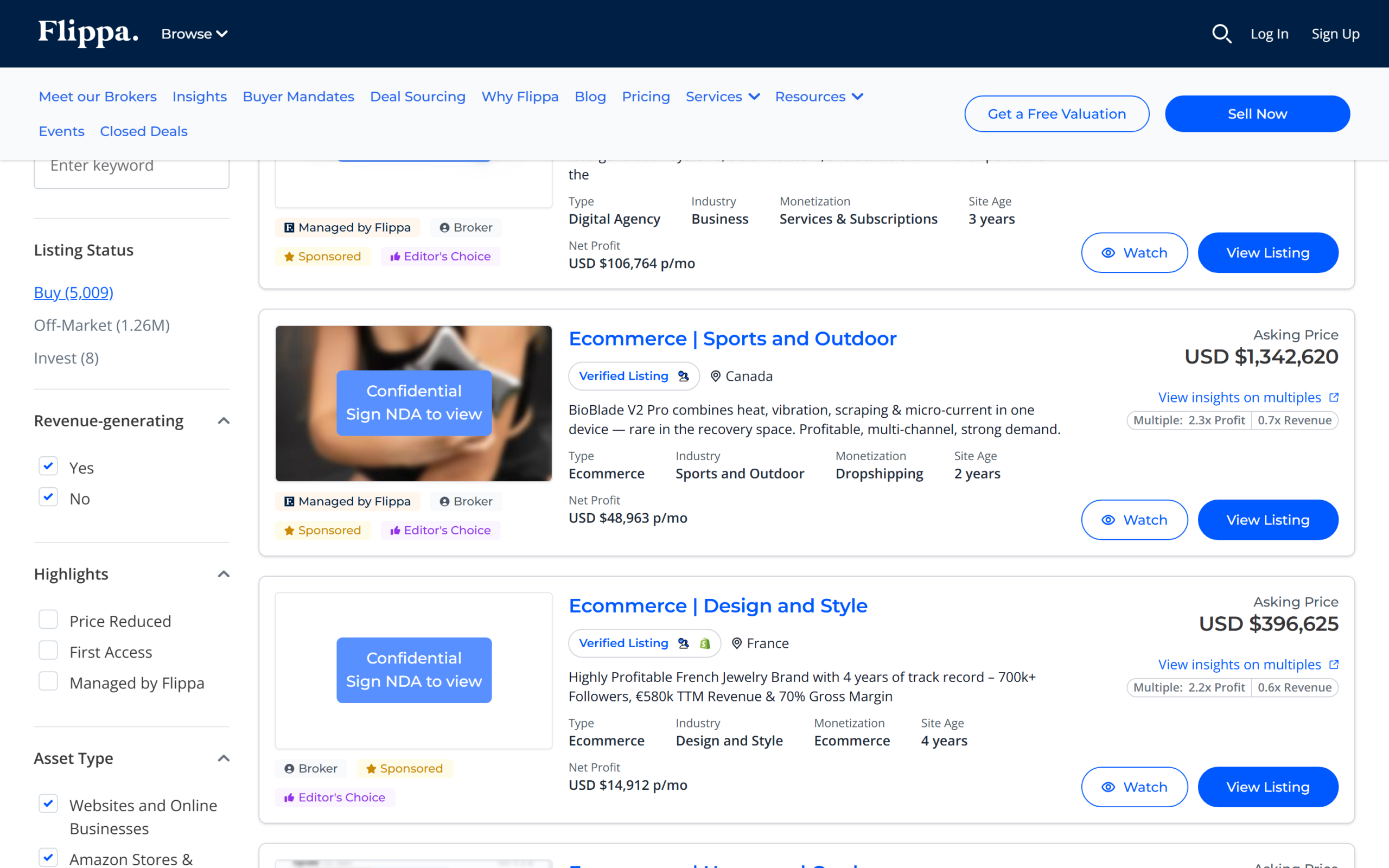
The consistency is the useful part. On the day this review was checked, the first six listings on the page showed profit multiples between 1.2x and 2.8x, and several carried a “Verified Listing” tag. Some listings are marked “Confidential” and ask a buyer to sign an NDA before the details appear, which is the normal way a seller protects a business that still trades under its own name. Buyers browse for free. Flippa’s own comparison page states that buyers browse unlimited listings without paying, though the buyer-side deposit rules described in the fees section below still apply once you bid.
How selling works: self-service or broker-led
The pricing page opens with a slider that asks you to choose an asking price from ten bands, from “Sub $10K” up to “$50M+”, and then shows the services that apply. The dividing line is $100,000. Below it, you sell through a self-service package: you pay for exposure, run the conversation with buyers yourself, and pay a success fee if the business sells. From $100,000 upwards, the page presents one route, a dedicated Flippa M&A broker who leads the transaction.
The broker route bundles what a seller would otherwise assemble piecemeal: expert negotiation support, buyer qualification and verification, deal structuring, confidential and NDA-protected sales, a custom confidential information memorandum and virtual data room, AI matching across what the page calls more than 2 million global buyers, letter of intent and asset purchase agreement builders with eSignature, and integrated payments and escrow. Flippa says the broker route makes a business “2x more likely to sell,” a claim the page does not source, so read it as marketing rather than measured performance.
Not every business qualifies for the broker route, and the page says so directly. It asks for proven profitability or scale, meaning 12 months of consistent monthly net profit (6 months for a YouTube channel), at least a 12 month trading history, and 12 months of financials that are ready or buildable. If Flippa cannot match your business with the right buyer at the right price, the page promises it will say so upfront and refund any fees paid. Every account can also run a free valuation, which the site says compares your inputs with thousands of similar businesses that sold on the platform and returns an estimate instantly.
Flippa pricing: listing fees, broker fees and success fees
Flippa’s pricing has three parts: a fee to list or to engage a broker, a success fee when the business sells, and separate payment costs covered in the next section. The table below lists the ten asking-price bands as the pricing page showed them, with the broker fee and success fee for each.
| Asking price | Route | Upfront fee | Success fee |
|---|---|---|---|
| Under $10K | Self-service | $29 (60 days), $49 (3 months) or $199 (6 months) | 10% |
| $10K to $49.9K | Self-service | $49, $399 or $599 per 6 months | 10% |
| $50K to $99.9K | Self-service | $129, $399 or $699 per 6 months | 10% |
| $100K to $249.9K | Broker-led | $399 (6-month term) | 10% |
| $250K to $499.9K | Broker-led | $499 | 10% |
| $500K to $999.9K | Broker-led | $899 | 9% |
| $1M to $4.9M | Broker-led | $1,299 | 8% |
| $5M to $9.9M | Broker-led | $1,299 | 7% |
| $10M to $49.9M | Broker-led | $1,499 | 6% |
| $50M and above | Broker-led | $1,499 | 5% |
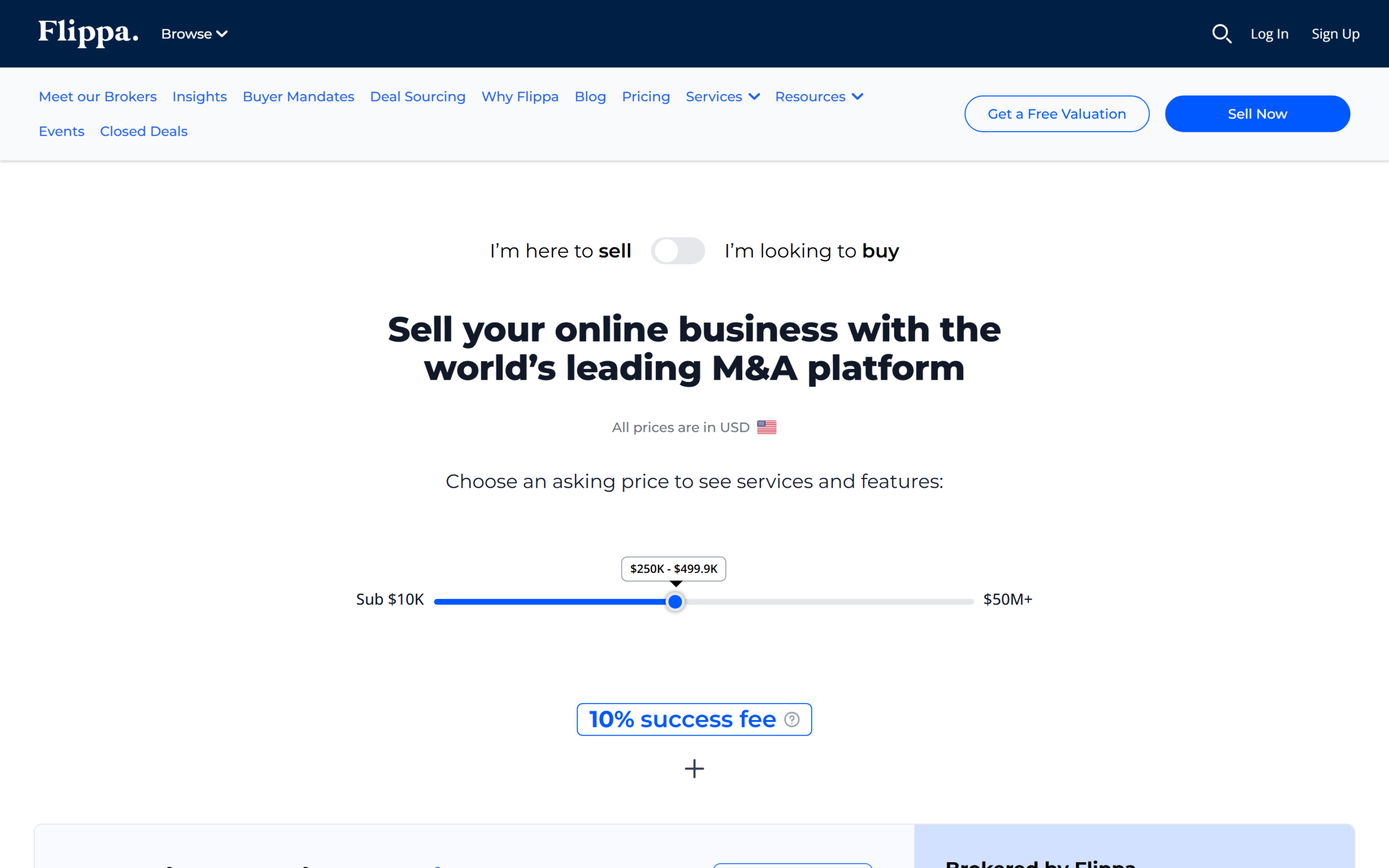
The self-service tiers differ in exposure. In the lowest band, Entry ($29 for 60 days) and Boosted ($49 for three months, marked “Most Picked”) are flat fees, and Premium ($199 for six months) adds NDA protection. In the $10,000 to $49,900 band the tiers are Standard ($49), Premium ($399, adding a dedicated relationship manager) and Ultimate ($599), and in the $50,000 to $99,900 band Standard rises to $129 and Ultimate to $699. The page notes that these are billed per six months with no monthly billing.
A worked example helps. Suppose you sell a business for $50,000 through the Standard package: $129 to list plus a 10 percent success fee is $5,129 before payment costs. Sell a business for $300,000 through a broker and the $499 fee plus 10 percent comes to $30,499. At $1.5 million the $1,299 fee plus 8 percent is $121,299. These are our calculations from the pricing page’s labels, and they assume the success fee applies to the whole sale price, which the page does not spell out, so confirm the exact basis in the checkout before you commit. If the bands fit your plans, start with Flippa’s free valuation to see which band your business lands in.
Escrow, FlippaPay and buyer holds
The success fee is not the whole cost of a sale. Flippa’s escrow and payments page describes two payment routes, FlippaPay and Escrow.com, for deals “from $1,000 to $100 Million,” in USD, AUD, GBP, EUR and CAD, with optional domain holding and support for seller financing or earn-outs. It advertises “lower costs, starting from just 1%,” and explains that FlippaPay funds sit in regulatory trust accounts with the banking partners AscendantFX and Trolley, while Escrow.com is an external provider. The fuller fee detail comes from a help centre article on pricing, escrow and FlippaPay fees. For transactions of $10,000 and above, FlippaPay offers cross-border payments through accredited platforms from just 0.5 percent of the final sale price, paid by the buyer. Escrow.com fees follow the schedule below. Flippa says buyers get a 20 percent discount on the variable escrow fees when they use it through the platform, and that sellers with non-US bank accounts may face a flat fee, usually $20, for international wires.
| Escrow.com transaction amount | Fee |
|---|---|
| $0 to $5,000 | 3.25% ($10 minimum) |
| $5,000.01 to $25,000 | $162.50 plus 0.26% of the amount over $5,000 |
| $25,000.01 and above | 0.89% |
There is also a buyer verification step: before you can bid, a $5 hold is placed on your card, and for a bid or offer where the price is $5,000 or more an additional $500 authorisation is required. These are holds rather than charges and are released within ten days under the card issuer’s process. One caution: that help article carries a February 2019 date on its face, and its “from just 0.5%” FlippaPay rate does not match the “starting from just 1%” on the current escrow page, so treat the exact figures as a guide and check the live numbers in the payment flow before you agree a price.
Verification, data integrations and payments
The trust page is where Flippa makes its strongest argument. It says an in-house verification team reviews revenue and primary expenses on thousands of listings each month, comparing stated financials with bank account and primary source data and checking traffic figures. The bigger, later clause matters more: Flippa says its expert vetting team reviews the stated financial performance of every asset priced above USD $50,000, and that listings which have passed are marked with a “Vetted by Flippa” icon.
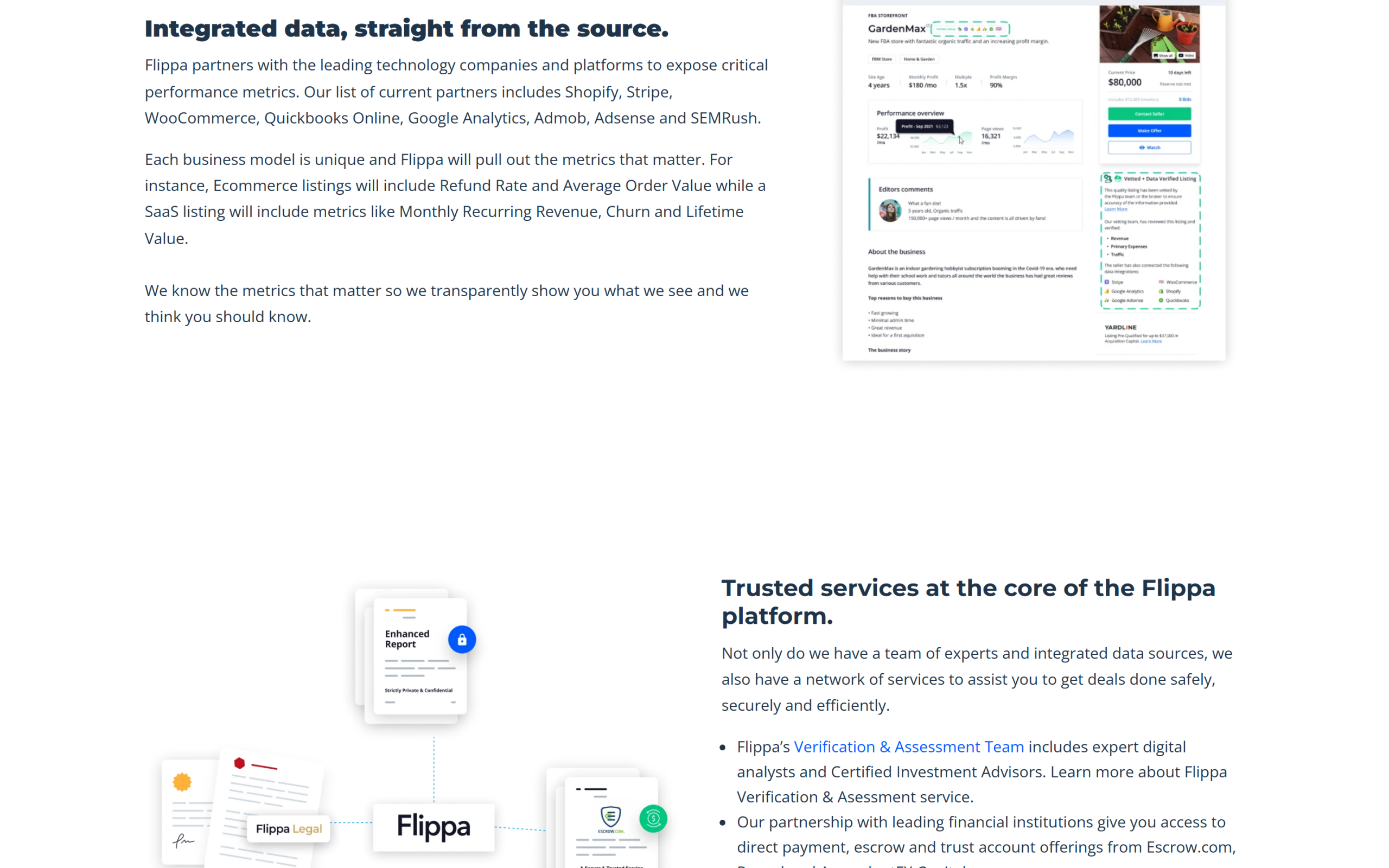
The second layer is direct data. Flippa lists Shopify, Stripe, WooCommerce, QuickBooks Online, Google Analytics, AdMob, AdSense and SEMrush as integration partners, and says each business model pulls the metrics that matter, for example refund rate and average order value for an ecommerce listing, or monthly recurring revenue, churn and lifetime value for a SaaS listing. On payments, the page names Escrow.com, PayPal and AscendentFX Capital, and it mentions embedded letter of intent and asset purchase agreement templates and a network of lawyers for complex deals. The page also claims $100 million in new listings value and a combined $10 billion of buyer budget each month, which are the company’s own figures and are not independently verified here.
Flippa vs Acquire.com: claims against the other side’s page
Flippa publishes a comparison page against Acquire.com, one of several such pages it maintains, and it is worth reading with the obvious caveat that a vendor wrote it. On pricing, it says buyers on Acquire “get access to 10 listings, then pay $780/year,” that Acquire sellers “pay 6 to 8%” depending on asking price, and that Flippa offers a price-match guarantee on success fees and listing packages from $29 for 60 days. On reach, it cites a third-party study for traffic, giving Flippa 22.2 million global visits and 8.9 million US visits in the twelve months to July 2024 against 1.2 million US visits for Acquire.
The check against Acquire’s own pricing page is instructive. As of September 21, 2026, Acquire.com shows a free Basic tier that lets buyers explore public startup listings, and a paid buyer membership “starting at $390.” That does not match the $780 a year on Flippa’s page, which is either an older figure or a different plan. The lesson is the general one for any vendor comparison: use it to learn which questions to ask, then check the rival’s live price list before deciding. This Flippa review does not judge Acquire.com beyond that, because its own pages were read only for pricing.
Where Flippa is less clear
The audience numbers are inconsistent across the vendor’s own pages. The homepage says “400,000+ Weekly Buyers,” the broker card refers to “AI Matching Across 2M+ Global Buyers,” the About page says 450,000 entrepreneurs and investors and 3,000,000 users, and the comparison page says “Over a Million Entrepreneurs Choose Flippa.” These are different things measured differently, but a seller trying to judge how many real buyers will see a listing cannot tell which figure applies. The escrow page adds two more: “Over 450,000 businesses sold on Flippa” and “10K+ Transactions,” the first of which is the same number the About page uses for entrepreneurs and investors.
The fees also need care. A 10 percent success fee applies across every band up to $499,900, which is a large cut of a small business, and the pricing page does not say whether the rate applies to the whole price or in layers. The most detailed fee article is dated 2019. Verification is strongest at the top: the vetting claim covers assets priced above $50,000, so smaller listings rely more on the buyer’s own diligence. And the broker route is limited to businesses with a profit history, so a young or pre-revenue project will not qualify.
Finally, most of the page-level claims here, buyer counts, the “2x more likely to sell” line, the market share study, are self-reported. That is normal for a marketplace, and it is the reason this review leans on prices and stated policies, which can be checked, over performance claims, which cannot.
Who Flippa is for, and who should look elsewhere
Flippa suits an owner of a small to mid-sized online business, roughly $10,000 to a few million dollars, who wants a public marketplace with a large audience and is happy to run part of the process themselves. It also suits a buyer who wants to browse many small businesses for free, with consistent listing cards, multiples on every listing and verification on the bigger ones.
It is a weaker fit for a seller who wants a private, hands-off sale of a very large or unusual business, and for anyone unwilling to pay a 10 percent success fee on a sub-$500,000 deal. It is also not the right place for a business without a profit history if you were hoping for the broker route. A buyer who wants tightly curated, vendor-vetted deal flow may prefer a curated marketplace, which is why comparing the live price lists before you choose is worth the hour it takes.
Flippa pros and cons
In this Flippa review the clearest advantages are transparency about price bands, a listing package from $29, a broker route with a refund promise if no match is found, free browsing for buyers and financial vetting above $50,000 backed by data integrations with Shopify, Stripe, QuickBooks Online and Google Analytics.
Against that: a flat 10 percent success fee up to $499,900, payment fees on top, an inconsistent story on how many buyers there are, vendor-written comparisons that do not always match the rival’s live page, and a fee article dated 2019. None of these rule Flippa out. They are the items to price before you list.
Frequently asked questions
How much does it cost to sell on Flippa?
It depends on your asking price. Self-service packages start at $29 for 60 days, broker-led sales cost $399 to $1,499 upfront, and a success fee of 10 percent down to 5 percent applies when the business sells.
Is Flippa free for buyers?
Browsing is free. Before you bid, Flippa places a $5 hold on your card, and an additional $500 authorisation applies to bids or offers of $5,000 or more; both are holds rather than charges.
What can you sell on Flippa?
Digital assets and online businesses, including SaaS products, apps, ecommerce stores, blogs, communities and plugins, according to Flippa’s pricing page FAQ.
Does Flippa verify listings?
Flippa says its team reviews the financials of every asset priced above $50,000 and marks vetted listings with a “Vetted by Flippa” icon, and that it pulls data directly from partners such as Shopify, Stripe and Google Analytics.
Do I need a broker to sell on Flippa?
Below $100,000 you sell through a self-service package. From $100,000 the pricing page presents the broker-led route, which needs 12 months of net profit and trading history.
How does Flippa compare with Acquire.com?
Flippa’s own comparison claims lower fees, a larger buyer pool and more services, but Acquire’s live pricing page shows a free basic tier and a paid buyer membership from $390, so check both price lists before you choose.
Is Flippa worth it?
This Flippa review finds a large, mature marketplace with unusually clear pricing for a business that changes hands through brokers: ten asking-price bands, a listing package from $29, broker fees of $399 to $1,499, and a success fee that shrinks as deals grow, backed by financial vetting above $50,000 and direct data from platforms such as Shopify and Stripe. The trade-offs are the heavy 10 percent fee on smaller deals, payment costs on top, audience numbers that do not line up between pages, and vendor comparisons that need checking.
For an owner of a small or mid-sized online business, or a buyer who wants a big pool to browse, check Flippa’s current listing and broker options against your realistic sale price before you choose a route.
7.7 Score
Pros
- Published pricing by asking price, with listing packages from $29 and a success fee shown for every band.
- Broker-led route includes negotiation, data room, buyer matching and a refund of fees if no match is found.
- Financials of every asset above $50,000 are reviewed, backed by data from Shopify, Stripe and Google Analytics.
- Buyers browse free, and a free valuation tool gives sellers a starting price.
Cons
- The 10% success fee applies to every sale up to $499.9K, a large cut of a small deal.
- Escrow and payment costs come on top, and the main fee article is dated 2019.
- Buyer and user counts differ between the vendor's own pages.
- The comparison with Acquire.com is vendor-written and does not match Acquire's live pricing.
Final Verdict
Flippa is a large, mature marketplace with unusually clear pricing: ten asking-price bands, listing packages from $29, broker fees of $399 to $1,499 and a success fee that falls from 10 to 5 percent. Financial vetting above $50,000 and direct data from Shopify and Stripe add trust. The flat 10 percent fee on smaller deals, payment costs on top and inconsistent audience numbers are the things to price before listing.