


Short answer: This Calilio review covers a cloud phone system for businesses, priced at $15 a user a month (or $12 annually) on Standard, and $35 a user a month (or $28 annually) on Premium, with virtual numbers in over 100 countries and an AI voice agent bundled into both paid tiers. Calilio states it is the “telephony partner of 1000+ businesses worldwide,” and its pricing page is unusually specific about overage costs, listing exact per-minute and per-SMS rates rather than leaving usage limits vague. A $1 free credit is included on signup, and once a plan’s free-call bundle is used, additional usage draws from a prepaid wallet rather than an automatic bill increase.
- Pick Standard at $12 to $15 a month per user if you are a solopreneur or small team needing 200 outgoing and 100 incoming minutes a month.
- Pick Premium at $28 to $35 a month per user for unlimited users, AI call reporting, live call monitoring and 24/7 support.
- Load your wallet before you need it; once the $1 signup credit and your plan’s free bundle are used, calls and SMS pause until the wallet is funded.
- Compare the AI voice agent minutes specifically; Standard includes 10 free minutes per user a month, Premium includes 100, each billed per minute beyond that.
Standard $15/mo ($12/mo annual, $144/yr). Premium $35/mo ($28/mo annual, $336/yr). Enterprise custom. Calilio.com, checked September 16, 2026.
Table of contents
What is Calilio and who is it for?
Calilio markets itself as an “AI-Powered Cloud Phone System for Growing Businesses,” built to replace a traditional business phone line with virtual numbers, team call handling, and AI-driven features like call summaries and voicemail transcription. Its own homepage states it is the “Telephony partner of 1000+ businesses worldwide.”
The buyer this suits is a small business, startup or call center that needs a real business phone number without a telecom contract, plus features like call recording, live call monitoring and AI call analytics that a basic mobile carrier plan does not offer. This Calilio review reads Calilio’s own pricing page in full, including its detailed pay-as-you-go rate card, and one named rival, Quo (the company formerly known as OpenPhone), for comparison, all on September 16, 2026.
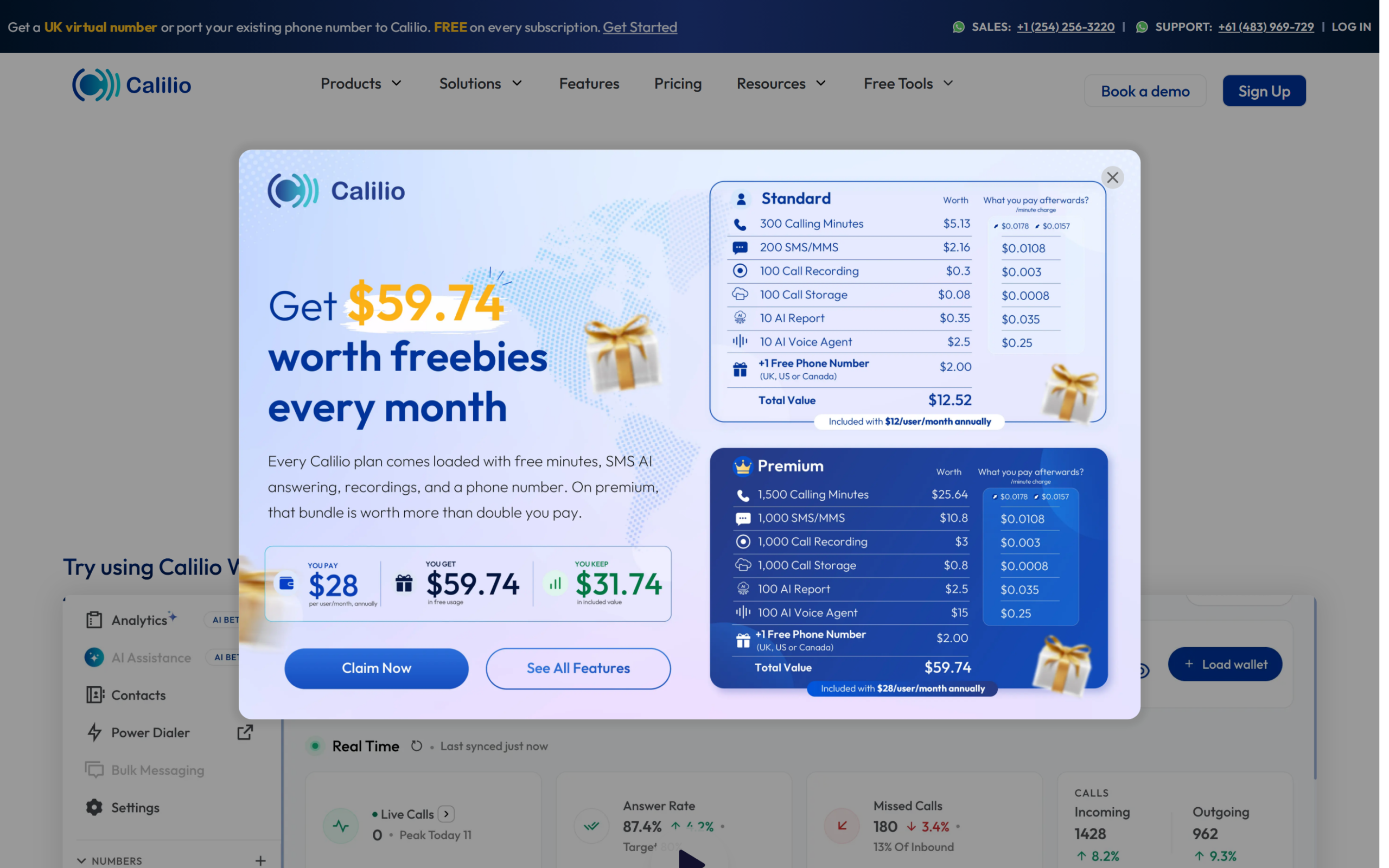
Calilio pricing: Standard, Premium and Enterprise
Calilio sells three tiers, priced per user per month, with a 20 percent discount for annual billing on both named tiers.
| Plan | Monthly | Annual | Free minutes (out/in) | Free SMS (out/in) |
|---|---|---|---|---|
| Standard | $15/user/mo | $12/user/mo ($144/yr) | 200 / 100 | 100 / 100 |
| Premium | $35/user/mo | $28/user/mo ($336/yr) | 1,000 / 500 | 500 / 500 |
| Enterprise | Custom | Custom | Custom | Custom |
From Calilio’s pricing page, checked September 16, 2026. Standard covers up to 10 users, one free local number, phone number sharing, call forwarding, call recording and basic call analytics, aimed explicitly at “solopreneurs, startups, and small businesses.” Premium removes the 10-user cap entirely (unlimited users), and adds inbound and outbound call management, live call monitoring, AI call reporting, bulk SMS, call transfer and 24/7 customer support, aimed at “growing businesses, franchises, and call centers.” Enterprise adds a dedicated account manager, developer support, phone and WhatsApp support, additional free calls and SMS, and API and webhook access (listed as “Coming Soon” at the time of this review).
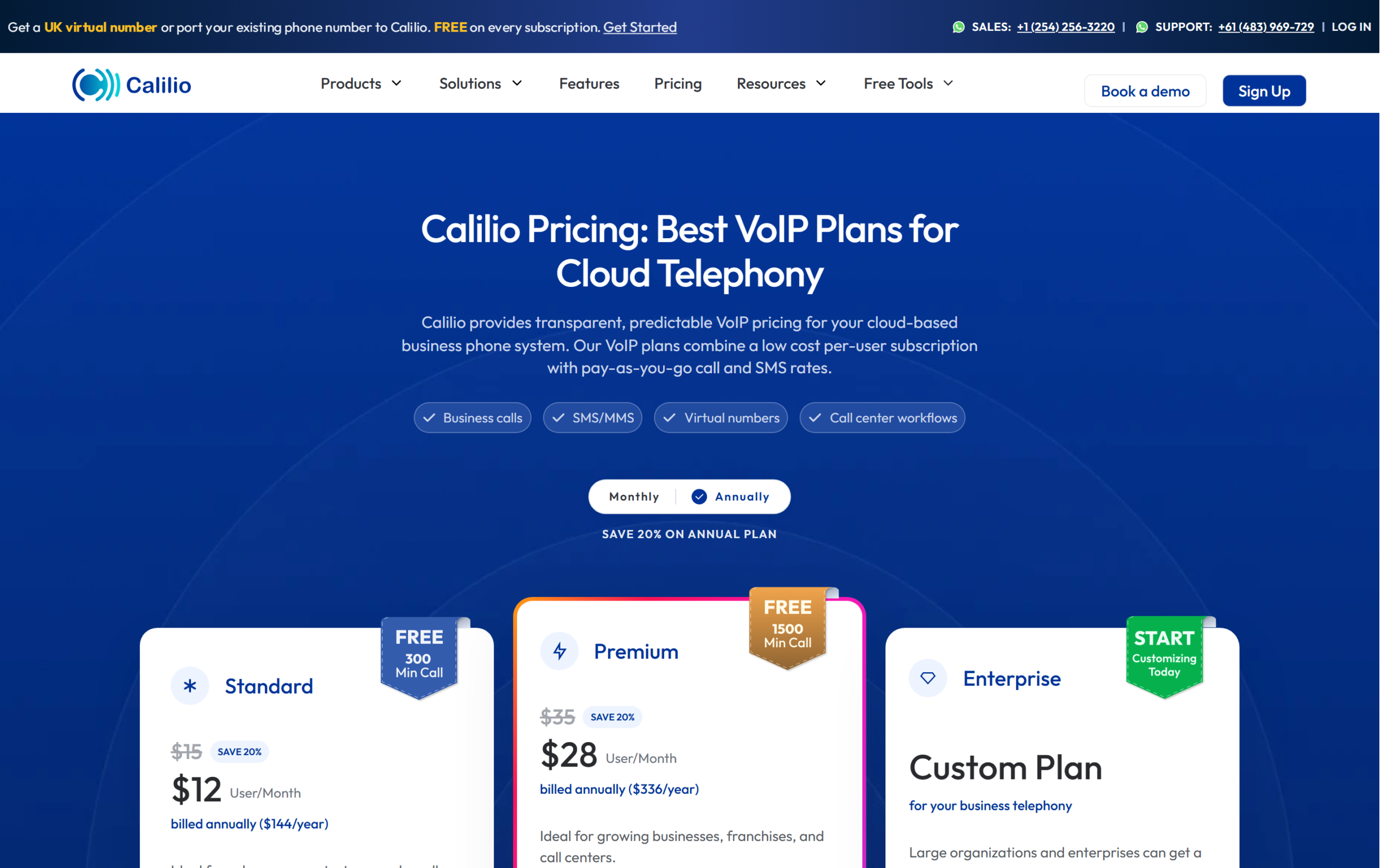
What happens when you go over your plan’s minutes
Calilio’s pricing page states plainly: “Your subscription only covers the plan and includes a complimentary $1 credit. When your free calls & SMS bundle is used up, calling charges are deducted from your wallet. Once your $1 credit is finished, you must load your wallet to make and receive calls/SMS.” Phone numbers and call and SMS charges beyond the free bundle are billed separately from the monthly subscription itself, a prepaid-wallet model rather than automatic overage billing to a card on file.
This is worth planning for specifically, since a team that runs out of wallet balance mid-month cannot make or receive calls until the wallet is funded again, a harder stop than a typical “we’ll bill you for the overage” SaaS model. Check Calilio’s current plan limits against your team’s real monthly call volume before assuming the included minutes will cover a full month of use.
The AI voice agent, call recording and analytics
Calilio’s plan comparison table lists exact overage rates for its AI-driven features rather than leaving them open-ended, a level of specificity worth noting directly. The AI Voice Agent is free up to 10 minutes per user a month on Standard ($0.25 a minute above that) and free up to 100 minutes per user a month on Premium ($0.15 a minute above). Voicemail transcription is free up to 10 minutes on Standard ($0.035 a minute above) and free up to 100 minutes on Premium ($0.025 a minute above). Call recordings are free up to 100 minutes on Standard and free up to 1,000 minutes on Premium, both at $0.003 a minute beyond that limit.
Call analytics is described as “Basic” on Standard and “AI-powered” on Premium specifically, one of the clearer, named feature differences between the two tiers rather than just a difference in included usage volume. Premium alone adds live call monitoring and AI call reporting, features aimed at a team lead or call center supervisor reviewing agent performance rather than a solo user managing their own calls.
The pattern across all three metered AI features, voice agent minutes, voicemail transcription and call recording storage, is consistent: Premium’s included allowance is roughly 10 times Standard’s on the first two, and the per-minute overage rate drops by 30 to 40 percent once you are paying for usage beyond the included bundle. That structure rewards a team that expects to lean on AI features heavily; a light user on Standard who occasionally goes over 10 minutes of AI voice agent use a month pays a higher per-minute rate for that overage than a Premium user would for the same extra minute, even before accounting for Premium’s much larger free allowance in the first place.
Basic call handling features, call forwarding, phone number sharing, internal team communication and call recording itself, are included on both tiers rather than gated behind Premium specifically; the tier difference is concentrated in AI-driven analysis, live monitoring, and the volume of usage each plan’s free minutes actually cover, not in whether a given feature exists at all.
Virtual numbers and the pay-as-you-go rates
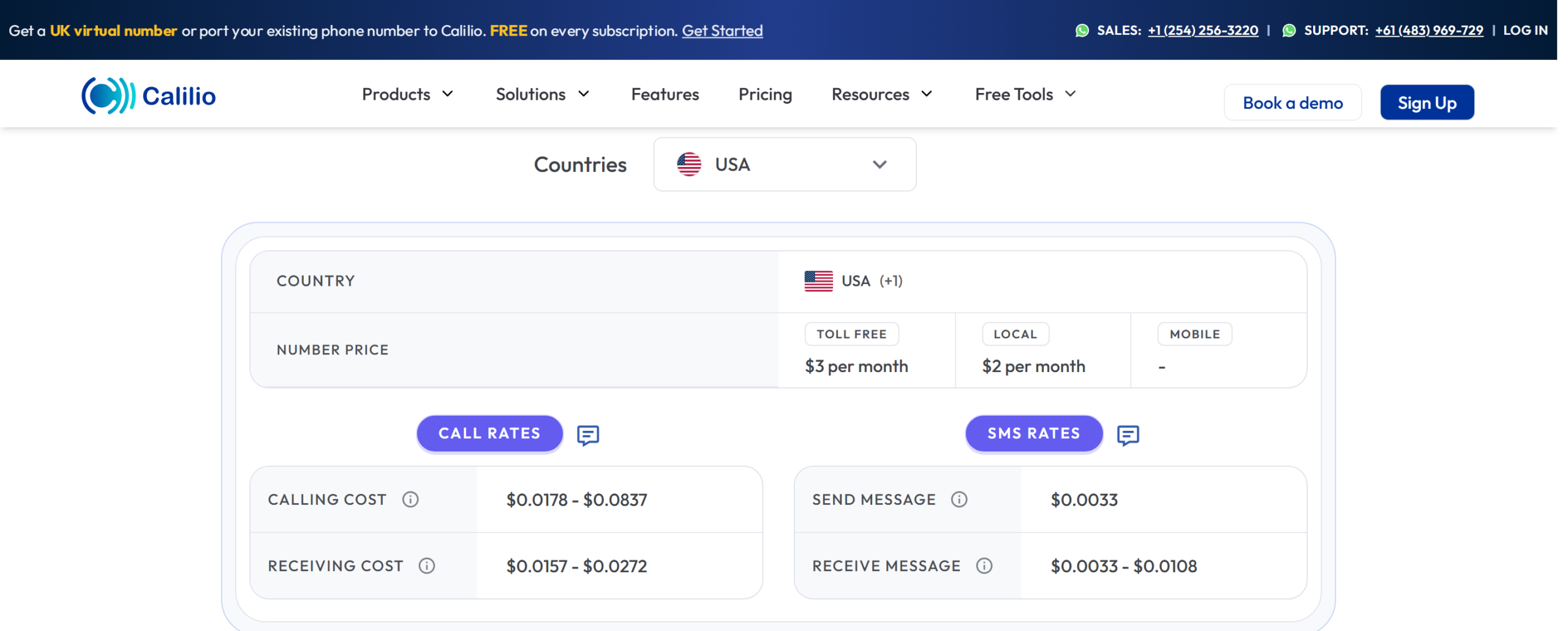
Calilio offers virtual numbers from over 100 countries, with the first local number (USA, Canada, or UK local, mobile or national) free per user after signup; additional numbers cost $2 a month each. For the USA specifically, a toll-free number costs $3 a month and a local number $2 a month, with calling rates of $0.0178 to $0.0837 a minute and receiving rates of $0.0157 to $0.0272 a minute, plus SMS at $0.0033 to send and $0.0033 to $0.0108 to receive. Calilio’s own blog publishes further guidance on choosing numbers and setting up call routing for different business types, worth reading before committing to a specific country’s number if your calling patterns are not yet clear.
How Calilio compares with Quo (formerly OpenPhone)
Quo, the business phone system previously known as OpenPhone, is a directly comparable named rival, also priced per user per month with tiered plans.
| Calilio | Quo (OpenPhone) | |
|---|---|---|
| Entry tier | $12/mo annual (Standard) | $15/mo annual (Starter) |
| Mid tier | $28/mo annual (Premium) | $23/mo annual (Business) |
| Top named tier | Enterprise (custom) | $35/mo annual (Scale) |
| Overage model | Prepaid wallet, itemized per-minute rates | Fair Usage Policy, largely unlimited US/Canada calling |
From Calilio’s and Quo’s own pricing pages, checked September 16, 2026.
Calilio’s entry tier undercuts Quo’s Starter plan by $3 a month, but the comparison flips at the middle tier: Quo’s Business plan at $23 a month is cheaper than Calilio’s Premium at $28. The bigger structural difference is the overage model itself: Quo advertises effectively unlimited calling and messaging to US and Canadian numbers under a fair usage policy, where Calilio meters usage against a specific included-minute bundle with a published per-minute rate beyond it. A team making high call volumes specifically within the US and Canada may find Quo’s model more predictable; a team needing broader international number coverage or Calilio’s specific AI voice agent minute structure may prefer Calilio’s itemized approach instead.
Quo’s own pricing page bundles a feature it calls Sona, described as an AI agent, plus what it calls “automation credits” (1,000 included free on every plan, with one call consuming 100 credits) into all three of its tiers rather than gating AI features behind its top plan the way Calilio ties its best AI Voice Agent allowance to Premium specifically. Quo also names direct CRM integrations, HubSpot and Salesforce specifically, from its Business tier up, a category of integration Calilio’s own pricing page does not name at either paid tier.
One-time setup costs differ too: Quo’s pricing page discloses a one-time $19.50 carrier review and registration fee tied to messaging major US carriers (AT&T, T-Mobile, Verizon), a compliance cost specific to US text messaging regulation that Calilio’s pricing page, focused more heavily on its per-minute call and SMS rate card, does not itemize in the same way. A buyer planning to send significant SMS volume to US numbers on either platform should confirm whether an equivalent registration fee applies before comparing the two vendors on subscription price alone.
Where Calilio is less clear
Enterprise’s API and webhook access is listed as “Coming Soon” rather than currently available, worth confirming directly if API integration is a requirement before signing an Enterprise contract. The “1000+ businesses worldwide” figure is a vendor-stated claim on Calilio’s own homepage, not an independently audited customer count.
This overview also did not find Calilio listed with a substantial independent review history on G2 or Capterra at the time of writing, so third-party validation of call quality or support responsiveness beyond Calilio’s own site is thin, worth weighing against a more established rival’s larger public review base. Call quality itself, latency, drop rates, audio clarity on international numbers specifically, is not something a pricing page can demonstrate either way; a buyer for whom call reliability on a specific country’s numbers is critical should test with a paid month or the lowest available commitment before moving a whole team onto the platform.
Calilio’s own comparison table also does not name every integration category a growing team might expect, a CRM sync or helpdesk integration list comparable to what Quo names specifically for HubSpot and Salesforce is not called out anywhere on Calilio’s own pricing or feature pages read for this review; a buyer relying heavily on CRM-triggered calling workflows should confirm what, if anything, Calilio supports there directly with sales rather than assuming parity with a rival that names its integrations explicitly.
Who is Calilio for, and who is it not for?
Scenario one: a solopreneur or small team needing a professional phone number
Standard at $12 to $15 a month per user covers this, with a free local number and up to 10 users included.
Scenario two: a call center or franchise managing agent performance
Premium’s unlimited users, live call monitoring and AI-powered call analytics are built specifically for this, at $28 to $35 a month per user.
Scenario three: a business needing numbers in many countries
Calilio’s 100-plus country virtual number coverage is a real differentiator worth checking against a specific rival’s own country list before choosing, since not every VoIP provider covers the same range of countries or offers local, mobile and toll-free options everywhere.
Scenario four: a business that needs a CRM-integrated calling workflow specifically
Neither Calilio’s Standard nor Premium tier names a specific CRM integration on its own pricing page; a rival like Quo, which names HubSpot and Salesforce integrations directly from its Business tier up, may be the more direct fit if that is a hard requirement rather than a nice-to-have.
Who Calilio is not for
A US and Canada-only team making very high call volumes may find Quo’s effectively unlimited calling under a fair usage policy more predictable to budget than Calilio’s itemized per-minute overage rates.
Common buying mistakes
Assuming the included minutes bundle resets or rolls over unused; Calilio’s pricing page describes it as a monthly allowance, not a banked balance. Forgetting to fund the prepaid wallet before the $1 signup credit and the plan’s free bundle run out, which stops calling and receiving entirely rather than generating a bill. Choosing Enterprise specifically for its API access before confirming that feature has shipped, since it was listed as “Coming Soon” at the time of this review. Staying on Standard’s 10-user cap past the point a team actually needs more seats, when Premium’s unlimited users and larger AI allowance may already pay for itself once headcount grows past that limit.
It is also worth double checking which numbers actually qualify for the one free local number per user; Calilio specifies USA, Canada, or UK local, mobile or national numbers for that free allowance, so a business primarily needing a number in a different country should confirm that country’s specific number cost before assuming it is included at no charge.
Calilio pros and cons
Calilio
- Itemized, specific overage rates for calls, SMS, AI voice minutes and recordings, not vague “fair use” language.
- Virtual numbers available in over 100 countries, with one free number per user included.
- AI call reporting, live call monitoring and AI-powered analytics on the Premium tier.
- Standard tier undercuts Quo’s comparable Starter tier by $3 a month.
- Prepaid wallet model means calling stops entirely once the balance runs out, not an automatic bill increase.
- Premium at $28 a month is more expensive than Quo’s comparable Business tier at $23.
- Enterprise’s API and webhook access is not yet available, listed as “Coming Soon.”
- Thin independent review presence found on major review aggregators at the time of this overview.
Frequently asked questions
How much does Calilio cost?
Standard is $15/mo ($12/mo billed annually, $144/year). Premium is $35/mo ($28/mo billed annually, $336/year). Enterprise is custom priced.
What happens when I use up my included minutes?
Additional usage is deducted from a prepaid wallet at Calilio’s published per-minute and per-SMS rates; calling and receiving stop once the wallet balance and the initial $1 signup credit are exhausted.
How many users does each plan support?
Standard supports up to 10 users total. Premium supports unlimited users, with no named seat cap on that tier at all whatsoever.
Does Calilio include an AI voice agent?
Yes, on both paid tiers: free up to 10 minutes per user a month on Standard ($0.25/min above that), and free up to 100 minutes per user a month on Premium ($0.15/min above that limit).
How many countries can I get a virtual number in?
Over 100 countries in total, per Calilio’s own pricing page, with one free local number per user included automatically after signup.
How does Calilio compare with Quo (OpenPhone) on price?
Calilio’s entry tier is $3 a month cheaper than Quo’s Starter at the annual rate, but Quo’s Business tier at $23 a month undercuts Calilio’s Premium at $28.
Is this Calilio review based on hands-on testing?
No. This Calilio review is built entirely from Calilio’s own pricing page, including its detailed pay-as-you-go rate card, and Quo’s own pricing page for comparison, all checked directly on September 16, 2026.
Is Calilio worth it?
This Calilio review finds a cloud phone system that is unusually transparent about its overage pricing, itemizing exact per-minute rates for calls, SMS, AI voice minutes and recordings rather than a vague fair-use policy, and its Standard tier undercuts a direct named rival’s comparable plan. The prepaid-wallet overage model is the one structural detail worth understanding clearly before signup, since it stops service rather than simply billing more once the free bundle and starting credit run out.
Calilio is a strong fit for a small team or call center that wants broad international number coverage and a genuinely itemized rate card to budget against. Check Calilio’s current plans and compare its per-minute rates directly against your team’s real call volume before choosing between Standard and Premium.
7.9 Score
Pros
- Itemized, specific overage rates for calls, SMS, AI voice minutes and recordings, not vague fair-use language.
- Virtual numbers available in over 100 countries, with one free number per user included.
- AI call reporting, live call monitoring and AI-powered analytics on the Premium tier.
- Standard tier undercuts Quo's comparable Starter tier by $3 a month.
Cons
- Prepaid wallet model means calling stops entirely once the balance runs out, not an automatic bill increase.
- Premium at $28 a month is more expensive than Quo's comparable Business tier at $23.
- Enterprise's API and webhook access is not yet available, listed as Coming Soon.
- Thin independent review presence found on major review aggregators at the time of this overview.
Final Verdict
Calilio's pricing page is unusually transparent about overage costs, itemizing exact per-minute and per-SMS rates for calls, AI voice minutes and recordings rather than a vague fair-use policy, and its Standard tier beats Quo's comparable Starter plan on price. The prepaid-wallet model is the one detail to plan around, since usage stops rather than auto-bills once the balance runs dry. A solid pick for a small team or call center wanting broad international number coverage and predictable, itemized rates.