



Short answer: The best license-free walkie talkies for most American teams are the Retevis RB48, a rugged FRS radio with 22 channels, IP67 sealing and a glove-sized talk button, but “license-free” only holds where the radio was made to be used: FRS radios are for the United States, PMR446 radios are for Europe and the UK, and neither is covered by the other side’s exemption.
- Pick the Retevis RB48 if you run a crew on a US work site, farm, school or warehouse and want tough FRS radios with no paperwork.
- Pick the Retevis RT22 for event staff and ushers, the Midland LXT500VP3 for hikes and family trips, and the Cobra ACXT1035R FLT for anything near water.
- Buy a PMR446 radio instead if you live in the EU or the UK: Retevis sells the RB648, a 0.5 W PMR446 sibling of the RB48.
- Skip all of these if you need many miles through hills: that is GMRS territory, which needs an FCC license.
This article contains Amazon affiliate links; TruePick may earn a commission at no extra cost to you. Ratings and specs checked October 11, 2026; check the current price on Amazon. Rules quoted from the FCC’s rules in 47 CFR Part 95 and CEPT’s ECC Decision (15)05 as published on October 11, 2026.
Table of contents
What does license-free mean in the US, the EU and the UK?
License-free means a regulator has decided that a particular kind of low-power radio may be used by anyone without applying for an individual licence, and that permission is tied to a specific frequency band, a power limit and an antenna rule. It is not a property of the radio alone. The same handset can be legal on one side of the Atlantic and outside every exemption on the other, which is why this guide starts with the rules and only then names products.
United States: the Family Radio Service (FRS)
In the US, the Federal Communications Commission (FCC) sets the rules in Part 95 of Title 47 of the Code of Federal Regulations. Section 95.305 authorises eligible people to operate Personal Radio Service stations without individual licences, unless the subpart for a particular service says otherwise. For FRS it does not, so an FRS radio is used with no form, no fee and no call sign. The rules define FRS as a short-distance two-way voice service between low power hand-held radios, for individual, family, group, recreational and business activities. Business use is named in the definition itself, which matters for anyone buying radios for a crew.
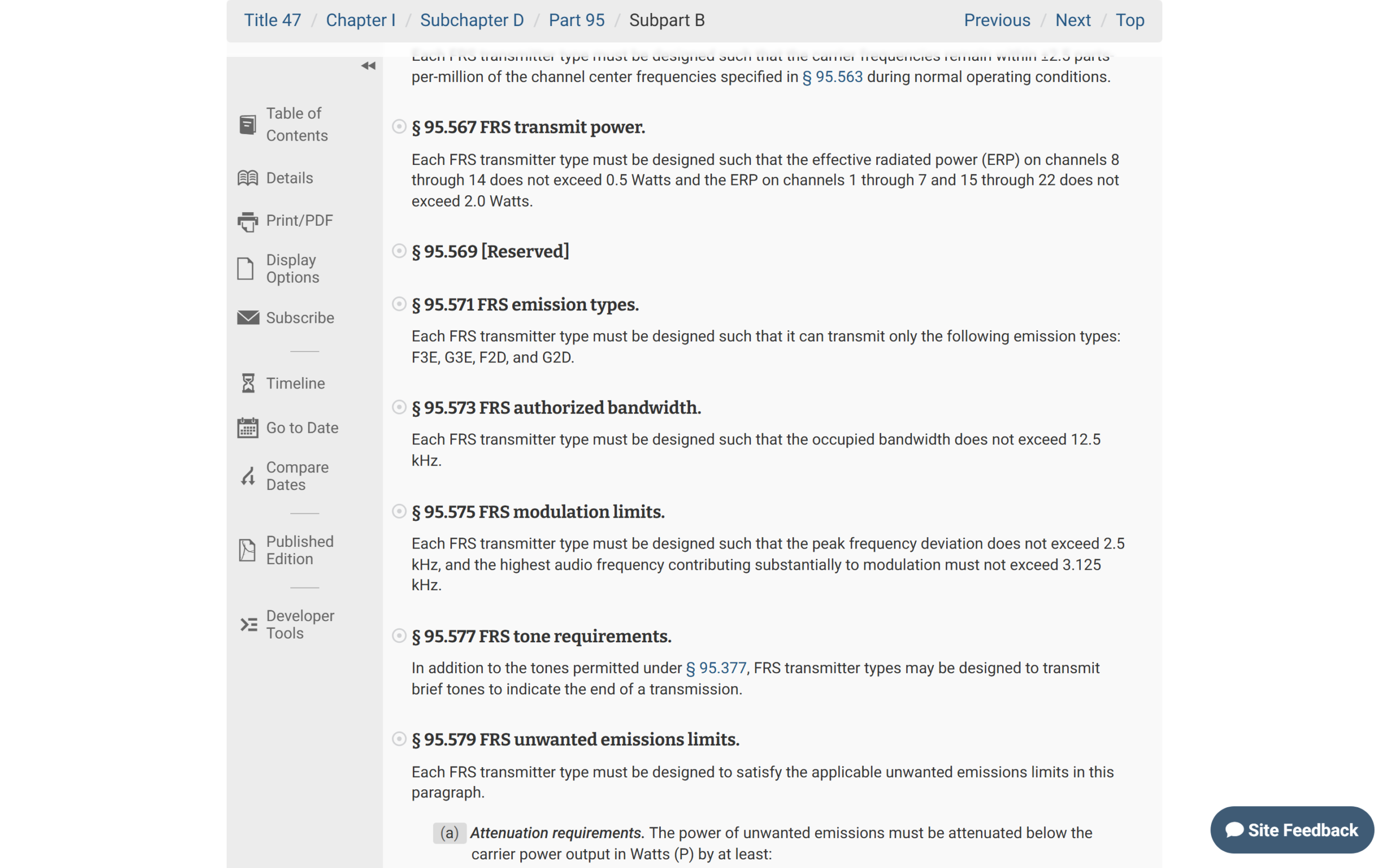
The technical box is tight. FRS has 22 channels, each 12.5 kHz wide, in two groups around 462 MHz and 467 MHz. Section 95.567 caps effective radiated power at 0.5 watts on channels 8 to 14 and at 2.0 watts on channels 1 to 7 and 15 to 22. Section 95.587 requires the antenna to be a non-removable, integral part of the radio and forbids an FRS radio from being capable of transmitting on any other frequency. That last rule is why an FRS radio cannot be modified into something more powerful and still count as FRS.
United States: GMRS is the licensed neighbour
All 22 FRS channels are shared with the General Mobile Radio Service (GMRS). GMRS allows much more: section 95.1767 permits up to 50 watts of output for mobile, repeater and base stations on the main channels. The price of that power is paperwork. Section 95.1705 states that a valid individual licence is required to operate a GMRS station, that applicants must be at least 18, and that fees apply under the FCC’s Part 1 rules. GMRS users must also transmit their FCC call sign at the end of a transmission and at least every 15 minutes during long ones. An FRS radio may talk to a GMRS station, but buying a “GMRS” radio and using it without the licence is not license-free use.
Europe and the UK: PMR446
In Europe the equivalent service is PMR446, harmonised by CEPT, the conference of European postal and telecommunications administrations, whose 46 member countries include all the EU states as well as the United Kingdom, Norway, Switzerland and Türkiye. Its current rule is ECC Decision (15)05, approved on 3 July 2015 and amended on 2 March 2018. The decision designates the band 446.0 to 446.2 MHz, requires that all PMR446 equipment is hand portable with an integral antenna only, limits effective radiated power to 500 mW, and excludes any base station, repeater or fixed infrastructure use. It tells member administrations to exempt PMR446 equipment from individual licensing and to permit its free carriage and use. CEPT’s implementation template sums it up as no registration or notification required, “commonly known as licence exempt”.
Two smaller rules affect buyers. A PMR446 radio must be able to receive, not only transmit, and a radio whose talk button can latch on must cut its own transmission after 180 seconds. Compliance is shown against the harmonised standard ETSI EN 303 405.
| Rule | FRS (United States) | PMR446 (EU, UK and other CEPT countries) | GMRS (United States) |
|---|---|---|---|
| Licence needed | No individual licence | Exempt from individual licensing | Yes, individual FCC licence, age 18+ |
| Frequencies | 22 channels, 462.5500 to 467.7125 MHz | 446.0 to 446.2 MHz | Shares all 22 FRS channels |
| Power limit | 2.0 W ERP (0.5 W on channels 8 to 14) | 500 mW ERP | Up to 50 W output for mobile, base and repeater stations |
| Antenna | Integral, non-removable | Integral only | Set by the GMRS rules in Subpart E |
| Station types | Low power hand-held radios | Hand portable only, no base station or repeater use | Mobile, base and repeater stations allowed |
| Rulebook | 47 CFR Part 95, Subpart B | ECC Decision (15)05, ETSI EN 303 405 | 47 CFR Part 95, Subpart E |
Can you use a US FRS radio in Europe, or a PMR446 radio in the US?
Not within either licence exemption, and the regulators’ own texts show why. The two services do not even overlap: the lowest FRS channel sits at 462.5500 MHz, more than 16 MHz above the top of the PMR446 band at 446.2 MHz. A US radio and a European radio therefore cannot talk to each other at all, whatever the box says about range.
A US FRS radio in Europe. The FCC’s authority stops where another government’s begins. Section 95.307 lists where Personal Radio Service stations may be operated and, for the rest of the world, excludes areas where radio is regulated by a foreign government, adding in brackets “You are subject to its rules.” On the European side, ECC Decision (15)05 exempts equipment in 446.0 to 446.2 MHz at no more than 500 mW. An FRS radio transmits only on 462 and 467 MHz and may run up to 2.0 W, four times the PMR446 limit, so the PMR446 exemption does not cover it. In plain terms: the radio you bought in the US is not license-free in Paris, Berlin or Manchester. Leave it at home, or keep it switched off.
A PMR446 radio in the US. The reverse fails for a similar reason. FCC section 95.335 says no one may operate a transmitter in any Personal Radio Service unless it is certified for that service, and section 95.587 says an FRS radio must not be able to transmit outside the 22 FRS channels. A radio built for 446 MHz cannot meet that, so it cannot be used as an FRS radio. Section 95.391 also forbids importing or selling non-certified Personal Radio Service equipment, which is why an EU model is not simply an FRS radio sold under a different label.
The practical lesson for travellers and for companies with sites on both continents is simple: buy the radio for the country where it will be switched on. Retevis makes this easy with the RB48 family, because the same body comes in an FRS version for the US and a PMR446 version for Europe, covered below.
One note on the future. CEPT’s working group on frequency management has an open work item, FM62_03, to revise Decision (15)05 so PMR446 radios may use 1 W effective radiated power. Its record lists the work as in progress, with a public consultation dated 30 October 2026 and a target date of 26 February 2027. Until a revised decision is published and adopted nationally, 500 mW is the limit.
Which license-free radios made the list, and how were they picked?
Our list of the best license-free walkie talkies covers radios sold on Amazon.com for the US Family Radio Service, plus a separate section for European and UK readers. Every new product we recommend had to pass our own bar on October 11, 2026: at least 200 ratings and at least 4.2 stars on Amazon.com. The Retevis RB48 is the exception to the ratings bar, because it is the radio we have already reviewed in depth and the listing we link sells it as a 10-pack, which collects fewer ratings than a pair. We describe each radio from its maker’s pages, its Amazon listing and the regulators’ rules, not from a hands-on test, and we say so where it matters.
| Radio | Best for | Service | Channels | Notable feature | Amazon rating, October 11, 2026 |
|---|---|---|---|---|---|
| Retevis RB48 | Work sites, warehouses, schools | FRS (US) | 22 | IP67, MIL-STD-810H claim, glove-sized PTT | 4.5 stars, 111 ratings |
| Retevis RT22 (4-pack) | Events, venues, ushers | FRS (US) | 16 | Pocket size, short thumb-length antenna | 4.5 stars, 4,681 ratings |
| Midland LXT500VP3 | Hikes, camping, family trips | FRS (US) | 22 | Runs on its packs or AAA batteries | 4.3 stars, 4,425 ratings |
| Cobra ACXT1035R FLT | Paddling, boating, rain | FRS (US) | 22 | IP67 and floats, replays the last 20 seconds | 4.2 stars, 1,217 ratings |
| Retevis RB648 / RB648A | Work sites in the EU and UK | PMR446 | Not stated on the pages we read | 0.5 W, IP67, shares RB48 chargers | Not linked |
The ranking weighs five things: whether the radio fits a named situation, how hard it is to break, how easy it is for someone who has never used a radio, what support the maker offers, and whether a team can add more of the same radio later without starting over.
Why is the Retevis RB48 the pick for US work sites?
The Retevis RB48 leads our best license-free walkie talkies because it takes the full FRS allowance and wraps it in a body designed for gloves, dust and drops, without asking anyone on the crew to hold a licence. Retevis’s own product page says the RB48 “is built on the FRS platform” and describes it as a heavy-duty 2W radio for jobsites, contractors and businesses. Two watts matches the FRS ceiling on the main channels, so the RB48 is not leaving legal power on the table.
Be precise about which version our link opens. It goes to the Amazon.com listing for the RB48 10-pack, and that listing names the frequency range as FRS with 22 channels. It is a US radio. The rest of the listing on October 11, 2026 promises what the existing review covered in detail: a MIL-STD-810H claim with 19 named tests, IP67 sealing, a large front talk button that works with gloves, vibration alerts, NOAA weather alerts and coverage of up to 300,000 square feet or 25 floors. The listing shows 4.5 stars from 111 ratings on Amazon.com when we checked on October 11, 2026. Our full Retevis RB48 review goes through the pack options, the owner reviews and the head-to-head with DeWalt, Motorola and Midland, so we will not repeat it here.
What this guide adds is the regulatory picture, and it favours the RB48 for US teams in three ways. First, FRS is defined by the FCC as covering business activities, so a site manager can hand these out without a licence. Second, because the antenna is fixed by rule, nobody can screw on a bigger antenna and drift out of the rules, which removes one compliance headache for a company. Third, the RB48 sits in a family: Retevis sells chargers, earpieces and speaker microphones that fit both the RB48 and its PMR446 sibling, the RB648, so a firm with crews in the US and Europe can standardise on one body and one set of accessories while buying the right radio for each country.
One honest difference between sources is worth knowing before you plan shifts. The Amazon listing says the 2000 mAh battery delivers up to 20 hours, while Retevis’s own product page says continuous use is up to 12 hours. Plan on the lower figure for a hard-working crew that talks a lot, and treat anything beyond it as a bonus. Retevis’s page also gives a communication distance of 2.3 km for the FRS version, which is a more realistic figure than the mile claims printed on many FRS boxes.
If your team is in the US and the job is a building, a yard or a campus, see the RB48 10-pack and its current price. If you only need two or four radios, read on, because the 10-pack is sized for a crew.
- Best for: US crews of about ten on one site who drop radios and wear gloves.
- Watch out for: sold as a 10-pack on our link, US only, battery life quoted differently by Amazon and Retevis.
Which radio suits events, venues and volunteer crews?
For event staff, ushers, stewards and volunteers, the Retevis RT22 is the better fit than a rugged work radio. Events need radios that disappear into a pocket, that a volunteer can pick up and use in a minute, and that are cheap enough that losing one at the end of the night is not a crisis. The RT22 is built around exactly that brief.
The Amazon listing for the four-pack describes a compact, lightweight radio that slips into a pocket or clips to a belt, a thumb-length antenna with a blunted angle that the maker says is safer around people, a detachable clip so the radio comes off the belt without the clip, a built-in 300 mW speaker and USB-C charging that lasts about 10 hours. It lists the frequency range as FRS and the channel count as 16, which is fine for an event: a stage crew, a gate crew and a medical team each need one channel, not twenty. The RT22 has the strongest crowd backing on this list, at 4.5 stars from 4,681 ratings on Amazon.com when we checked on October 11, 2026.
Because both radios are FRS, an RT22 and an RB48 can share a channel when they are set to the same channel and privacy code, which lets a venue give rugged RB48s to the loading dock and pocketable RT22s to front of house. Confirm the channel and code settings in both manuals before the event, since 16 channels on one radio and 22 on the other means not every channel exists on both. You can check the Retevis RT22 four-pack on Amazon.
- Best for: conferences, festivals, churches, school events and volunteer teams.
- Watch out for: water resistant rather than waterproof, a 2 mile maximum range on the listing, and 16 channels rather than 22.
Which radio suits hikes, camping and days on the water?
For hiking, camping and family trips, the Midland LXT500VP3 is the more sensible pick than either Retevis radio, for one reason: batteries. Its Amazon listing says it runs on the included rechargeable packs or on four AAA alkaline batteries, so a weekend away from a socket does not end the conversation. A rechargeable-only radio is the better buy for a crew that returns to a charging shelf every evening; a radio that also takes shop batteries is the better buy for a trail.
The rest of the listing fits family use. It has all 22 FRS channels with channel scan, a keypad lock with silent operation, and a box with two radios, two rechargeable packs, a desktop charger, a wall adapter and belt clips. It held 4.3 stars from 4,425 ratings on Amazon.com when we checked on October 11, 2026. The listing’s 24-mile range claim applies, in its own words, to open areas with little or no obstruction, which on a forested trail is not where you will be; see the range section below. If it suits your group, you can see the Midland LXT500VP3 pair on Amazon.
Near water: Cobra ACXT1035R FLT
Kayaks, canoes, fishing boats and rainy campsites call for a radio that survives a dunk and is easy to find afterwards. The Cobra ACXT1035R FLT is listed as IP67 waterproof and floating, with 22 channels and 121 privacy codes, NOAA weather channels and two features that matter outdoors: Rewind-Say-Again, which replays the last 20 seconds of incoming audio when wind or water noise swallowed a call, and a “burp” function that pushes water out of the speaker grille after a full submersion. It had 4.2 stars from 1,217 ratings on Amazon.com when we checked on October 11, 2026, which clears our bar but only just, so expect more mixed reviews than on the Retevis and Midland radios. You can check the Cobra ACXT1035R FLT on Amazon.
All three of these are FRS radios. The same travel rule applies to them as to the RB48: they belong in the United States, not on a hiking holiday in the Alps or the Lake District.
What should readers in the EU and the UK buy instead?
Readers in the EU, the UK and other CEPT countries should buy a PMR446 radio, and for anyone who liked the RB48 the obvious candidate is its own sibling. Retevis’s product page describes the RB648 as a PMR446 heavy-duty radio rated at 0.5W for jobsites, contractors and businesses, with IP67 sealing, a 2000 mAh battery for about 12 hours of continuous use, a two-metre drop rating, dual talk buttons that work with gloves and vibration alerts. Retevis’s chargers, earpieces and speaker microphones are sold as fitting both the RB48 and the RB648, which suggests the two share the same body.
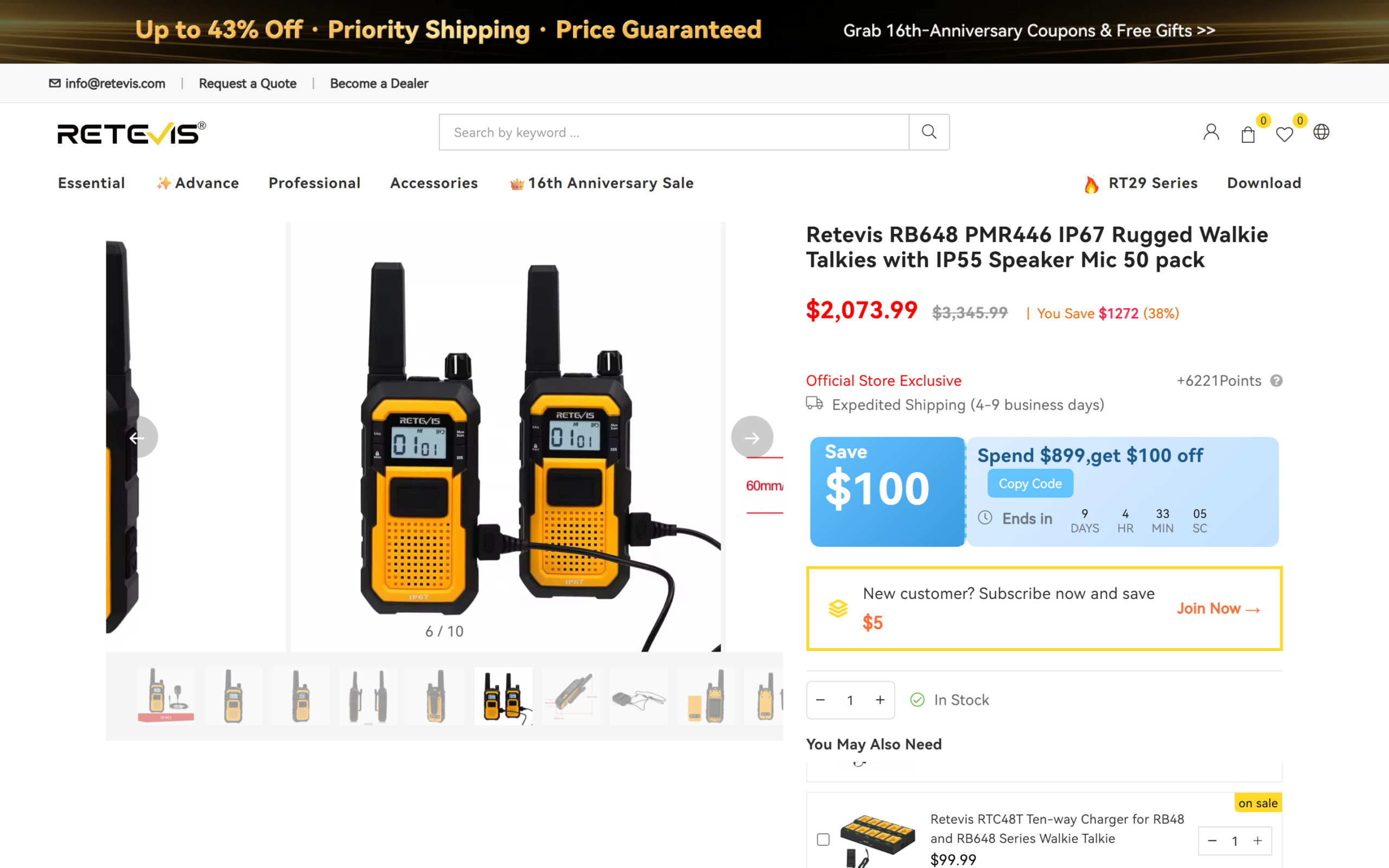
Retevis also lists a newer RB648A, described as built on the PMR446 platform, with two-way noise reduction, IP67 protection, resistance to 1,000 drops from two metres, up to 12 hours from a 2000 mAh battery and a floating design. Its page gives unusually honest range figures: about 0.8 to 1.6 km in urban areas, 1.2 to 1.9 km in suburban settings and up to 3 km in open outdoor areas. Those are the numbers to plan with in Europe, where PMR446 is limited to a quarter of the power FRS allows on its main channels.
We have not linked these models, because our affiliate links run through Amazon.com and we could not verify a European listing to the same standard on October 11, 2026. When you shop, look for three things in the listing: the word PMR446, the 446 MHz band and a CE mark. Avoid any radio sold in Europe that advertises FRS, GMRS, removable antennas or several watts of output; those are signs that it was built for a different rulebook.
For UK readers, PMR446 sits inside the UK’s own framework. Ofcom made the Wireless Telegraphy (Exemption) Regulations 2021, which exempt from licensing equipment that complies with Ofcom’s published interface requirements, and the UK remains one of CEPT’s 46 member countries. Ofcom’s own PMR446 page could not be loaded by our tools on October 11, 2026, so read it before buying anything unusual, such as a radio with an external antenna socket.
For the full rules text, read CEPT’s record of ECC Decision (15)05 on PMR 446, which links the decision itself.
What range should you expect, and which mistakes cost the most?
Even the best license-free walkie talkies reach hundreds of metres to a few kilometres, not tens of miles. The FCC describes FRS as a short-distance service, and box claims of 24, 30 or 37 miles describe ideal line-of-sight conditions that almost nobody uses a walkie talkie in. The RB48’s maker quotes 2.3 km for its FRS version and 2 km for the PMR446 version, and Retevis’s RB648A page gives 0.8 to 1.6 km in a town. Buildings, trees, hills and the body of the person holding the radio all cut that further. If you genuinely need many kilometres through terrain, you are shopping for GMRS with an FCC licence in the US, not for a stronger license-free radio, because the license-free power limits are fixed by rule.
The FCC’s FRS rules in 47 CFR Part 95, Subpart B are short and readable, and worth ten minutes for anyone buying radios for a business.
Five mistakes we see with license-free radios
- Buying for the wrong continent. FRS and PMR446 do not overlap in frequency and neither exemption covers the other’s radios. A US radio will not talk to a European one.
- Buying a GMRS radio for “more range” and skipping the licence. FCC rules require an individual GMRS licence for anyone 18 or over, plus a call sign on air.
- Trusting the box range. Plan on the maker’s realistic figures, like the RB648A’s urban 0.8 to 1.6 km, not on the headline miles.
- Mixing radios without checking channels. A 16-channel radio and a 22-channel radio share only the channels both have, and privacy codes must match too.
- Ignoring how you will charge. A crew with a charging shelf wants USB-C or a gang charger; a family on a trail wants AAA backup.
Frequently asked questions
Do I need a license for an FRS walkie talkie in the US?
No. FCC section 95.305 authorises people to operate Personal Radio Service stations without individual licences unless a service’s own rules require one, and the FRS rules do not. You can use FRS radios for family, recreation and business. GMRS is different: section 95.1705 requires an individual licence, available to people aged 18 or over.
Can I use my American walkie talkies on holiday in Europe or the UK?
Not legally under the European licence exemption. That exemption, ECC Decision (15)05, covers radios on 446.0 to 446.2 MHz at up to 500 mW with an integral antenna. FRS radios use 462 and 467 MHz and up to 2 W, and the FCC’s own rules defer to foreign governments abroad. Take PMR446 radios or rent locally.
Can I use a European PMR446 radio in the United States?
No. FCC rules allow only transmitters certified for a Personal Radio Service to be operated in it, and an FRS radio must not be able to transmit outside the 22 FRS channels. A radio built for 446 MHz does not meet that, and it could not talk to FRS radios anyway, because the bands are more than 16 MHz apart.
How many channels does PMR446 have?
The decision sets the channel plan rather than a channel count: analogue radios use 12.5 kHz spacing from 446.00625 MHz, and digital radios may use 6.25 kHz or 12.5 kHz. Across the 200 kHz band, that works out to 16 analogue channels of 12.5 kHz, or 32 digital channels at 6.25 kHz.
Is the Retevis RB48 available as a PMR446 radio?
Not under that name. The RB48 is Retevis’s FRS radio, and the Amazon.com listing we link names its frequency range as FRS. Retevis sells the RB648 and the RB648A as PMR446 heavy-duty radios with IP67 sealing and 2000 mAh batteries, and lists chargers and earpieces that fit both the RB48 and the RB648.
Can FRS radios talk to GMRS radios?
Yes. The FCC rules say FRS units normally talk to other FRS units but may also communicate with GMRS stations, and all 22 FRS channels are shared with GMRS. The FRS user needs no licence, but the person on the GMRS radio does, and must identify with an FCC call sign.
Will PMR446 radios get more power soon?
Possibly. CEPT has an open work item to revise ECC Decision (15)05 so PMR446 equipment may use 1 W effective radiated power, with a public consultation dated 30 October 2026 and a target date of 26 February 2027. Until a revised decision is adopted, 500 mW remains the limit.
Is this guide based on hands-on testing?
No. It is built from the FCC’s rules in 47 CFR Part 95, CEPT’s ECC Decision (15)05 and its records, the UK’s 2021 exemption regulations, Retevis’s own product pages and the Amazon.com listings, all read on October 11, 2026. Ratings and counts are the figures shown that day and will change.
Which license-free walkie talkie should you choose?
Choosing the best license-free walkie talkies starts with the country, then the job. In the United States, FRS is the license-free service, and the Retevis RB48 is our pick for crews on work sites, farms, schools and warehouses: full FRS power, IP67 sealing, glove-friendly controls and a body that Retevis also builds as a PMR446 radio. The Retevis RT22 is the better buy for event staff who need pocket radios, the Midland LXT500VP3 for hikers who want AAA backup, and the Cobra ACXT1035R FLT for anyone who might drop a radio in a lake.
In the EU and the UK, none of these is license-free. Buy a PMR446 radio such as the Retevis RB648 or RB648A, and expect a realistic range of one to three kilometres. Do not buy an FRS radio for European use, do not use a GMRS radio in the US without the licence, and do not buy any of these for long range through hills. For a US crew that needs ten tough radios with no paperwork, order the Retevis RB48 10-pack from Amazon and plan shifts around Retevis’s own 12-hour battery figure.
8.4 Score
Pros
- Uses the full FRS allowance of 2 W on the main channels, with no licence needed in the US.
- IP67 sealing, a MIL-STD-810H claim and a glove-sized talk button suit real work sites.
- Shares chargers and earpieces with the PMR446 RB648, so mixed US and EU fleets can standardise.
- Works on the same FRS channels as other FRS radios, such as the Retevis RT22 for front of house.
Cons
- FRS only: not covered by the licence exemption in the EU or the UK.
- Our link sells a 10-pack, too many radios for a family or a pair of hikers.
- Battery life is quoted as up to 20 hours on Amazon but up to 12 hours on Retevis's own page.
- Range is limited by FRS rules; long distance through terrain needs licensed GMRS.
Final Verdict
The Retevis RB48 is our pick among license-free walkie talkies for US crews: an FRS radio at the full legal power, sealed to IP67, easy to use with gloves and backed by a family of shared accessories. It is the wrong radio for Europe or the UK, where its PMR446 sibling, the RB648, is the one to buy, and it is sized for teams rather than families, who are better served by the Midland LXT500VP3 or the Retevis RT22.