

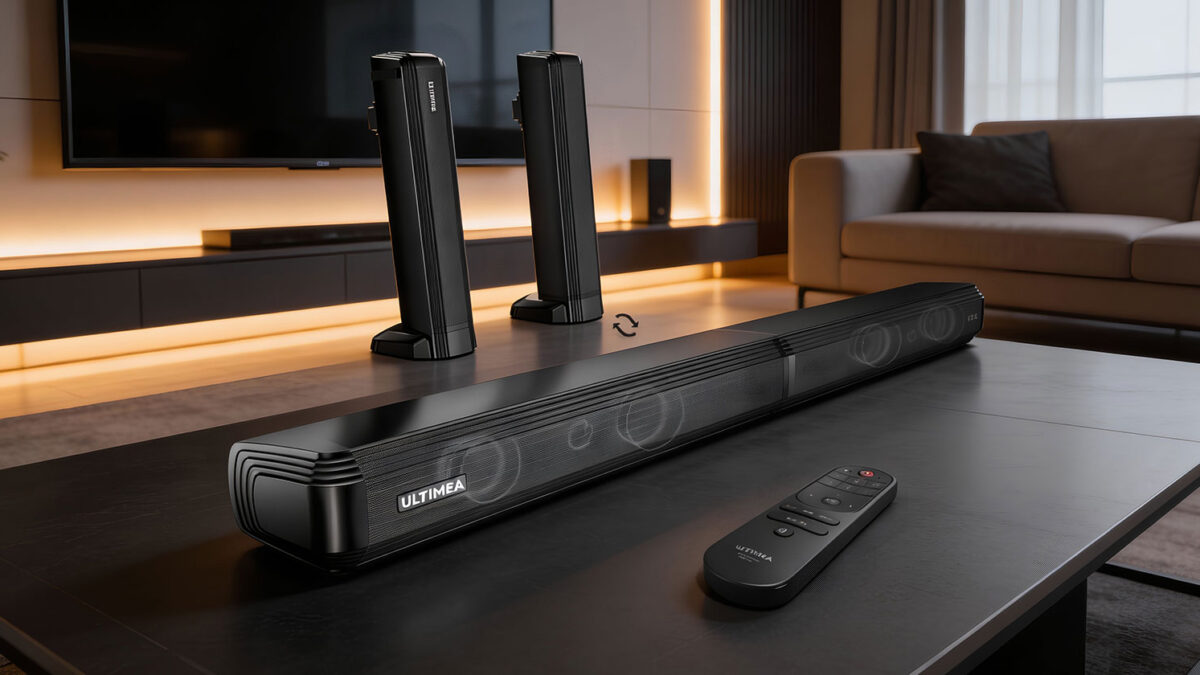
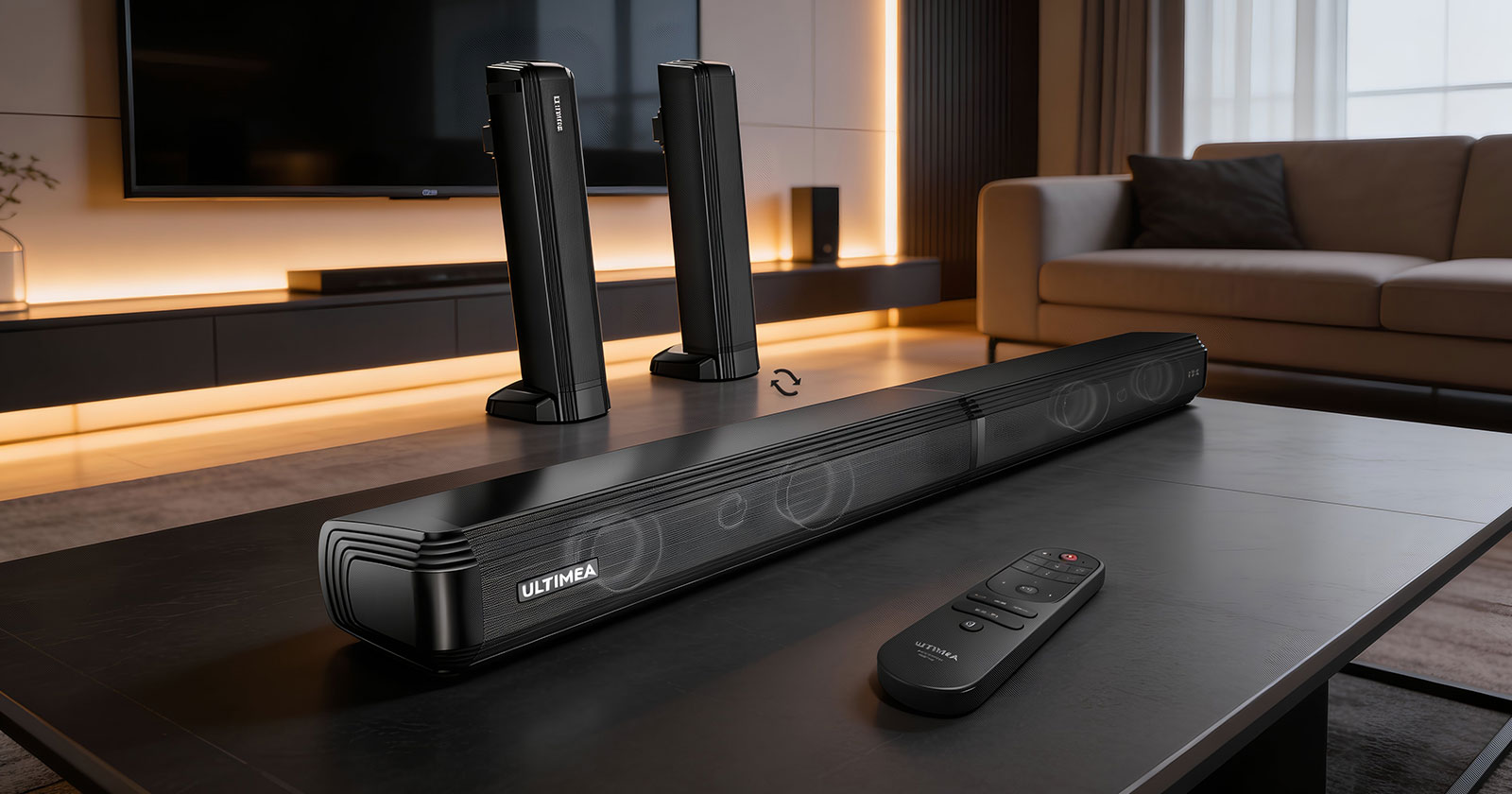
Ultimea Apollo S40 Soundbar Review: A Detachable 2.2 Setup That Actually Makes Sense?
As an Amazon Associate, TruePick earns from qualifying purchases.
Table of Contents
Ultimea Apollo S40 Soundbar Review: Quick Take & Who It’s For
A punchy, space-friendly TV audio upgrade, without the “fake surround” hype
If you’re looking at the Ultimea Apollo S40, chances are you’re in the most common audio situation on earth: you want your TV to sound better, but you don’t want a complicated receiver, rear speaker stands, or a living-room makeover just to hear dialogue clearly. The Apollo S40 goes after that exact problem with a very specific idea: a compact 2.2-channel soundbar that can be used as one bar or detached into two left/right speaker pieces, with built-in dual subwoofers and app control.
That detachable concept matters more than it sounds on paper. In small rooms, stereo separation is usually the missing ingredient with budget soundbars. A single bar under your TV often pushes everything into a narrow center blob. With the S40, you can keep it as one bar when space is tight, or split it into two pieces to widen the soundstage and make voices and effects feel less “stuck to the screen.” It won’t turn your room into a cinema, but it can make movies, sports, and console gaming feel noticeably more alive than TV speakers.
Just as importantly, the Apollo S40 aims to be friendly. HDMI ARC support (for one-remote control in many setups), Bluetooth streaming, optical input for older TVs, and simple EQ modes are the kinds of things that decide whether you actually enjoy using your soundbar after week two. Ultimea also leans on app-based tweaking (often branded as VoiceMX on listings) so you can adjust EQ and bass without playing “remote-control archaeology.” If you want a clean, modern-looking bar that stays out of the way but still adds real body to TV audio, the S40 is built for that.
If you want to check current pricing or availability for the Apollo S40 on Amazon, you can do that here: see the latest Apollo S40 deal on Amazon.
Who should buy the Apollo S40
- Small-to-medium room viewers who want clearer dialogue and fuller sound than built-in TV speakers.
- Apartment users who want bass presence without a huge external subwoofer dominating the room.
- People who hate clutter and prefer one simple bar, or the option to detach for wider stereo when it helps.
- Casual gamers who want better positional feel than TV speakers, without chasing true surround setups.
- Anyone upgrading an older TV who still needs optical input, but would like HDMI ARC if available.
Who should not buy it
- Surround purists who want rear channels, height effects, or “you can hear it behind you” immersion.
- Large open-plan rooms where you need serious output, a dedicated subwoofer, and better dispersion.
- Bass-first listeners who want chest-thump for action movies at high volumes (a compact 2.2 can only do so much).
- People with zero patience for tweaking if you expect perfect sound out of the box on every TV and every room.
Opening verdict
The Ultimea Apollo S40 is a smart “real life” soundbar: it prioritizes practical improvements (dialogue clarity, fuller mids, more bass body, wider stereo when detached) over big claims. It’s best viewed as a clean and flexible TV audio upgrade for normal rooms, not as a home theater replacement. If your expectations match that, it’s one of the more sensible detachable 2.2 options in the affordable category, especially for viewers who value an easy setup and a noticeably wider soundstage when split into two speaker pieces.
Apollo S40 Specs, Setup, and Real-World Performance
Quick specs overview (and what they mean in practice)
| Model | Ultimea Apollo S40 (also sold as Apollo S40 Pro in some regions/versions) |
| Channel configuration | 2.2 (stereo + dual built-in subwoofers) |
| Detachable design | Use as one soundbar, or split into two L/R speaker sections for wider separation |
| Peak output (listing-based) | Up to ~100 W (varies by listing/region) |
| Connectivity | HDMI ARC, Optical, AUX (3.5mm), Bluetooth (often listed as 5.3), sometimes USB depending on bundle |
| Controls | Remote + mobile app control (often branded VoiceMX on listings) |
| Sound modes | Commonly 3 EQ modes (movie/music/voice or similar), plus bass adjustment |
| Design details | Ultra-slim profile; listings commonly mention ~7 cm height; wall-mount support |
| Warranty (listing-based) | Often listed as 24 months (region-dependent) |
How to read these specs without getting misled
With budget soundbars, specs often look more confident than the real-world experience. The best way to interpret the Apollo S40 is to focus on its layout (2.2 with built-in subs) and its usability features (HDMI ARC, optical, Bluetooth, and app EQ). Those are the things that decide whether it will feel like a genuine upgrade on day one and day ninety.
The 2.2 configuration is important because it generally means you get more body than the typical “thin bar with tiny drivers” approach. The detachable design is important because it can create more stereo width than a single narrow bar under your TV. And HDMI ARC is important because it can make your life easier, volume control via the TV remote, power syncing in many setups, and fewer cable headaches.
Unboxing expectations: what you’re really buying
The Apollo S40 is designed to be a simple, self-contained system. In most packages, you can expect the soundbar (or detachable sections), a remote, power supply, and basic cables (often at least one of HDMI or optical depending on region), plus wall-mount hardware if the bundle includes it. The big “what you’re buying” reality is this: you’re not getting a separate subwoofer box. You’re getting a bar with built-in bass drivers that aim to add weight and warmth compared to TV speakers.
Setup guide: the fast path (and the common pitfalls)
Step 1: Use HDMI ARC if your TV supports it
If your TV has an HDMI port labeled ARC, that’s your first choice. HDMI ARC tends to be the simplest daily experience because it often enables one-remote volume control and can let the TV automatically switch audio output when the soundbar is on. If you run into sync issues or handshake weirdness, don’t panic, this is common across brands and TVs. A quick power cycle of the TV and soundbar, plus re-seating the cable, often fixes it.
Step 2: Use optical for older TVs or stubborn ARC behavior
Optical is the reliable fallback: it’s stable, it avoids a lot of HDMI handshake drama, and it usually “just works.” The trade-off is that you may lose some convenient control features depending on your TV, and you might need to use the soundbar remote more often.
Step 3: Decide whether to keep it as one bar or detach it
Here’s where the Apollo S40’s main feature becomes practical. If your TV stand is narrow, or you want maximum simplicity, keep it as one unit. If you can place the two sections wider, closer to the edges of your TV stand or shelf, you’ll often get better separation and a more open sound. Think of it like moving from “mono-ish TV sound” to “actual left/right presence.” It’s not magical, but it’s audible.
Step 4: Run a quick EQ check and bass sanity check
Many budget soundbars ship with a “showroom” tuning that emphasizes either bass or treble. Before you judge the S40, try its EQ modes and bring bass down one notch if it sounds boomy in a small room. A small room can amplify bass dramatically, especially if the bar sits close to a wall.
Sound Quality & BassMAX in Practice
Dialogue clarity: the thing most people actually care about
Let’s be honest: the main reason people buy a soundbar is dialogue. TV speakers fire downward or backward on many modern sets, and voices can get swallowed by background music. The Apollo S40 improves this in a few ways. First, it’s physically larger and purpose-built for forward-facing audio. Second, its EQ modes usually include a voice/dialogue-friendly option that boosts the midrange where speech lives. Third, when detached into two sections, the stereo image often becomes less congested, helping voices feel more distinct from effects.
In real viewing, news, YouTube, Netflix series, the improvement is typically immediate. You don’t necessarily get studio-monitor clarity, but you do get fewer “what did they say?” moments at normal volumes, and you can often reduce reliance on subtitles.
Music performance: better than TV speakers, but know the limits
For casual music listening, the Apollo S40 does a respectable job for a compact system. Bluetooth makes it easy to stream playlists, and the 2.2 layout tends to give music more body than ultra-cheap 2.0 bars. Vocals are generally fuller than TV speakers, and the built-in bass drivers can add warmth to pop and hip-hop.
The limit is scale and openness. A dedicated pair of bookshelf speakers, or a larger soundbar with a separate subwoofer, will sound bigger and more effortless. If you want background music while cooking or a quick party playlist without hauling speakers around, the S40 fits the job. If music is your main hobby and you want separation, imaging precision, and deeper bass extension, this isn’t the finish line.
Movies and “surround feel”: what it can and cannot do
The Apollo S40 is not a true surround system. It doesn’t have rear speakers, and it doesn’t create real behind-you effects the way a 5.1 setup can. What it can do is create a wider front stage, especially when detached. That makes action scenes feel less boxed-in and can give effects more left/right movement. Explosions and impacts also gain weight compared to TV speakers because of the built-in bass drivers.
In a small-to-medium room, this “bigger front sound” can be satisfying. Just don’t buy it expecting Dolby Atmos height effects or true wraparound immersion. It’s an upgrade in fullness and width, not a shortcut to cinema-grade surround.
Bass performance: pleasantly present, sometimes room-dependent
The built-in dual subwoofers (often marketed with names like BassMAX/BassMX depending on product family) are a key selling point. They won’t hit the deepest sub-bass you’d get from a separate subwoofer, but they do add punch and warmth that TV speakers simply can’t deliver. In many living rooms, that translates to more impact in action scenes and fuller sound for sports and live events.
However, compact soundbars are sensitive to placement. If the bar sits inside a TV cabinet cubby, bass can sound boomy or “boxy.” If it sits on an open stand, it often sounds cleaner. If you’re in an apartment, you’ll likely appreciate that you can dial bass down while still keeping voices clear.
Connectivity & App Control
HDMI ARC: the daily convenience feature
HDMI ARC is one of those features you only appreciate after you live with it. In many setups, it lets you control the soundbar volume using your TV remote, and it can power on/off along with the TV. That means fewer remotes on the couch and fewer “why is there no sound?” moments when someone else in the household uses the TV.
If you want a deeper technical explanation of HDMI ARC and what it does, an authoritative overview can be found via the HDMI organization: HDMI.org. (This is also useful when you’re troubleshooting whether your TV port is ARC/eARC and what cables are appropriate.)
Optical and AUX: compatibility for older TVs and simple setups
Optical is the compatibility hero. If you have an older TV, a projector, or a stubborn ARC implementation, optical often solves the problem instantly. AUX is there for basic analog connections, useful for older gear, but generally not the best choice if optical or HDMI is available.
Bluetooth: convenience, not a high-end codec playground
Bluetooth is great for quick music streaming and podcasts. On budget soundbars, Bluetooth is usually about convenience rather than audiophile codecs. Expect stable pairing and decent everyday sound, not the last word in detail.
App control: the difference between “fine” and “dialed in”
The S40’s app control (often presented under VoiceMX branding on listings) is more useful than it sounds. Why? Because rooms are different. Your TV placement, walls, furniture, and listening distance all change the sound. Being able to adjust EQ and bass without cycling through tiny remote buttons makes it more likely you’ll actually tune it to your liking.
A practical tip
For movies and series, start with the “movie” or “voice” EQ and reduce bass if dialogue sounds muddy. For music, try the “music” EQ and adjust bass to taste. A small change can turn “boomy and harsh” into “balanced and enjoyable.”
Long-Term Use & Reliability
Build quality: budget product, but designed for daily handling
The Apollo S40 is built to be moved, split, and repositioned, so it needs to feel stable in daily use. In this class, you should expect mostly plastic housing with a metal grille or mesh front, and a compact footprint that’s easy to place. The detachable connection mechanism is the one area to treat with care: detach and reattach gently, don’t force it, and don’t twist aggressively. If you plan to detach it often, build a habit of doing it slowly and consistently rather than like you’re assembling gym equipment.
Remote and controls: simple is the point
Most users will live with the remote for quick changes and the app for deeper tuning. The best long-term experience usually comes from setting a “default mode” that works for most content and then only tweaking when needed.
Long-term expectations vs reality
Here’s the realistic way to judge reliability in budget audio: keep your expectations aligned with the price. The Apollo S40 is not a premium metal-and-wood system meant to last a decade of heavy use in a busy commercial space. It is a home soundbar designed for normal living rooms. Treat it reasonably, give it good ventilation, avoid max volume for hours at a time, and it’s likely to serve you well for typical TV and music use.
Value for money: where the Apollo S40 makes the most sense
The Apollo S40’s value proposition is strongest when you compare it to the common alternatives in the same budget range: ultra-cheap single-bar 2.0 soundbars with weak bass, or “surround-ish” bars that claim a lot but don’t give you real separation. The S40 offers a meaningful step up via its 2.2 layout and detachable design, plus the modern conveniences that make it easy to live with.
If you’re price shopping, it’s worth checking the current Amazon price because this model tends to move around depending on promos: check the Apollo S40 current price on Amazon.
Real-world usage scenarios (detailed)
Scenario 1: Netflix series in a small living room (the “dialogue test”)
You’re watching a series where characters whisper, background music swells, and explosions show up every few minutes. TV speakers often force you into a constant volume chase: turn it up for voices, turn it down for action. With the Apollo S40, the practical win is midrange presence and a voice-friendly EQ option. You set a comfortable baseline volume and get clearer speech without needing subtitles every scene.
Detached placement helps here. If you can separate the left/right sections to widen the stage, the sound becomes less congested. The result isn’t just “louder,” it’s “more organized,” which is what most people interpret as clarity.
Scenario 2: Console gaming at night (impact without annoying everyone)
Gaming needs two things: positional cues and impact. The Apollo S40 can’t do true surround, but it can do a wider front stage when detached, which helps you perceive left/right movement more clearly than TV speakers. Meanwhile, the built-in bass drivers add punch to explosions and engine sounds, at reasonable volumes.
The night-time benefit is control. You can reduce bass to avoid rattling the room and still keep effects and voices present. That’s a big deal in apartments or family homes where you don’t want to wake anyone.
Scenario 3: Sports and live events (crowd noise without muddy commentary)
Sports broadcasts are brutal on TV speakers: crowd noise and stadium ambiance can swallow commentary. With the Apollo S40, a voice-focused EQ plus slightly reduced bass often gives you a more readable mix. Commentary becomes easier to follow without feeling like you’re listening to a tin can. The crowd still feels bigger, but not as smeared.
Common buying mistakes (and how to avoid them)
Mistake 1: Expecting real surround or “Atmos-like” height effects
A 2.2 soundbar is not a 5.1 or 7.1 system. Buy the Apollo S40 for clearer dialogue, fuller sound, and wider stereo (especially when detached). If you want true surround, you’ll need rear speakers or a higher-tier system.
Mistake 2: Putting it in a cabinet and blaming the soundbar
Placing any soundbar inside a tight cabinet can make it sound boxy and can exaggerate bass. Give it open space, avoid blocking the front, and keep it at the edge of the TV stand if possible.
Mistake 3: Using the wrong connection and missing the easy life
If your TV supports HDMI ARC, use it first. It often makes day-to-day use smoother. If ARC is problematic, optical is a perfectly good plan B.
Mistake 4: Judging sound before trying one EQ change
Room acoustics can make a soundbar seem harsh or boomy. Try the different EQ modes and adjust bass slightly before you decide. This is especially true in small rooms with reflective surfaces.
Mistake 5: Detaching it but placing the two sections too close together
Detaching only helps if you create real separation. If the two sections end up almost touching, you’ve basically rebuilt the same narrow bar. Spread them wider, within reason, and aim them toward the listening position if possible.
Alternatives, Buying Mistakes, FAQ, and Final Verdict
Alternatives (2–4 realistic options, depending on what you actually want)
Alternative 1: A true budget 2.1 soundbar with an external subwoofer
If your priority is bass impact for movies, a budget 2.1 system with a separate subwoofer can outperform built-in subwoofers for low-end extension. The trade-off is more clutter and more placement complexity. If you have the space and you want deeper bass, this route can be better than any compact 2.2 bar.
Alternative 2: Ultimea Poseidon D60 (step-up to real surround with satellites)
If you’re specifically chasing surround effects and you can handle a bit more setup, Ultimea’s Poseidon D60 line (where available) adds satellite speakers and a subwoofer for a more home-theater-like experience. It’s a bigger system, typically costs more, and needs more placement effort, but it’s closer to the “sound around you” feeling.
Alternative 3: A compact pair of powered bookshelf speakers
If music is equally important as TV, a pair of powered bookshelf speakers can deliver better stereo imaging and more natural sound than many budget soundbars. The downside is they don’t integrate as neatly under a TV, and you may lose some TV-remote convenience unless your TV setup is friendly to it.
Alternative 4: Entry-level soundbars from big brands (Samsung/LG/Sony) in the same price band
Big brands often offer excellent HDMI compatibility and polished user experience, but in the lowest price tiers you may get weaker bass or a narrower soundstage compared to what the Apollo S40’s detachable design can create. If your top concern is “it must work instantly with my TV’s ecosystem,” a major brand can be a safe choice.
Buyer guidance: how to decide in 60 seconds
- If you want simple setup + clearer dialogue + wider stereo in a normal room, the Apollo S40 fits.
- If you want deep bass for action movies, consider a 2.1 with an external subwoofer.
- If you want true surround, look at systems with satellites (5.1-class setups).
- If you want music-first sound quality, consider powered bookshelf speakers instead of a soundbar.
FAQ (minimum 5 questions)
1) Is the Ultimea Apollo S40 actually “surround sound”?
Not in the true sense. It’s a 2.2-channel system designed to create a bigger, clearer front soundstage. Detaching the bar into left/right sections can widen stereo, but it won’t create real rear-channel surround.
2) Should I use HDMI ARC or optical?
Use HDMI ARC if your TV supports it, because it often enables easier daily control (including TV remote volume in many setups). If ARC is unreliable on your TV, optical is a stable and good-sounding alternative.
3) Does the Apollo S40 have strong bass without a subwoofer?
It has noticeably fuller bass than most TV speakers and many basic 2.0 bars thanks to its built-in dual subwoofers. It won’t match the depth and slam of a dedicated external subwoofer, but for apartments and smaller rooms it’s often “enough” while staying controllable.
4) Is detaching it worth it?
If you can place the two sections wider than the typical single-bar position, yes. The improvement is usually a wider soundstage and a less congested mix. If your space forces the two sections to sit close together, the benefit is smaller.
5) Is the app required?
No, you can use the remote for basic control. The app is most useful for dialing in EQ and bass more comfortably. If you like tweaking sound to match your room, the app becomes a nice advantage rather than a requirement.
6) Will it work with a projector?
Often yes, as long as your projector has a compatible audio output (HDMI ARC is less common on projectors, but optical or AUX may be available depending on your model). In projector setups, optical can be the simplest stable connection.
7) Can it get loud enough for a medium room?
For typical TV watching in a small-to-medium room, it usually has enough volume headroom. For large, open rooms, you may hit the limits of a compact 2.2 bar, especially if you want both loudness and clean bass at the same time.
One more authoritative resource (optional but useful)
If you want a practical explanation of why dialogue clarity and EQ matter so much for TV and film mixes, Dolby’s educational resources can be helpful background reading: Dolby.com.
Final verdict (soft CTA, no hype)
The Ultimea Apollo S40 is at its best when you treat it like what it is: a flexible, affordable TV sound upgrade that’s designed for normal homes, not audio labs. It improves the things that frustrate most people, thin TV sound, unclear dialogue, and a narrow front stage, while keeping the setup approachable through HDMI ARC, optical fallback, and easy EQ control. The detachable design is the headline feature, and in a small-to-medium room it can genuinely help sound feel wider and more “room-filling” than a single compact bar.
If your goal is simple: better TV sound, cleaner voices, and a fuller overall presentation without building a full theater system, the Apollo S40 is a strong fit. And if you want to verify the current price before deciding, you can do that here: check Apollo S40 availability on Amazon.
8.3 Score
Pros
- Detachable design meaningfully widens stereo
- Clearer dialogue than most TV speakers
- Built-in bass adds warmth without extra subwoofer clutter
- HDMI ARC makes daily use easier
- App EQ helps tune sound to the room
Cons
- Not real surround; no rear-channel immersion
- Bass depth can’t match a dedicated external subwoofer
- Sound can get boomy if placed inside a cabinet
- Benefits of detaching are limited in very tight spaces
- Requires minor EQ tweaking to sound its best in some rooms
Final Verdict
The Ultimea Apollo S40 is a smart budget soundbar for people who want clearer TV dialogue, fuller sound, and a wider stereo stage without the hassle of a full surround setup. Its detachable design can genuinely improve separation in small-to-medium rooms, and HDMI ARC plus app EQ make it easy to live with. It’s not for surround purists or big-room bass seekers, but it’s an excellent everyday upgrade for typical living rooms and apartments.