



Short answer: Among zoominfo alternatives for a small sales team, Apollo.io is the best value, because it publishes its prices, starts free, and gives each paid seat 30,000 to 48,000 data credits a year plus sequences, a dialer and a light CRM, where ZoomInfo asks you to fill in a form before it will quote anything.
- Pick Apollo.io if one to ten reps need emails, phone numbers and outreach in one tool, and you want to see the price before talking to sales.
- Pick Lusha if you only need to reveal contact details inside LinkedIn and your CRM, with a small monthly plan and credits that roll over.
- Pick Amplemarket if you are a funded team replacing ZoomInfo and a sequencer together, and can commit to an annual term.
- Stay with ZoomInfo if you rely on its org charts, technographics and intent at enterprise scale and have the budget it quotes.
Apollo.io from $49 per seat/mo billed yearly ($65 monthly), Free plan with 900 credits a year; Lusha from $37.45/mo billed yearly; UpLead from $99/mo; Amplemarket from $600/mo on an annual term; ZoomInfo and Cognism publish no prices. Prices checked October 11, 2026.
Table of contents
Why do small teams look for zoominfo alternatives?
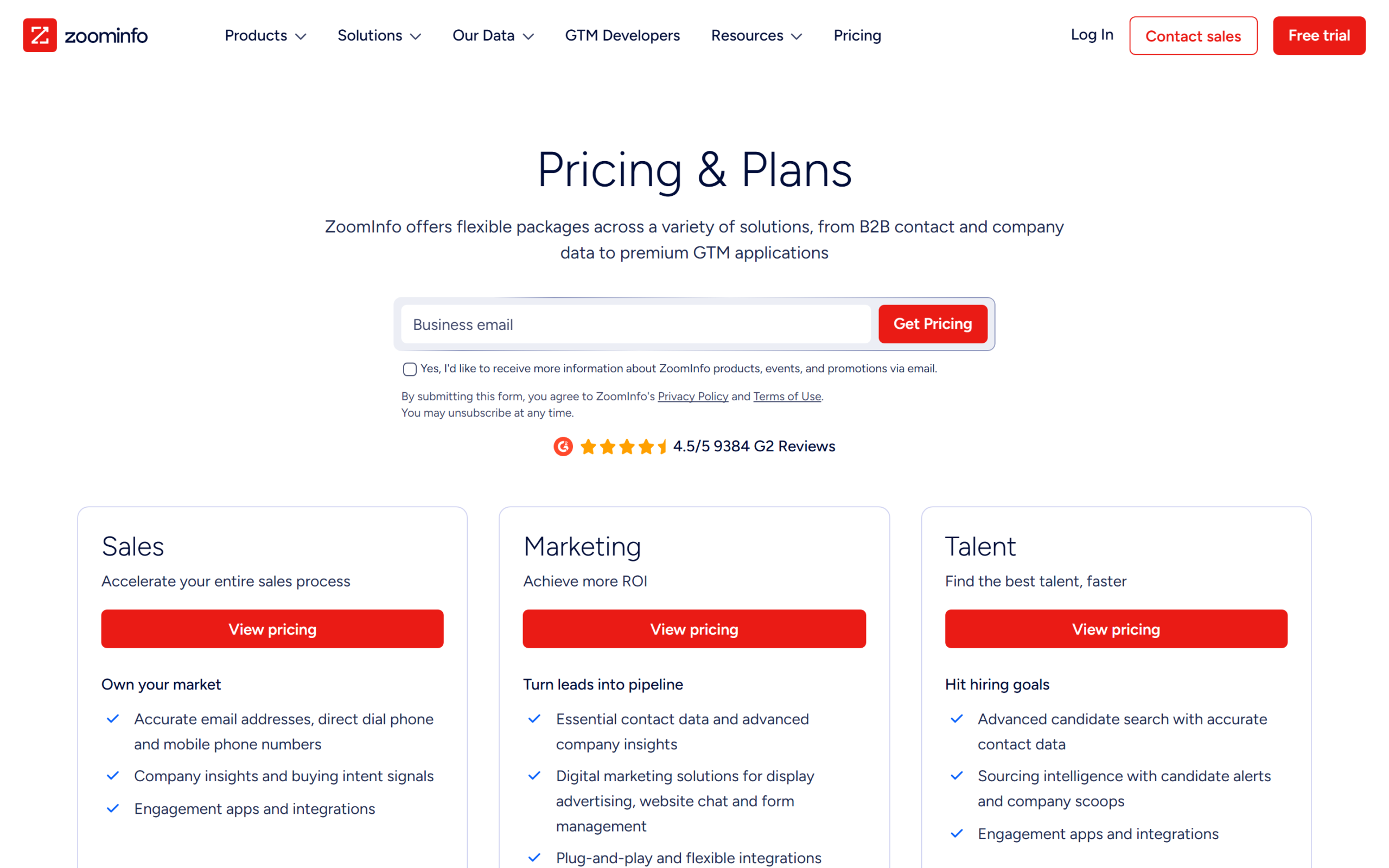
Small teams rarely leave ZoomInfo because the data is bad. They leave, or never sign, because they cannot see what it costs and because the contract is built for a sales organisation larger than theirs. ZoomInfo’s own pricing page, read on October 11, 2026, lists three sales packages, Professional, Copilot Advanced and Copilot Enterprise, each with a “Start free trial” button and a “Get Pricing” form, and no price for any of them.
The page’s FAQ explains why. ZoomInfo says pricing is based on features and functionality, the number of licences and credit usage, and that credits cost more when you want deeper data such as technographics, department budgets, org charts and real-time company alerts. A credit, in ZoomInfo’s words, is the export of one professional or company profile, whether it leaves through the platform, the Chrome extension or an integration’s API call. Integrations with CRMs and sales tools, the same FAQ adds, typically carry a base cost to install and require a minimum purchase of bulk credits.
None of that is unreasonable for a large revenue team. For a founder with two account executives, it means three things: a sales call before you know the number, a minimum commitment sized for someone else, and integration costs on top. The alternatives below are ranked for teams of one to about ten sellers who want contact data and, ideally, a way to act on it, without that process.
We judged each one on what it publishes: price, what a credit buys, whether credits roll over, whether there is a free way to test the data on your own accounts, and how much of the outreach work happens in the same tool. We have not run a head-to-head accuracy test across these databases, so accuracy figures below are the vendors’ own and are labelled as such.
How do the alternatives compare at a glance?
Four of the six tools publish a price and two do not. That single fact sorts the field before features do. The table summarises what each vendor’s pricing page said on October 11, 2026.
| Tool | Published entry price | Free way to test | What a credit buys | Outreach built in |
|---|---|---|---|---|
| Apollo.io | $49 per seat/mo billed yearly; $65 monthly | Free plan, 900 credits a year | Email 1 credit, phone 8 credits | Yes: sequences, dialer, CRM |
| Lusha | $37.45/mo billed yearly; $49.90 monthly | Free plan, 40 credits a month | Email 1 credit, phone 5 credits | Basic email sequences |
| UpLead | $99/mo for 170 credits | 7-day trial, 5 credits | 1 credit = 1 contact with email and mobile | No |
| Amplemarket | $600/mo on an annual term, 2 users | Free trial on every plan | Separate email and phone credits per user | Yes: sequences, dialer, AI |
| Cognism | Not published | Demo on request | 1 credit = 1 unlocked contact | No |
| ZoomInfo | Not published | Free trial | 1 credit = 1 exported profile | Engagement apps on higher packages |
Seamless.AI, another name that comes up in this search, also hides its price: its pricing link redirects to a “Pricing Inquiry” page offering special pricing for unlimited users and bulk credits. We left it out of the ranking for the same reason ZoomInfo frustrates small buyers.
What does one contact really cost on each platform?
The fairest way to compare data tools is the price of one revealed email and one revealed phone number at list price, because that is what you actually consume. Using each vendor’s published plan price and credit rules, the arithmetic looks like this.
| Plan | Price per year | Credits per year | Cost per email | Cost per phone number |
|---|---|---|---|---|
| Apollo Basic (1 seat, yearly) | $588 | 30,000 | About 2 cents | About 16 cents |
| Apollo Professional (1 seat, yearly) | $948 | 48,000 | About 2 cents | About 16 cents |
| Lusha Starter (yearly) | $449.40 | 4,800 | About 9 cents | About 47 cents |
| Lusha Pro (yearly) | $629.40 | 7,200 | About 9 cents | About 44 cents |
| UpLead Essentials (monthly x 12) | $1,188 | 2,040 | About 58 cents per contact, email and mobile together | |
| UpLead Plus (monthly x 12) | $2,388 | 4,800 | About 50 cents per contact, email and mobile together | |
Two cautions keep this table honest. First, a credit only has that value if you use it: Apollo grants yearly credits upfront and its pricing FAQ says unused credits expire at the end of the billing cycle and do not roll over. Lusha’s FAQ says annual plans also reset at the end of the cycle, while monthly plans roll unused credits over up to twice the monthly limit as long as you stay subscribed. A team that buys 48,000 Apollo credits and uses 10,000 has paid closer to 9 cents an email, not 2.
Second, the cost of a failed lookup differs. Lusha’s FAQ says seeing whether an email or phone exists costs nothing and a lookup that finds no match costs nothing. UpLead counts one credit per contact unlocked for download or CRM export, including the email and mobile direct dial. Apollo’s knowledge base article on credit usage lists every action that consumes credits, from email and phone reveals to waterfall enrichment, AI research and dialer minutes, and it is worth reading before you choose a plan size.
Why is Apollo.io the best fit for most small teams?
Apollo wins this list because it is the only option that combines a published price, a usable free plan, the lowest cost per revealed email and the outreach tools to act on the data, all in one seat. For a team leaving ZoomInfo, it replaces the data contract and often the sequencer as well.
What the plans include
Apollo’s pricing page lists Free at $0 with 900 credits per seat per year, granted monthly; Basic at $49 per seat per month billed annually with 30,000 credits per seat per year; Professional at $79 with 48,000 credits; and Organization at $119 with a three-seat minimum and 72,000 credits. On monthly billing, Basic is $65 and Professional $99, with 2,500 and 4,000 credits a month. Apollo describes its own database as 240 million contacts and 30 million companies.
Beyond the data, Basic adds unlimited sequences, CRM integrations, a deliverability suite with email warmup, five automated workflows and a US dialer that draws on credits; Professional adds A/Z testing, AI lead scoring, call recordings with AI insights and lifts sending limits. The plan comparison is specific on sending: Free and Basic allow one mailbox per user and 250 email sends a day, Professional and Organization allow unlimited daily sends.
Waterfall enrichment closes the coverage gap
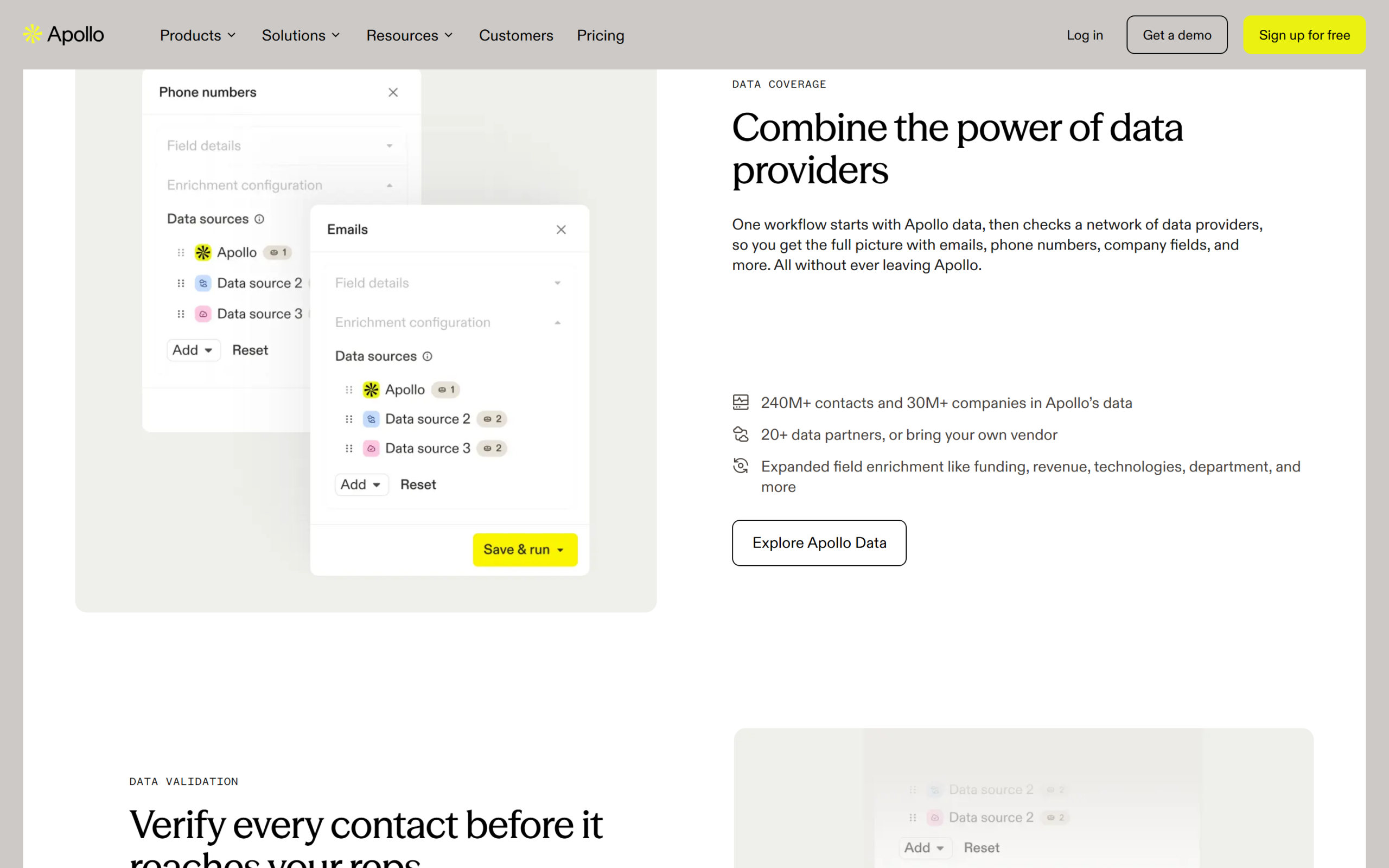
The feature that matters most against ZoomInfo is waterfall enrichment. Apollo’s product page says it enriches each record from its own data first and then checks more than 20 partner data providers in an order you set, for emails and phone numbers, with optional validation before the data reaches your reps. That answers the usual objection to a cheaper database, which is coverage: where Apollo has no number, a partner might, and you see the result in the same record. It is included from the Basic plan, according to the pricing page, and consumes credits as described in the knowledge base.
Where Apollo is weaker
Apollo is not ZoomInfo. It does not sell org charts and department budgets in the way ZoomInfo’s FAQ describes its deeper credits, its intent data is limited to 6 topics on Basic and Professional and 12 on Organization, and all seats on an account must sit on the same plan, according to its pricing FAQ. Annual plans cannot be switched to monthly mid-term, and downgrades take effect without refunds for unused time. Our Apollo.io review goes through the billing rules and the support complaints in detail.
When is Lusha the better choice?
Lusha is the better choice when your team does not want a new place to work. Alongside its own workspace, it reaches reps where they already are: a Chrome extension on LinkedIn and company websites, CRM integrations and an API.
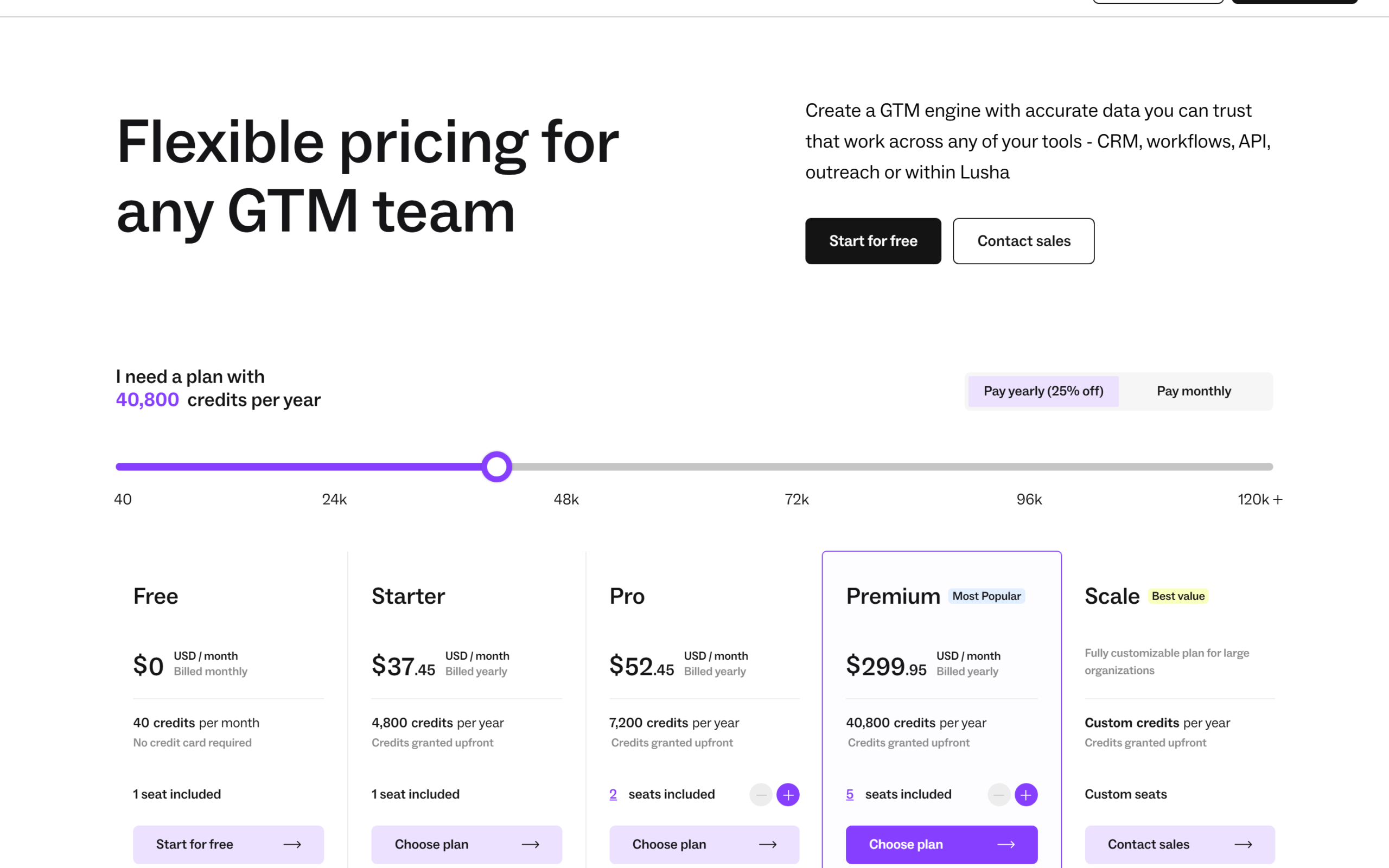
Lusha’s pricing page lists a permanent Free plan with 40 credits a month and one seat, Starter at $37.45 a month billed yearly with 4,800 credits a year, Pro at $52.45 billed yearly with 7,200 credits and two free seats, and Premium at $299.95 billed yearly with 40,800 credits and five free seats. Monthly billing is $49.90 for Starter with 400 credits a month and $69.90 for Pro with 600. The Lusha FAQ sets the credit rule plainly: a verified email costs 1 credit, a phone number 5, company information 1, and a lookup that finds nothing costs nothing.
Lusha describes its database as 515 million verified contacts and 29 million companies, and publishes its own accuracy figures: 98 percent for email and 85 percent for US phone numbers, by its account. Those are vendor numbers, but Lusha’s FAQ suggests testing them on your own list with the free credits before paying, which is the right way to judge any of these tools.
Where Lusha is weaker than Apollo is outreach: its Free plan lists automated email sequences, but it is not built to replace a sequencer with mailboxes, warmup and a dialer. If your team already runs outreach in a CRM or a sender, Lusha is the lighter purchase. If you need both, Apollo’s credits are cheaper per email.
Where do Amplemarket, UpLead and Cognism fit?
Amplemarket: the all-in-one replacement for ZoomInfo plus a sequencer
Amplemarket is the alternative for a team that wants to retire ZoomInfo and a sales engagement tool at the same time. Its pricing page lists Startup at $600 a month on an annual term with two users, 27,000 contacts, multichannel sequences, AI intent signals and the Duo Copilot assistant; Growth with four users and Elite with ten are quoted. Per user per year, Startup includes 13,500 email credits, 600 phone credits and two mailboxes, and the plan list adds an outbound dialer, workflows and deliverability tools. The same page lists customers as having migrated off ZoomInfo and Outreach.
At $7,200 a year for two users it is expensive next to Apollo, and the 600 phone credits per user on Startup are thin for a calling team. For a funded team of two to four sellers consolidating three subscriptions, it is a serious option; our Amplemarket review covers Duo and the plan differences, and you can book an Amplemarket trial on your own target accounts before agreeing to the annual term.
UpLead: pay per contact, month to month
UpLead is the simplest model on the list. Its pricing page lists Essentials at $99 a month for 170 credits and Plus at $199 a month for 400 credits, with extra credits at $0.60 and $0.50, and a 7-day trial with 5 credits. One credit unlocks one contact for download or CRM export, including the email and mobile direct dial, and UpLead’s FAQ says monthly plans have no contract. Plus adds data enrichment, technographics and advanced filters. It costs more per contact than Apollo or Lusha, but it suits a team that buys a few hundred carefully chosen contacts a month and wants no commitment.
Cognism: verified mobile numbers, by quote only
Cognism, like ZoomInfo, does not publish prices. Its pricing page, which served us the German version from Europe, describes two packages, Standard and Pro, each including five licences, with Pro adding verified mobile numbers, on-demand phone verification and intent data, and a CRM enrichment add-on. One credit equals one unlocked contact, browsing is free, and an unlocked contact can be reused across prospecting, enrichment and the API without another charge. With five licences in the entry package and a sales call to get a number, it is a better fit for a growing team than for a two-person startup.
Which one fits your team?
The right replacement depends on how many people need data and what they do with it next. Here are four common small-team situations, priced from the published lists on October 11, 2026.
A founder doing outbound alone. Apollo’s Free plan gives 900 credits a year and two sequences, enough to test the data on your market for nothing. When you outgrow it, Basic at $49 a month billed yearly adds 30,000 credits and unlimited sequences, though you will need Professional for more than one mailbox. Lusha’s Free plan at 40 credits a month is the alternative if you only want to look up a few people a week.
Two account executives who live in their CRM. Lusha Pro at $52.45 a month billed yearly includes two seats and 7,200 credits a year, with API, CSV enrichment and signals, and keeps the reps in their CRM and LinkedIn. Apollo Basic for two seats costs $1,176 a year with 60,000 credits, which is more data for more money; choose it if you also want Apollo’s sequences.
A team of five SDRs running cold email and calls. This is Apollo Professional’s home ground: five seats at $79 billed yearly come to $4,740 a year with 240,000 credits, unlimited daily sends, multiple mailboxes per rep, call recordings and A/Z testing. That replaces a data contract and a sequencer at once, which is why it is our pick. If you are ready, compare Apollo’s Basic and Professional plans against your current ZoomInfo quote.
A funded team replacing ZoomInfo and Outreach. Amplemarket’s Startup plan, or a Growth quote for four users, is worth a trial here, because the comparison is no longer data against data but three tools against one. Apollo Organization at $119 per seat with a three-seat minimum is the published alternative.
If your team already has the lists and only needs to send, a data platform is the wrong purchase; our guide to lemlist alternatives and how each one bills compares the senders instead.
What should you check before signing a data contract?
Whichever tool you choose, five checks protect a small team from the mistakes that make data contracts expensive.
Test on your own accounts first. Every tool here offers a free plan, a trial or a demo. Pull 30 to 50 contacts you already know are correct and see how many each tool finds and gets right. Vendor accuracy claims are averages over someone else’s market.
Size the plan to real usage. Count how many new contacts your team reveals in a typical month now. Credits that expire unused, as Apollo’s and Lusha’s annual credits do at the end of the cycle, raise your true cost per contact.
Read the term and cancellation rules. Apollo’s FAQ says cancellations take effect at the end of the plan term and annual plans cannot move to monthly mid-term. Amplemarket’s published plan is an annual term. UpLead’s monthly plans carry no contract.
Check who on the team needs a seat. Apollo requires every seat on an account to be on the same plan. Lusha includes extra seats on Pro and Premium. Cognism’s packages start at five licences. A team where only two people prospect should not pay for five seats.
Confirm the compliance paperwork. Lusha’s plan comparison lists GDPR, CCPA, SOC 2 and ISO 27701, and Apollo’s pricing page lists GDPR compliance. If you sell into regulated industries or Europe, ask each vendor for its data processing agreement before you load any data into your CRM.
Part of our outbound sales stack guide, which covers lead data, sequencing and deliverability together.
Frequently asked questions
What are the best zoominfo alternatives for small sales teams?
Apollo.io is the best overall for teams of one to ten sellers, because it publishes its prices, has a free plan, and includes sequences and a dialer. Lusha is the lighter choice for reps who work in LinkedIn and the CRM, UpLead suits month-to-month buying, and Amplemarket suits funded teams consolidating tools.
How much does ZoomInfo cost?
ZoomInfo does not publish prices. Its pricing page asks you to request a quote, and its FAQ says the price depends on features, the number of licences and credit usage, with integrations typically requiring a base cost and a minimum purchase of bulk credits. You will only know the number after a sales conversation.
Is Apollo.io data as good as ZoomInfo?
It depends on your market, and no independent test we trust settles it. Apollo lists 240 million contacts and adds waterfall enrichment from more than 20 partner providers when its own data has a gap. ZoomInfo offers deeper company data such as org charts and technographics. Test both on 30 to 50 accounts you already know.
Which ZoomInfo alternative has the cheapest phone numbers?
At list price, Apollo: a phone number costs 8 credits, which works out to about 16 cents on Basic or Professional billed yearly, against about 44 to 47 cents on Lusha’s yearly Starter and Pro plans, where a phone costs 5 credits. Unused credits change that math, so size the plan to real use.
Do Apollo and Lusha credits roll over?
Apollo’s pricing FAQ says unused credits expire at the end of each billing cycle and never roll over. Lusha’s FAQ says monthly plans roll unused credits over up to twice the monthly limit while you stay subscribed, but annual plans reset at the end of the annual cycle.
Is there a free ZoomInfo alternative?
Yes. Apollo’s Free plan includes 900 credits per seat per year, two sequences and Gmail sending, and Lusha’s Free plan includes 40 credits a month with one seat and no card. Both are permanent plans rather than trials, which makes them the cheapest way to test the data.
Does Amplemarket replace ZoomInfo?
For many small and mid-size teams it can, because it combines contact data, intent signals, multichannel sequences and a dialer. It starts at $600 a month on an annual term for two users, so it makes sense when it replaces ZoomInfo and a sequencer together, not as a cheaper data source.
Which of the zoominfo alternatives should you choose?
Choose Apollo.io if you are a small team that wants to see the price, test for free and get data, sequences and a dialer in one seat. It has the lowest published cost per revealed email and phone number on this list, and waterfall enrichment narrows the coverage gap that usually makes cheaper databases a false economy. Do not choose it if you need ZoomInfo-depth company intelligence, or if your reps will never leave their CRM, in which case Lusha is the lighter fit.
Choose Amplemarket only when you are replacing several tools at once, UpLead when you buy a few hundred contacts a month with no commitment, and Cognism when verified mobile numbers matter most and you can take a five-licence package. For everyone else, open a free Apollo account and test it on your best accounts before you take another ZoomInfo call.
8.5 Score
Pros
- Published prices and a permanent free plan, where ZoomInfo quotes only after a form.
- About 2 cents per revealed email at list price on Basic or Professional billed yearly.
- Sequences, a dialer, deliverability tools and a light CRM come in the same seat.
- Waterfall enrichment checks more than 20 partner providers when Apollo's data has a gap.
Cons
- Unused credits expire at the end of each billing cycle.
- Free and Basic cap sending at 250 emails a day and one mailbox per user.
- No org charts or department budgets of the kind ZoomInfo sells in deeper packages.
- Annual plans cannot switch to monthly mid-term, and every seat must be on the same plan.
Final Verdict
Apollo.io is the ZoomInfo alternative we would recommend to a team of one to ten sellers: it publishes its prices, starts free, has the lowest list cost per revealed contact here and bundles sequences and a dialer. Lusha is the lighter pick for reps who stay in LinkedIn and the CRM, and Amplemarket suits funded teams replacing several tools at once.