



Short answer: In the getresponse vs mailerlite choice, GetResponse is the better buy for most small businesses that send regularly, because its Starter plan costs less than MailerLite Comfort at every list size from 1,000 contacts and includes unlimited sending, and its higher plans add webinars, courses and ecommerce automation at prices that undercut MailerLite Power from 10,000 contacts. MailerLite wins when you need many automations on a small list, or a free plan that keeps running automations after the trial.
- Pick GetResponse if you send newsletters often, run one welcome series, sell online at 10,000 contacts or more, or want webinars and courses in the same account.
- Pick MailerLite if your list is under 5,000 and you want several automations without paying for a top tier, or you are starting from zero on a free plan.
- Skip GetResponse Starter if you need more than one custom automation workflow; skip MailerLite Comfort if you send more than ten emails per subscriber a month.
GetResponse at 1,000 contacts: Starter €16/mo or €13.12/mo billed yearly; Marketer €54/mo or €44.28/mo; Creator €62/mo or €50.84/mo; unlimited sends on all. Free plan: yes, 500 contacts and 2,500 messages a month. MailerLite at 1,000 subscribers: Comfort €17/mo or €183.60/yr; Power €35/mo or €378/yr; Free up to 250 subscribers. Prices checked October 11, 2026.
MailerLite Black Friday: 26% off any annual plan, on any list size, with a code entered at checkout, from 17 November until 18 December 2026. The discount lasts 12 months from the date you pay; monthly plans are not included, but a monthly customer can switch to an annual plan during the sale and get it. See the MailerLite Black Friday deal
Table of contents
How do GetResponse and MailerLite compare at a glance?
GetResponse and MailerLite are both hosted email marketing platforms priced by list size, but they are built for different buyers. GetResponse packages email with sales features: abandoned cart recovery, sales funnels, web push notifications, webinars and a course creator, spread across Starter, Marketer and Creator plans. MailerLite keeps every feature on every paid plan and charges more mainly for a bigger list or more sending, with Comfort and Power as its two paid tiers and a free plan underneath.
That difference shapes everything below. With GetResponse you choose a plan for the features you need, and the list size sets the price within that plan. With MailerLite you choose mostly for sending volume and automation count. Our separate GetResponse review and MailerLite review describe each tool in depth; this page puts them side by side for a small business deciding between the two. All prices are read from the two pricing pages on October 11, 2026 in euros, the currency both showed us; GetResponse’s FAQ also quotes Starter from $19 a month for 1,000 subscribers, and MailerLite’s US prices are shown on its page in dollars.
| GetResponse | MailerLite | |
|---|---|---|
| Paid plans | Starter, Marketer, Creator, Enterprise | Comfort, Power, Enterprise |
| Cheapest paid plan at 1,000 contacts | Starter, €157.44 a year (€13.12/mo) | Comfort, €183.60 a year (€15.30/mo) |
| Monthly sending | Unlimited on every paid plan | Comfort: 10 times your tier; Power: unlimited |
| Automation on the entry plan | Welcome series plus 1 custom workflow | 50 automations, up to 100 steps |
| Free plan | 500 contacts, 2,500 messages a month; automation publishing lost after 14 days | 250 subscribers, 2,500 emails a month, 3 automations |
| Users | Starter 3, Marketer and Creator 5 | Free 2, Comfort 3, Power unlimited |
| Webinars and courses | Creator plan: webinars for 100 attendees, courses for up to 500 students | No webinars; digital products, bookings and paid newsletters |
| Yearly billing discount | Up to 18% | 10% |
| Nonprofit discount | 50% on monthly plans for charities and NGOs | 30% on paid plans |
| Best for | Frequent senders, stores and course sellers | Small lists that need several automations |
Which is cheaper at your list size?
Price is where the getresponse vs mailerlite question gets interesting. For plain email marketing, GetResponse Starter is cheaper than MailerLite Comfort at every list size we checked, while for automation-heavy work MailerLite Comfort is cheaper than GetResponse Marketer at every size. Which comparison applies to you depends on how many automated workflows you really need. The table shows yearly billing, multiplied out to a full year.
| Contacts | GetResponse Starter | GetResponse Marketer | GetResponse Creator | MailerLite Comfort | MailerLite Power |
|---|---|---|---|---|---|
| 1,000 | €157.44 | €531.36 | €610.08 | €183.60 | €378.00 |
| 2,500 | €265.68 | €678.96 | €777.36 | €313.20 | €486.00 |
| 5,000 | €472.32 | €806.88 | €924.96 | €475.20 | €637.20 |
| 10,000 | €678.96 | €974.16 | €1,121.76 | €853.20 | €1,177.20 |
| 25,000 | €1,466.16 | €1,859.76 | €2,154.96 | €1,717.20 | €2,257.20 |
| 50,000 | €2,548.56 | €3,138.96 | €3,630.96 | €3,013.20 | €4,093.20 |
Starter against Comfort: the newsletter sender’s comparison
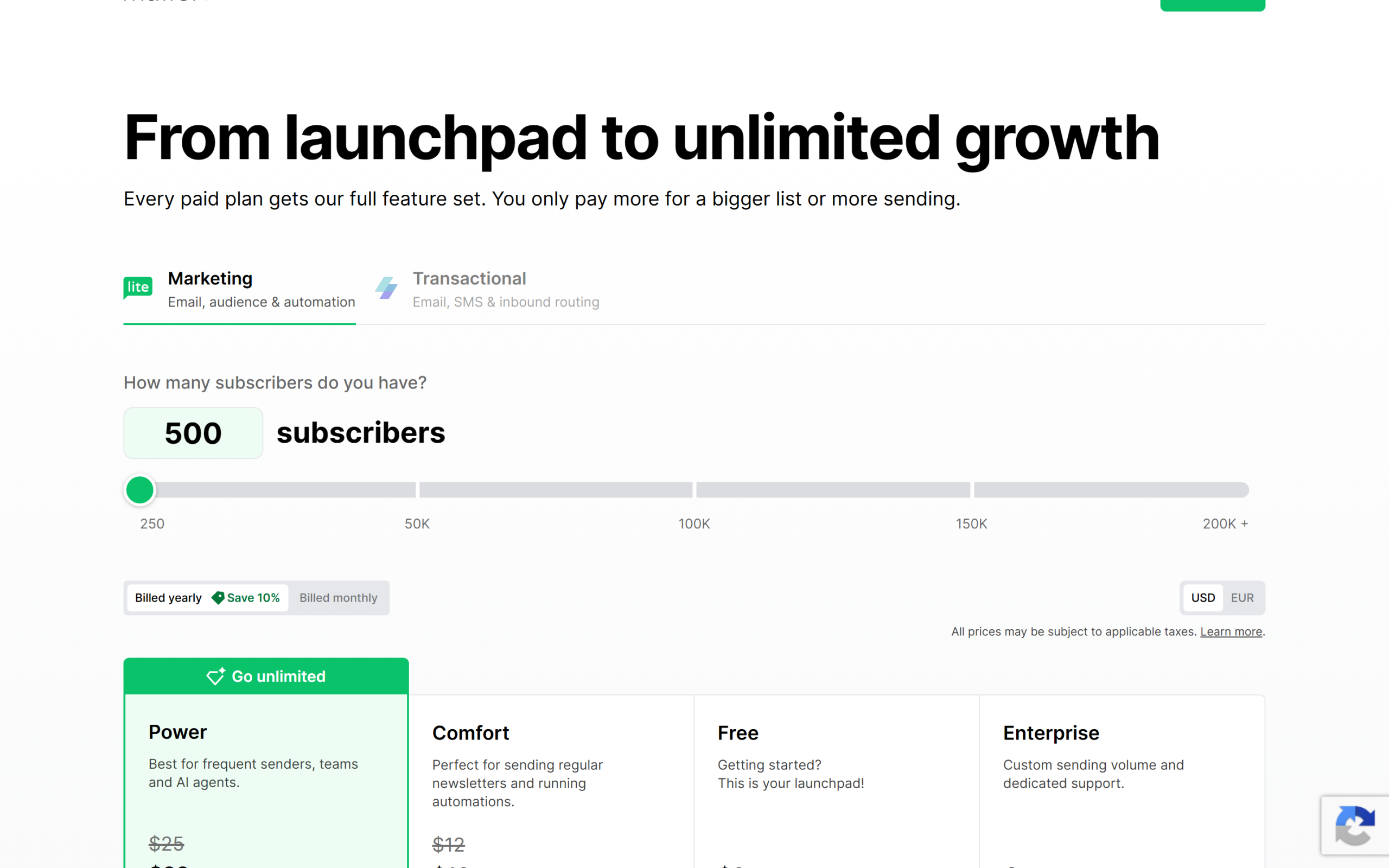
If you mostly send newsletters and one welcome series, compare GetResponse Starter with MailerLite Comfort. Starter is €26.16 a year cheaper at 1,000 contacts, practically level at 5,000 (€2.88 apart), and €174.24 cheaper at 10,000, widening to €464.64 at 50,000. Starter also includes unlimited monthly sends, while Comfort’s FAQ says you get ten times the top of your subscriber tier each month, so a 1,000-contact tier allows 10,000 emails. A business that emails its list twice a week will not hit that ceiling, but one that sends daily promotions will, and MailerLite’s answer is to move you to Power.
Marketer against Comfort and Power: the automation buyer’s comparison
If you need several automated flows, the honest comparison is GetResponse Marketer against MailerLite Comfort or Power, because Starter allows only one custom workflow. Here MailerLite wins clearly on small lists: at 1,000 contacts Comfort costs €347.76 a year less than Marketer and still gives you 50 automations. The gap narrows as the list grows, to €120.96 at 10,000 and €125.76 at 50,000. Against MailerLite Power, which is what an unlimited-sending, multi-trigger MailerLite user would buy, Marketer is cheaper from 10,000 contacts: €203.04 a year less at 10,000 and €954.24 less at 50,000.
Put simply: below about 5,000 contacts with lots of automation, MailerLite is the cheaper tool. Above 10,000 contacts, or at any size if you send a lot and automate little, GetResponse is. If that describes your list, price GetResponse at your exact contact count, since the slider moves in tiers and your number may sit just under a step. For a deeper look at MailerLite’s own tiers, our MailerLite pricing explainer goes plan by plan.
What do the free plans actually let you do?
GetResponse’s free plan holds more contacts, but MailerLite’s free plan keeps more of the useful features running once the trial ends. That makes MailerLite the better free tool for anyone who wants an automated welcome email from day one.
GetResponse Free
GetResponse’s help article on its free account says the free plan is free forever with no card, and lets you publish one landing page, send up to 2,500 newsletters a month and add up to 500 contacts, with unconfirmed and removed contacts counting toward that limit, which cannot be reset. For the first 14 days you also get premium features, which the same article lists as including scheduling newsletters, sending autoresponders, publishing automation workflows, conversion funnels, webinars and websites. After those 14 days the premium features go. In practice, that means a free GetResponse account can keep sending newsletters but cannot keep an automated welcome series running.
The 2,500 monthly message limit, according to GetResponse’s help centre, counts newsletters, autoresponders, A/B tests and automation messages, but not notification emails such as confirmations. Once you pass 500 contacts on Free, new contacts wait in a contact queue and are removed after 32 days if you do not upgrade.
MailerLite Free
MailerLite’s free plan covers up to 250 subscribers and 2,500 emails a month, with two user seats, three automations of up to five steps each, one website and one landing page, three signup forms and community support. The paid features are open for a 14-day trial with no card, and MailerLite says none of your data is removed when the trial ends. If your free account goes over 250 active subscribers, MailerLite locks campaigns and automations until you upgrade or remove contacts.
The verdict on free plans: GetResponse Free suits a newsletter-only list of up to 500 people; MailerLite Free suits a list under 250 that needs a welcome sequence or a lead magnet delivery working without paying.
How far does automation go on each plan?
MailerLite gives you more automation per euro at the entry level, while GetResponse’s Marketer plan goes further into ecommerce with abandoned cart recovery, sales funnels and promo codes. Both use a visual workflow builder with delays, conditions and actions.
GetResponse: plan decides what you can automate
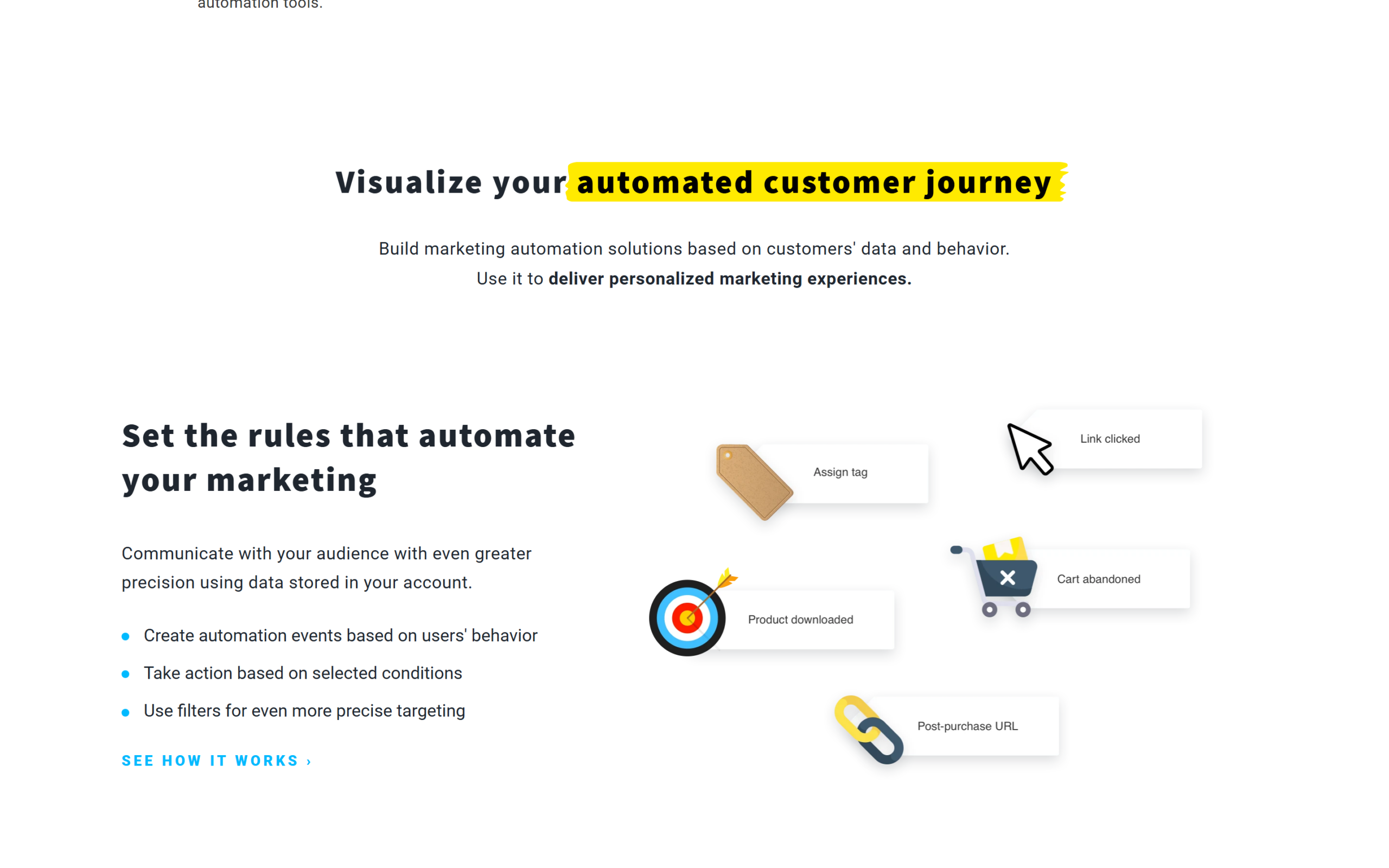
GetResponse’s plans are explicit about automation. Starter includes a welcome email series and one custom automation workflow. Marketer and Creator include unlimited automation workflows, advanced audience segmentation, abandoned cart recovery, sales funnels, promo codes and revenue reports, and unlimited web push notifications. GetResponse’s automation page describes workflows that react to behaviour, such as reaching cart abandoners or recommending products, and segments built from tracked actions and scores. Its comparison table also lists contact scoring and tagging, and segmentation based on contact details, actions, geolocation and scoring.
MailerLite: same features, more automations as you pay more
MailerLite’s automation trigger guide lists seven default triggers, joins a group, completes a form, clicks a link, updated field, joins a segment, event anniversary and exact date, plus e-commerce triggers. The pricing table shows ecommerce triggers, RSS campaigns and auto resend campaigns on every plan. The limits are quantity, not capability: Free allows three active automations of five steps, Comfort 50 automations of up to 100 steps, Power unlimited automations and up to three triggers per workflow.
For a small business, the deciding question is how many separate flows you run. A shop that needs a welcome series, an abandoned cart flow, a post-purchase thank you and a win-back flow is already past GetResponse Starter’s single custom workflow, and Comfort at 1,000 contacts costs a third of Marketer. A business that only needs the welcome series gets it on Starter at the lowest price of the four plans.
What happens when your list goes over the limit?
MailerLite upgrades you to the next tier automatically, while GetResponse either asks you to upgrade during an import or charges a list extension fee at the end of the billing cycle. The two companies also count contacts differently, which matters more than most buyers realise.
GetResponse’s help centre explains that it monitors active contacts and the total number of contacts added during the billing month. If you go over through signups on forms, landing pages and webinars, integrations, the API, manual additions or copying contacts between lists, it charges a list extension fee at the end of the cycle, and keeps charging it each cycle until you remove the excess contacts. The same article notes that one email address on several lists counts as several contacts. If you organise subscribers into many lists, that rule alone can push you into a higher tier.
MailerLite counts active subscribers once, excluding unsubscribed and bounced addresses, but uses a cumulative count within each billing cycle, so an address that was active at any point in the cycle counts even if you delete it. When a paid account exceeds its limit, the subscriber limit rises automatically and your card is charged for the next tier. The practical advice for both is the same: clean your list before your billing date, and in GetResponse prefer tags over duplicate lists.
Plan changes work differently too. GetResponse’s FAQ says upgrades take effect immediately and restart your billing cycle, while downgrades, including moving from annual to monthly payments, must be requested from support. MailerLite says in its FAQ that it can only apply one discount at a time.
What do you get beyond email?
GetResponse adds live tools for selling, such as webinars, courses and chat, while MailerLite adds publishing tools, such as websites, digital products and paid newsletters. Which set is more useful depends on how you sell.
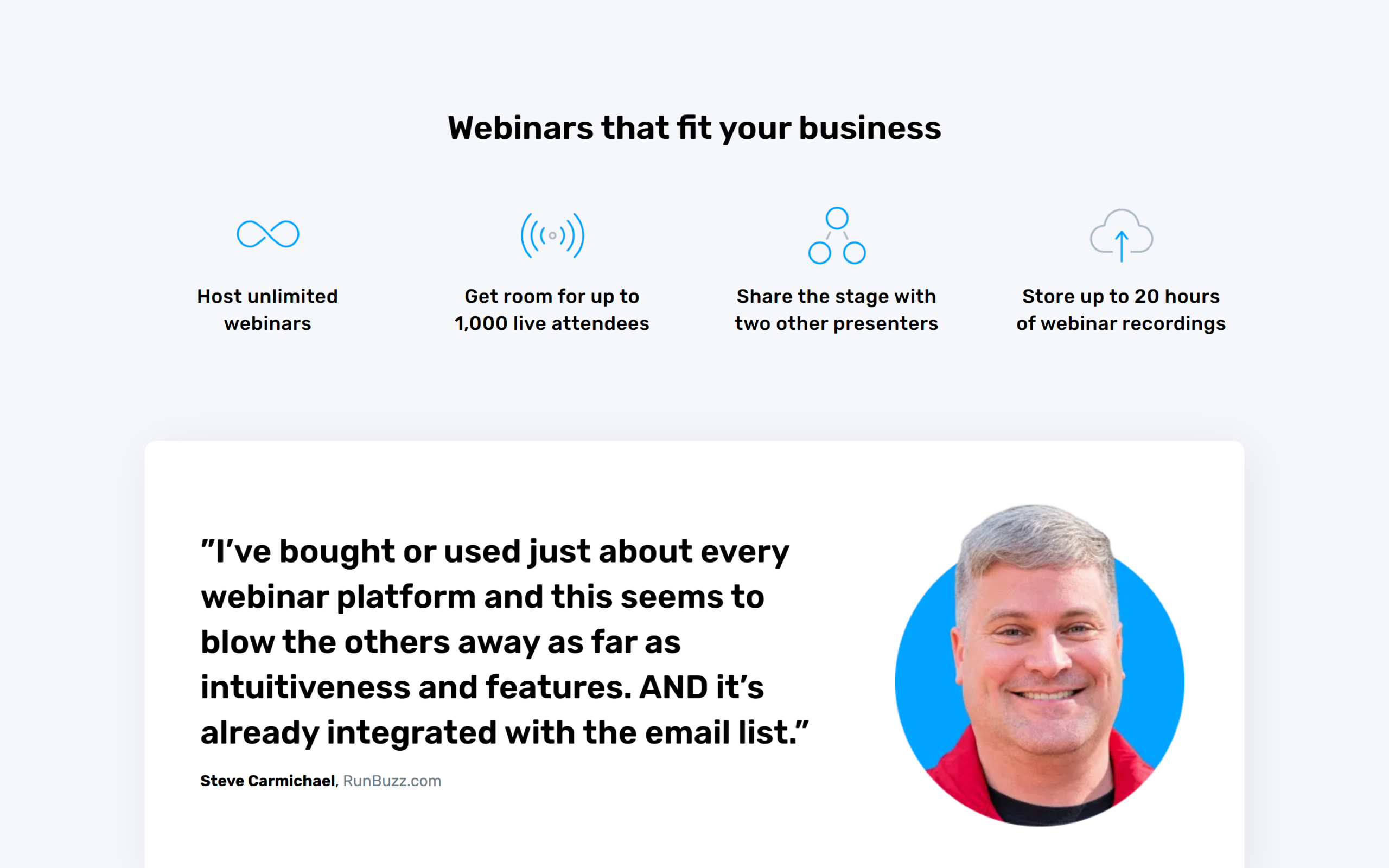
On GetResponse’s Creator plan, the comparison table lists live webinars for up to 100 attendees with three presenters and three hours of recording storage, a course creator for up to 500 students, premium newsletter subscriptions and a website builder. Enterprise raises webinars to 1,000 attendees and 20 hours of recordings, and adds SMS marketing, transactional emails, a dedicated IP address and single sign-on. Marketer and Creator also include unlimited web push notifications, and the comparison table lists GetResponse Chats with five seats on the plans that include it.
MailerLite includes websites with a blog section, landing pages, digital products and bookings, paid newsletters, recurring subscriptions, surveys and quizzes. The limits are counts: one website and one landing page on Free, ten on Comfort and unlimited on Power, with one, five or unlimited digital products or bookings. MailerLite also lists an MCP server and integrations for Claude and ChatGPT, with sending through the API and MCP reserved for paid plans. If you are weighing MailerLite against a self-hosted WordPress option instead, our FluentCRM vs MailerLite comparison covers that trade-off.
For a consultant or course creator who sells through live sessions, GetResponse Creator replaces a separate webinar tool. For a writer or coach who sells downloads and bookings from a simple site, MailerLite covers it on Comfort.
Which one fits your small business?
The getresponse vs mailerlite answer depends on list size, sending frequency and how many automations you run. Here are six common small business situations and the pick for each.
A local service business with 800 contacts and a monthly newsletter. GetResponse Starter at the 1,000 tier, €157.44 a year, with one welcome series. If you want to pay nothing and stay under 500 contacts, GetResponse Free keeps newsletters going but not the welcome series.
A new online shop with 1,500 customers and four automated flows. MailerLite Comfort at the 2,500 tier, €313.20 a year, against €678.96 for GetResponse Marketer. Comfort’s 50 automations cover welcome, abandoned cart, post-purchase and win-back flows.
A daily deals sender with 5,000 contacts. GetResponse Starter or Marketer. Thirty emails per subscriber a month would exceed Comfort’s 50,000 monthly emails at the 5,000 tier, and MailerLite Power at that size costs €637.20 a year.
An established store with 9,000 customers and frequent promotions. GetResponse Marketer at the 10,000 tier, €974.16 a year against €1,177.20 for MailerLite Power, with abandoned cart recovery, promo codes and revenue reports included and no sending cap.
A coach who sells through webinars. GetResponse Creator, with webinars for 100 attendees and a course creator, from €610.08 a year at 1,000 contacts.
A blogger starting from zero. MailerLite Free until 250 subscribers, because its welcome automation keeps working after the trial.
Common buying mistakes
The first mistake is comparing GetResponse Starter with MailerLite Comfort on price and forgetting that Starter allows one custom workflow. The second is the reverse: comparing Marketer with Comfort on a large list and ignoring that Comfort caps monthly sending. The third is keeping the same subscribers on several GetResponse lists, which counts each copy as a contact. The fourth is judging a free plan on contact count alone; GetResponse Free holds 500 people but stops publishing automations after the trial. And the fifth is forgetting MailerLite’s cumulative count: deleting contacts on the day before billing does not lower that month’s bill.
Where does each one fall short?
GetResponse
GetResponse’s entry plan is cheap partly because it restricts automation to one custom workflow, so most stores end up on Marketer. Duplicate contacts across lists count separately, overage is billed as a recurring list extension fee, downgrades go through support, and the free plan loses autoresponders and automation publishing after 14 days. Webinars and courses sit on Creator, not on the plans most small businesses start with.
- Pros: Starter is cheaper than MailerLite Comfort at every list size from 1,000; unlimited sending on all paid plans; Marketer adds abandoned carts, funnels and promo codes; Creator adds webinars and courses; up to 18% off for yearly billing; 50% off monthly plans for charities.
- Cons: one custom workflow on Starter; same address on several lists counts several times; recurring list extension fee for overage; free plan cannot run automations after the trial.
MailerLite
MailerLite’s weakness is scale. Comfort caps sending at ten times your tier, Power gets expensive past 10,000 subscribers, and there are no webinars or SMS. The free plan stops at 250 subscribers and locks sending above it. Our MailerLite vs Mailchimp comparison shows how it fares against the other popular entry-level tool, where its pricing looks better than it does against GetResponse.
- Pros: 50 automations on Comfort at a low price on small lists; every paid feature on every paid plan; free plan with three working automations; websites, digital products and paid newsletters included; unsubscribed and bounced contacts not billed.
- Cons: Comfort sending capped at ten times the tier; Power costs more than GetResponse Marketer from 10,000 contacts; no webinars; cumulative counting within each billing cycle.
Frequently asked questions
Is GetResponse cheaper than MailerLite?
For newsletter sending, yes. On October 11, 2026, GetResponse Starter billed yearly cost €157.44 at 1,000 contacts against €183.60 for MailerLite Comfort, and €678.96 against €853.20 at 10,000. For several automations on a small list, MailerLite Comfort is cheaper than GetResponse Marketer, by €347.76 a year at 1,000 contacts.
Which has the better free plan, GetResponse or MailerLite?
GetResponse Free holds up to 500 contacts and 2,500 messages a month, but after the 14-day premium period it cannot send autoresponders or publish automation workflows. MailerLite Free holds 250 subscribers and 2,500 emails a month and keeps three automations running, so it is better for a welcome sequence.
Does GetResponse have unlimited email sending?
Yes, on paid plans. GetResponse’s pricing page lists unlimited monthly email sends on Starter, Marketer, Creator and Enterprise. MailerLite Comfort allows ten times the top of your subscriber tier per month, and MailerLite Power is unlimited. The free plans of both are capped at 2,500 messages a month.
Can I run webinars with MailerLite?
No. MailerLite does not include webinars. GetResponse includes live webinars on its Creator plan, with up to 100 attendees, three presenters and three hours of recording storage according to its comparison table, and up to 1,000 attendees on Enterprise.
How do GetResponse and MailerLite count contacts?
MailerLite counts active subscribers once and excludes unsubscribed and bounced addresses, but any address active during the billing cycle counts that month. GetResponse monitors active contacts and contacts added during the month, and the same email address on several lists counts as several contacts.
What happens if I go over my plan’s contact limit?
MailerLite raises your subscriber limit automatically and charges the next tier. GetResponse offers an upgrade if an import takes you over; for signups, integrations and API additions it charges a list extension fee at the end of each billing cycle until the excess contacts are removed.
Which is easier to switch away from later?
Switching in either direction is the same job whichever way your getresponse vs mailerlite decision goes. Both let you export contacts, and both import CSV files, so the list itself moves easily. Automations, templates and landing pages do not transfer between the two and must be rebuilt. GetResponse’s FAQ says downgrades need a support request, so plan your timing around the billing date.
Which should you choose?
Choose GetResponse if you are a small business that sends regularly, runs one welcome series or sells online at 10,000 contacts or more. Starter gives unlimited sending for less than MailerLite Comfort at every list size we checked, Marketer adds the ecommerce tools a store needs at less than MailerLite Power from 10,000 contacts, and Creator brings webinars and courses into the same account. That is why GetResponse wins this getresponse vs mailerlite comparison for most growing small businesses.
Choose MailerLite if your list is under about 5,000 and you need several automations, or if you want a free plan that keeps a welcome sequence running. Its Comfort plan with 50 automations is the cheapest way to automate a small list, and the 14-day trial needs no card. Do not choose GetResponse Starter if you need more than one custom workflow, and do not choose MailerLite Comfort for daily sending. If GetResponse fits, try GetResponse free for 14 days and build your welcome series and one workflow before you pick a plan.
8.2 Score
Pros
- Starter billed yearly costs less than MailerLite Comfort at every list size from 1,000 to 50,000 contacts.
- Every paid plan includes unlimited monthly email sends.
- Marketer is cheaper than MailerLite Power from 10,000 contacts and adds abandoned carts, funnels and promo codes.
- Creator adds webinars for 100 attendees and a course creator for up to 500 students.
Cons
- Starter allows only one custom automation workflow besides the welcome series.
- The same email address on several lists counts as several contacts.
- Going over the limit through signups triggers a recurring list extension fee.
- The free plan stops sending autoresponders and publishing automations after 14 days.
Final Verdict
GetResponse suits most small businesses that send often: Starter undercuts MailerLite Comfort at every list size with unlimited sending, Marketer beats MailerLite Power from 10,000 contacts with ecommerce tools, and Creator adds webinars and courses. MailerLite is the better pick for automation-heavy lists under about 5,000 contacts and for a free plan that keeps a welcome sequence running after the trial.