



Short answer: In the Emergent vs Lovable cost question, Lovable is cheaper to keep a small web app online, because publishing and hosting carry no fixed fee and a monthly Cloud grant absorbs light backend use, while every published Emergent app pays a fixed monthly credit fee from 50 to 1,100 credits. Emergent earns its higher running cost when you want a native iPhone or Android build, a known hosting bill that does not move with traffic, or a heavier backend with dedicated CPU and memory.
- Pick Emergent if you are shipping a mobile app to the App Store or Google Play, or you want each app’s hosting to be one fixed, predictable number every month.
- Pick Lovable if you are publishing a web app, a landing page or an internal tool with modest traffic and want the cheapest way to keep it live.
- Skip both if you need a guaranteed monthly ceiling with no metering at all and no lock to one vendor’s credit system; a plain host plus your own code is simpler to budget.
Emergent: Free $0 (no production publishing), Standard $20/mo with 100 credits, Pro $200/mo with 750 credits; each published app then costs 50 to 1,100 credits a month by tier. Lovable: Free €0 (publishing to lovable.app included), Pro from €25/mo incl. VAT for 100 credits (€21/mo billed yearly), Business from €50/mo. Prices checked October 11, 2026.
Table of contents
How do Emergent and Lovable compare at a glance?
Both are AI app builders that turn a chat into a working app, both sell their plans in credits, and both host what you build. The difference that shows up on your bill comes after the build is finished. Emergent charges every published app a fixed monthly fee in credits, sized by the CPU and memory you choose. Lovable hosts the published site itself without a fee and meters only what the app’s backend and AI features actually consume. That single design choice decides most of the Emergent vs Lovable cost comparison, so it is the focus of this article.
Our Emergent review already covers what Emergent is like to build with, its plan features and its custom agents. Here we do something narrower: we take the two companies’ own billing documentation, read on October 11, 2026, and work out what it costs to keep an app online once it is built. Every figure comes from Emergent’s and Lovable’s pricing pages and help centres; the dollar and euro totals are our arithmetic from those figures. One caveat applies throughout: Emergent lists prices in US dollars, while Lovable’s pricing page showed us euros including VAT, so small gaps between the two are within currency and tax noise.
| Emergent | Lovable | |
|---|---|---|
| Cheapest plan that can publish to a custom domain | Standard, $20/mo | Pro, €25/mo incl. VAT |
| Credits on that plan | 100 a month | 100 a month, plus 5 daily build credits |
| Publishing on the free plan | Not to production; credit-gated, 50 credits minimum | Yes, to a lovable.app address |
| Cost of keeping one app live | Fixed tier fee: 50, 125, 225, 450 or 1,100 credits a month | No fee for the site; backend and AI use metered |
| Included monthly grant for running apps | None stated | 20 Cloud credits and 4 AI credits |
| Do unused plan credits roll over? | No, they expire at renewal | Yes, for up to 2 months on monthly plans |
| Extra credits | From $50 for 250, never expire | $15 per 50 on Pro, valid 12 months |
| Database | MongoDB on a shared managed cluster | Built-in backend on Supabase’s open-source base |
| Native mobile store builds | Yes, iOS and Android on paid plans | Not described in the docs we read |
| Best for | Mobile apps and predictable per-app hosting | Low-traffic web apps on the smallest budget |
What does each one charge for after launch?
Emergent charges a fixed monthly fee per published app, and Lovable charges only for the resources the running app uses. Everything else follows from that.
Emergent: a tier fee per app, plus usage
Emergent’s help centre is direct about this: building, testing and publishing all consume credits, and “keeping an app live has a monthly fee.” Publishing your app “uses a fixed monthly tier fee (Starter, Launch, Grow, Scale, or Elite), not a variable charge based on build time or app size.” On top of the tier fee, Emergent lists other running costs that draw from the same balance: calls to third-party APIs, scheduled jobs and background workers are charged by execution duration and frequency, heavy database work incurs “small incremental charges”, and any language model calls your app makes through Emergent’s Universal LLM Key are billed through your Emergent credits. Republishing, replacing and rolling back a published app are free.
Lovable: the site is free to host, the backend is metered
Lovable’s hosting page says publishing to a lovable.app address “is free and available on all plans” and that “a live site does not consume credits on its own.” What uses credits is what the app does while it runs: the built-in backend (database, storage, network, compute and realtime updates) and AI features. Lovable’s credits and usage documentation lists exactly what drives those Cloud costs, and gives Free, Pro and Business workspaces a monthly grant of 20 Cloud credits and 4 AI credits that is spent before general credits. Lovable labels those grants a temporary offering subject to change, so treat them as a current bonus rather than a permanent allowance.
Why credit counts do not compare directly
It is tempting to set 100 Emergent credits against 100 Lovable credits, but the units are not the same. Lovable’s illustrative examples put a small Build mode edit at 0.50 credits and a landing page with generated images at 2.00 credits, and a Plan mode message at 1 credit. Emergent says a single prompt can use “anywhere from a handful of credits” to hundreds for a full feature with tests. What does compare cleanly is the hosting side, because Emergent publishes a fixed fee for it and Lovable publishes that there is none for the site itself.
How much does an Emergent app cost to keep online?
An Emergent app costs between 50 and 1,100 credits a month to keep online, depending on the publishing tier you pick, and that fee is fixed rather than per hour of uptime. Emergent’s publishing plan levels page lists five tiers. To turn credits into money, we use $0.20 a credit, which is what both the Standard plan ($20 for 100 credits) and Emergent’s top-up packs (250 credits for $50) work out to.
| Tier | Credits per month | CPU and memory | Emergent’s suggested use | Rough dollar value at $0.20 a credit |
|---|---|---|---|---|
| Starter | 50 | 0.05 vCPU, 200 MB | Prototypes, low-traffic APIs, internal tools | $10 |
| Launch | 125 | 0.5 vCPU, 2 GB | Small production apps, hobby projects | $25 |
| Grow | 225 | 1 vCPU, 4 GB | Production web apps, moderate concurrency | $45 |
| Scale | 450 | 2 vCPU, 8 GB | High-traffic services, background workers | $90 |
| Elite | 1,100 | 4 vCPU, 16 GB | Compute-heavy workloads, ML inference | $220 |
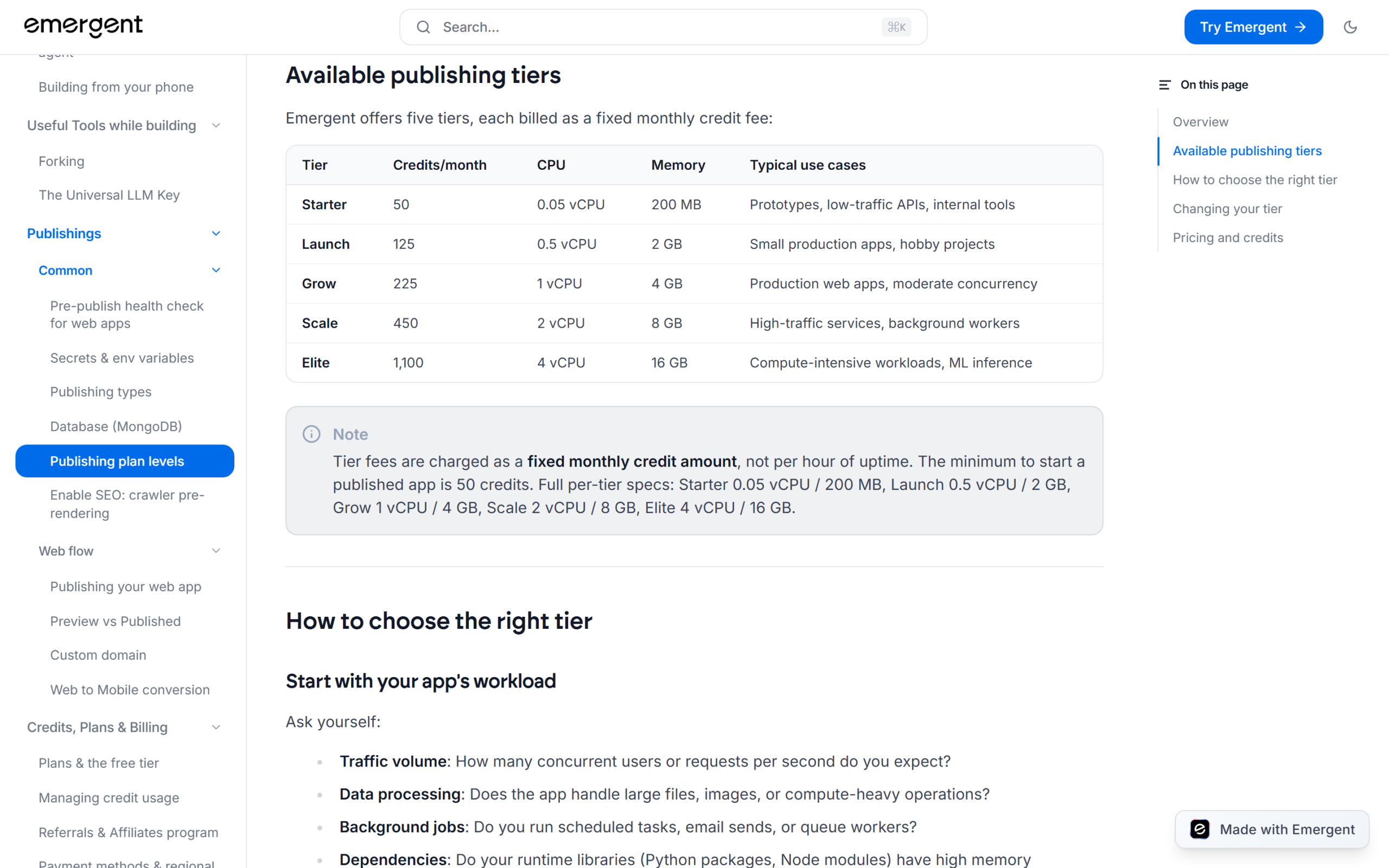
Starter is cheap, but Emergent warns against it for real traffic
The 50-credit Starter tier is the one that makes Emergent look cheap, and Emergent itself warns that it is “tightly resource-constrained” and “not suitable for production apps under meaningful load,” advising Launch or higher “for anything beyond minimal usage.” So for a real app with users, the realistic starting point is Launch at 125 credits a month. That is the number to budget with.
The Standard plan does not cover a Launch-tier app
This is the detail that changes the arithmetic. Standard gives 100 credits a month. One Starter app takes 50 of them, leaving 50 for building and edits. One Launch app takes 125, which is 25 more than the whole Standard allowance before you have written a single new prompt. The gap has to come from top-up credits, sold from 250 credits for $50. Because top-ups never expire, one pack covers a 25-credit monthly gap for ten months if you do no building at all, but any edits, tests or API usage come out of the same pot. In practice, a Launch-tier app on Standard costs $20 a month plus top-ups, or about $25 a month of credits for hosting alone.
Pro credits cost more each than Standard credits
Emergent’s credit guide suggests that heavy users consider “a higher-tier plan with a more generous monthly credit allowance and lower per-credit rate.” At the list prices on Emergent’s pricing page, the opposite is true for the two self-serve plans: Pro’s 750 credits for $200 work out to about $0.27 each, against $0.20 on Standard and on top-up packs. Standard plus three 250-credit packs comes to $170 for 850 credits, while Pro is $200 for 750, and the top-up credits never expire while subscription credits do. Pro is still worth it if you need its 1M context window, Ultra thinking, custom agents or priority support, but not as a cheaper source of credits for hosting.
How much does a Lovable app cost to keep online?
A Lovable app costs nothing to keep online as a site, and its backend costs whatever it consumes, starting from a 20-credit monthly Cloud grant. Lovable puts it plainly: hosting “is part of Lovable, not a separate product or add-on,” the published app “scales with traffic automatically,” and “your plan does not cap visitors or bandwidth.” The single exception is on the Free plan, where newer apps are limited to 1,000 server requests per project per 10 seconds.
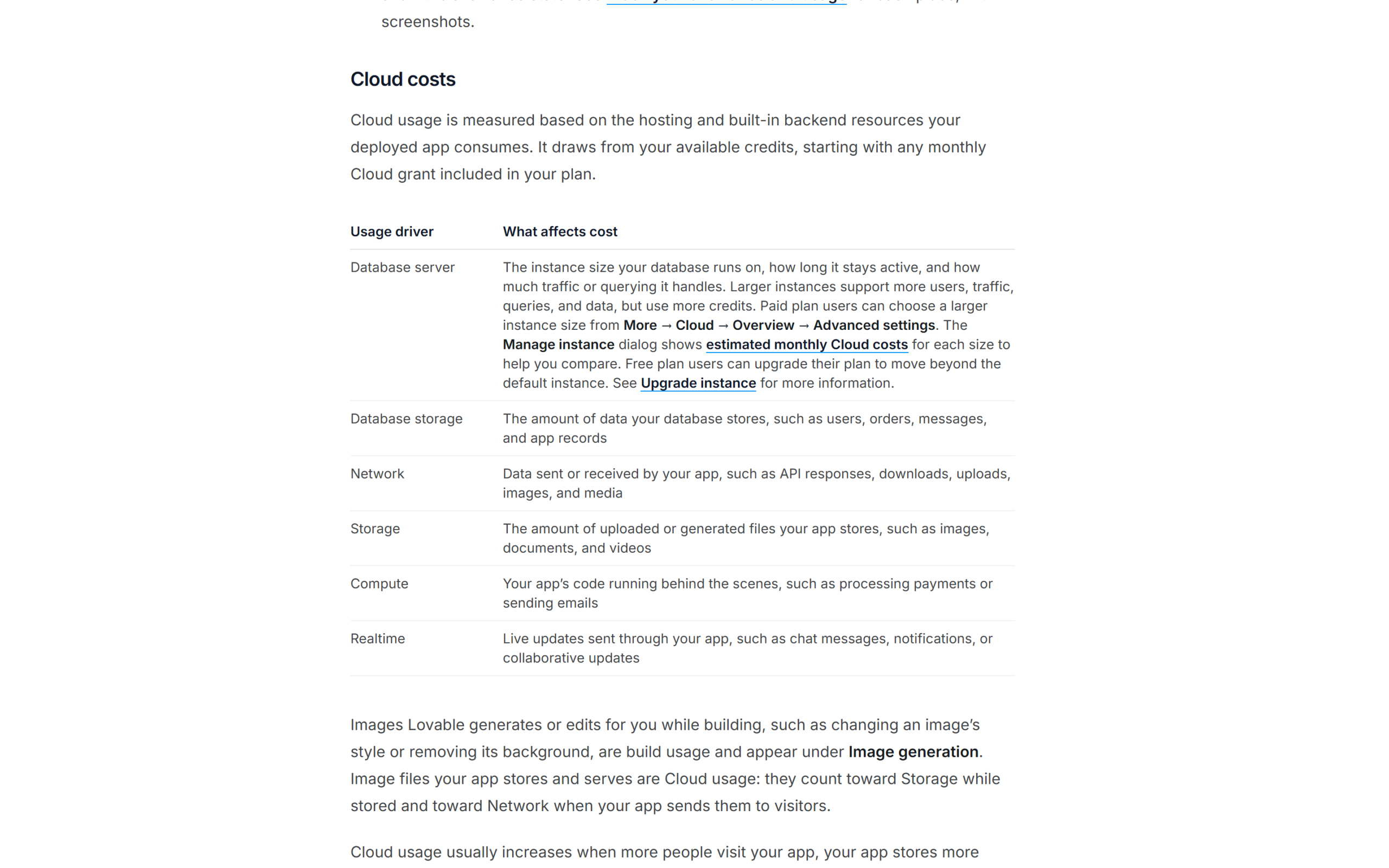
What drives the Cloud bill
Lovable’s built-in backend runs on Supabase’s open-source foundation and is billed on six drivers: the database server (its instance size, how long it is active and how much querying it handles), database storage, network traffic, file storage, compute for backend code, and realtime updates. AI features in a deployed app are billed separately as AI gateway usage, based on the model and the tokens used. Lovable does not publish a fixed price per instance size in its public docs; it says the Manage instance dialog inside a project shows estimated monthly Cloud costs for each size. That makes Lovable harder to budget up front than Emergent, even though for a quiet app it is likely to be cheaper.
Turning Lovable credits into money
Lovable Pro starts at €25 a month for 100 credits, or €0.25 a credit, and the same rate holds as you move up the dropdown: 200 credits for €50, 400 for €100 and 800 for €200. Larger tiers add small discounts, such as 2,000 credits for €480. Top-ups on Pro cost $15 per 50 credits, or $0.30 each, and on Business $30 per 50, or $0.60 each, valid for 12 months. At €0.25 a credit, the 20-credit Cloud grant is worth about €5 of backend usage a month before general credits are touched.
Rollover helps a quiet month
Unused Lovable plan credits roll over while the subscription is active, expiring two months after issue on monthly plans. Emergent’s subscription credits do not roll over and are “cleared at renewal.” For an app that needs a burst of work one month and very little the next, Lovable wastes less of what you pay for.
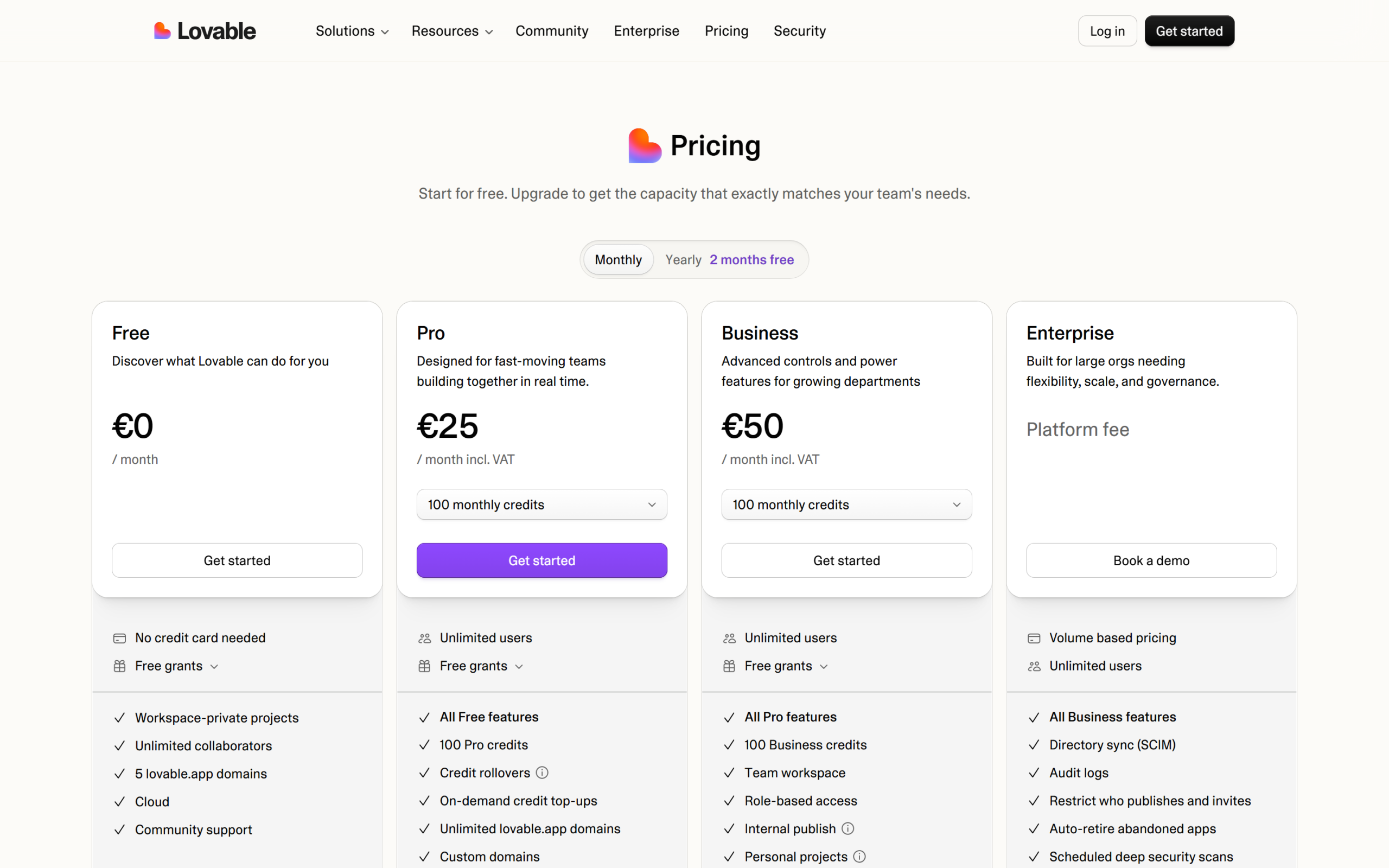
Which one is cheaper for your kind of app?
Lovable is cheaper for a web app with light or moderate traffic, and Emergent’s fixed fee only becomes the better deal when you want a predictable bill or a mobile app. Here are five common cases, using list prices seen on October 11, 2026.
A landing page or portfolio on your own domain
Lovable Pro at €25 a month covers a custom domain, and a static page with no backend uses no Cloud credits. On Emergent, Standard at $20 covers a custom domain and a Starter-tier publish at 50 credits leaves 50 credits a month for edits. The two are close; Emergent is a few dollars cheaper on paper, while Lovable leaves your whole 100 credits plus daily build credits for changes. If you can live with a lovable.app address, Lovable’s Free plan publishes for nothing.
A small production app with logins and a database
This is where the gap opens. Emergent recommends Launch or higher for production, which costs 125 credits a month per app, more than Standard’s 100, so expect $20 plus regular top-ups, around $25 a month of credits for hosting alone. On Lovable, the app sits on Pro at €25, and the database, authentication and storage draw from the 20-credit Cloud grant first. For a small user base that grant may cover most months; Lovable does not publish enough per-resource pricing for us to promise it will. If a fixed, known hosting number matters more to you than the lowest possible one, compare Emergent’s Standard and Pro allowances against the tier your app needs before you commit.
An agency running five client apps
Five Emergent apps on Launch cost 625 credits a month in tier fees, which fits inside Pro’s 750 credits with 125 left for work, at $200 a month. The cheaper route on Emergent is Standard plus top-ups: 525 extra credits at $0.20 is $105, so about $125 a month in total. On Lovable, the five sites cost nothing to host, and their backends share one workspace’s Cloud grant and credit balance. Agencies should also note that Lovable’s Business plan adds website access control, so a client app can be limited to signed-in users.
A mobile app headed for the App Store and Google Play
Emergent wins outright here, because it documents a managed Expo and EAS build pipeline that produces iOS and Android store binaries on any paid plan, with TestFlight upload handled for you and no Mac required. Budget for the stores themselves too: Emergent’s guide notes Apple’s developer membership at $99 a year for individuals and Google’s one-time $25 registration fee. Lovable’s documentation, as we read it, covers publishing web apps and a mobile app for building on your phone, not native store builds.
A busy app with real traffic
Once an app needs a full CPU or more, Emergent’s Grow tier at 225 credits (about $45) or Scale at 450 credits (about $90) gives you a fixed allocation of 1 to 2 vCPU and 4 to 8 GB of memory. On Lovable, traffic to the site itself is not capped, but database instance size, network and compute grow with use, and the bill moves with them. A busy app is the one case where Emergent’s flat fee can come in lower or at least steadier, and where you should ask both vendors for numbers before launch.
| Scenario | Emergent, monthly | Lovable, monthly | Cheaper |
|---|---|---|---|
| Public site on the vendor’s subdomain | Not on Free; Standard $20 | Free €0 | Lovable |
| Landing page on your own domain | $20 (Starter tier inside Standard) | €25 (Pro) | Close; Emergent slightly |
| Small production app with database | $20 plus top-ups, about $25 of credits for hosting | €25 plus any Cloud use beyond the 20-credit grant | Usually Lovable |
| Five client apps on Launch | About $125 (Standard plus top-ups) or $200 (Pro) | Pro plan plus metered backend use | Usually Lovable |
| Native iOS and Android app | Paid plan plus tier fee, store fees extra | Not offered in the docs we read | Emergent |
What happens when credits run out or you stop paying?
On Lovable your site stays online when credits hit zero; on Emergent a published app depends on credits covering its tier fee. This matters more than the headline price, because it decides whether a missed top-up takes your app offline.
Emergent
If your balance reaches zero mid-build, Emergent pauses generation, builds and publishes, and there is “no overage billing.” The risk is at renewal: if an account has fewer than 50 credits, the balance may briefly go negative to finish a build, and if it stays negative after the next billing check, typically within 24 to 48 hours, “your published app may be taken down until you recharge.” The cancellation page adds that after you cancel, live published versions “will stay up only while credits cover the tier fee.” Top-up credits survive cancellation and can be spent on the Free plan, so a small reserve of top-ups is cheap insurance for an Emergent app.
Lovable
Lovable says running out of credits “does not remove your published site.” Building stops, AI features in the deployed app fail, and backend services such as the database, storage and authentication pause shortly after, with the data kept safe. A paused backend may need a manual Wake up from the project’s Cloud view once credits are back. On the Free plan, Lovable can unpublish a project after 12 months without visits or workspace owner logins. For a static site, an empty balance changes nothing; for an app that relies on its backend, the effect is close to Emergent’s, but the pages stay up.
Refunds and expiry
Emergent offers prorated refunds of unused subscription credits after cancellation, minus published app usage, and treats top-ups as non-refundable. Lovable top-ups expire 12 months after purchase, while Emergent’s never expire. If you buy credits in advance, Emergent’s are the safer store of value; if you prefer to pay as you go, Lovable’s rollover wastes less.
Which one is easier to leave?
Lovable is easier to leave, mostly because its code syncs to GitHub on every plan and its backend is built on Supabase, a common open-source stack. Both companies say you own your code, so the difference is in the mechanics.
Code
Lovable offers two-way Git sync with github.com on all plans, including Free, and lets paid plans download the codebase directly. Its ownership page says it is “intentionally built so that you are never locked in,” and that newer apps use TanStack Start while older ones use React and Vite. Emergent includes GitHub integration from the Standard plan up, and its FAQ in our review states that you own all the code it generates and can host it anywhere.
Data
Emergent apps store data in MongoDB on a shared cluster Emergent manages, with preview and production in separate databases. You can export the preview database with mongodump from the workspace terminal, but the managed production cluster “does not accept direct external connections,” so a production export goes through the Database Manager or support. Moving to your own MongoDB is “a manual runbook” with no automatic sync and “no guaranteed rollback.” Lovable describes its database, storage and configuration as portable, can export Cloud data, and lists managed or self-hosted Supabase as a destination for the backend.
Domains
Emergent connects custom domains with two A records and a www CNAME, issuing SSL through Cloudflare, and also offers an automatic Auto-link setup. Lovable can sell you a domain inside the app, which then belongs to your workspace, or connect one you already own. Both are paid-plan features. Keep your domain at a registrar you control if you think you might move later.
Where does each one fall short?
Emergent
The fixed tier fee is the weakness and the strength. It makes Emergent predictable, but it also means every published app costs something every month, even one nobody visits, and the plan that most people start on cannot cover a single production-tier app without top-ups. Subscription credits vanish at renewal, Pro credits cost more each than Standard credits at list prices, and a negative balance can take an app offline.
- Pros: native iOS and Android store builds on paid plans; fixed, published hosting fees per app; dedicated CPU and memory from 0.5 vCPU on Launch; top-up credits that never expire; free republishes and rollbacks.
- Cons: no production publishing on Free; Standard’s 100 credits do not cover one Launch-tier app; unused subscription credits expire; production database export goes through tools or support, not a direct connection.
Lovable
Lovable’s metered backend is cheap when an app is quiet and harder to predict when it is not, because instance pricing sits inside the product rather than on a public page. Its Cloud and AI grants are labelled temporary, so the free allowance that makes small apps nearly free today could shrink. And if your goal is a native mobile app in the stores, its documentation does not cover that path.
- Pros: free hosting for published sites on every plan; no visitor or bandwidth cap on paid plans; 20 Cloud and 4 AI credits a month before general credits; plan credits roll over; Git sync on all plans.
- Cons: backend costs vary with use and are not priced publicly per instance; grants are temporary; top-ups cost $0.30 a credit on Pro and expire after 12 months; Free plan apps can be unpublished after a year without visits or logins.
Common buying mistakes
The first mistake is comparing credit counts across the two platforms, when a Lovable credit and an Emergent credit buy different amounts of work. The second is budgeting an Emergent app at the Starter tier and then discovering that production needs Launch. The third is assuming Lovable is free to run because the site is free, without checking the Cloud usage view once real users arrive. The fourth is letting credits hit zero near renewal on Emergent with a live app.
Frequently asked questions
Is Lovable cheaper than Emergent?
For most web apps, yes. Lovable hosts the published site without a fee and meters only backend and AI usage, starting with a 20-credit monthly Cloud grant. Emergent charges every published app a fixed fee of 50 to 1,100 credits a month by tier. Emergent can be close or cheaper for a tiny site on its Starter tier, and it is the only one of the two with native mobile store builds.
How much does it cost to host an app on Emergent?
Each published app pays a fixed monthly tier fee in credits: Starter 50, Launch 125, Grow 225, Scale 450 or Elite 1,100. At $0.20 a credit, the rate on Standard and on top-up packs, that is about $10 to $220 a month per app. Emergent recommends Launch or higher for production, and the minimum to start a published app is 50 credits.
Does Lovable charge for hosting?
Not for the site itself. Lovable says publishing to a lovable.app address is free on all plans and a live site does not consume credits on its own. Custom domains need a paid plan. What costs credits is the app’s built-in backend, such as database, storage, network, compute and realtime usage, and any AI features it calls.
Can I publish an app on Emergent’s free plan?
Not to production. Emergent’s Free tier gives 10 credits on your first day for building and testing, and its plans page says publishing is credit-gated with a 50-credit minimum. It adds that free-tier users may qualify for a free frontend-only published app, but full publishing and custom domains need Standard or Pro.
Do Emergent and Lovable credits roll over?
Lovable’s unused plan credits roll over while your subscription is active and expire two months after issue on monthly plans; top-ups last 12 months. Emergent’s subscription credits do not roll over and are cleared at renewal, but its purchased top-up credits never expire, even after you cancel.
What happens to my app if I run out of credits?
On Lovable, the published site stays up, while building stops and backend services and AI features pause until you add credits. On Emergent, builds pause at zero, and if your balance stays negative after a billing check, the published app may be taken down until you recharge. After cancelling Emergent, live apps stay up only while credits cover the tier fee.
Which one is better for a mobile app?
Emergent. It runs a managed Expo and EAS pipeline that builds iOS and Android binaries for the App Store and Google Play on paid plans, uploads iOS builds to TestFlight for you and needs no Mac. You still pay Apple’s and Google’s own developer fees. Lovable’s documentation focuses on web apps.
Emergent vs Lovable: which should you choose?
If the question is which one costs less once you deploy, the answer for most web apps is Lovable. Its published sites are hosted without a fee, a monthly Cloud grant soaks up light backend use, its plan credits roll over, and a missed top-up does not take your pages offline. Choose it for landing pages, internal tools, prototypes you want to share and small web apps where traffic is modest and you are happy to watch a usage chart.
Choose Emergent when what you value is a fixed, published hosting cost per app, dedicated CPU and memory as you grow, or a native app in the App Store and Google Play, which Emergent builds for you on any paid plan. Budget it honestly: plan on the Launch tier at 125 credits for anything in production, which means Standard plus top-ups or Pro, and keep a small reserve of never-expiring top-up credits so a renewal never takes your app down. Do not choose Emergent for a single quiet website you only need to keep online cheaply. That settles Emergent vs Lovable on running costs; if Emergent’s model fits your app, start on Emergent and pick your publishing tier once the app is ready to go live.
7.3 Score
Pros
- Native iOS and Android store builds on any paid plan, with TestFlight upload handled for you.
- Hosting cost per app is a fixed, published credit fee, so the bill does not move with traffic.
- Purchased top-up credits never expire, even after you cancel.
- Dedicated CPU and memory from the Launch tier upward, with free tier changes and rollbacks.
Cons
- Every published app pays a monthly fee, while Lovable hosts sites without one.
- Standard's 100 credits do not cover one production-grade Launch app at 125 credits.
- Unused subscription credits are cleared at renewal; Lovable's roll over.
- A negative balance after renewal can take a published app offline.
Final Verdict
Emergent costs more than Lovable to keep a typical web app online, because each published app pays a fixed monthly tier fee and production apps need the 125-credit Launch tier. It is still the better buy for native mobile apps and for anyone who wants a predictable hosting number with dedicated resources. Budget for top-ups on Standard, and keep a reserve so a renewal never takes your app down.