



Short answer: This Woodpecker review comes down to a new meter: Woodpecker now sells plans by emails sent, from $39 a month for 5,000 emails or $26 a month billed annually, and still includes unlimited email accounts, unlimited team members, unlimited contact storage, free verification and three free warm-ups at that first tier. It is the right buy for a founder, a recruiter or a small lead generation agency that sends measured, personalised campaigns from its own Gmail or Outlook accounts, and the wrong buy for a volume shop sending six figures of emails a month, which Instantly prices lower.
- Pick the Email plan at $39 ($26 billed annually) if you send up to 5,000 emails a month, follow-ups included, and want warm-up and verification without paying for them.
- Pick 50,000 emails at $79, or Multichannel at $108 with one LinkedIn account, if you run an agency or a small SDR team, need 10 warm-ups, and can live with the agency panel at $27 per client.
- Skip it if you send well over 100,000 emails a month, if you need a built-in database beyond 100 to 1,200 Lead Finder credits, or if you expect CRM sync and the API to be included rather than a $20 add-on.
Email plan from $39 a month for 5,000 emails sent, $79 for 50,000, $119 for 100,000, $219 for 250,000; annual billing saves 33 percent ($26 for 5,000); Multichannel from $68 and LinkedIn from $29 per account; opened from Europe the page shows euros with the same numerals · Free plan: no, a 14-day or 500-email free trial with no card · Prices checked November 17, 2026.
Table of contents
What is Woodpecker and who is it for?
Woodpecker is a cold email and LinkedIn outreach tool from Woodpecker AI sp. z o.o., a company based in Wrocław, Poland, whose site footer dates it to 2015. The product sends campaigns from your own email accounts, Gmail and Outlook with one-click connections or anything else over SMTP and IMAP, automates the follow-ups, stops the sequence when someone replies, and gives you one inbox for the answers. Its solutions menu names four customers: sales teams, lead generation agencies, recruiters and business owners, and the agency panel and the client-based billing say the agencies are the ones it thinks about most.
The thing that makes a Woodpecker review worth writing in 2026 is not the feature list, which every cold email tool now shares, but the bill. Woodpecker used to be the odd one out, charging for contacted prospects; it now meters emails sent, like Instantly, while lemlist still sells its multichannel plan per user. What sets Woodpecker apart is what the entry plan gives away: mailboxes, team members, contact storage, verification and warm-up slots. Whether that makes it the cheapest option depends on how many emails you send, and this Woodpecker review sets out the numbers so you can tell which side you are on.
How much does Woodpecker cost?
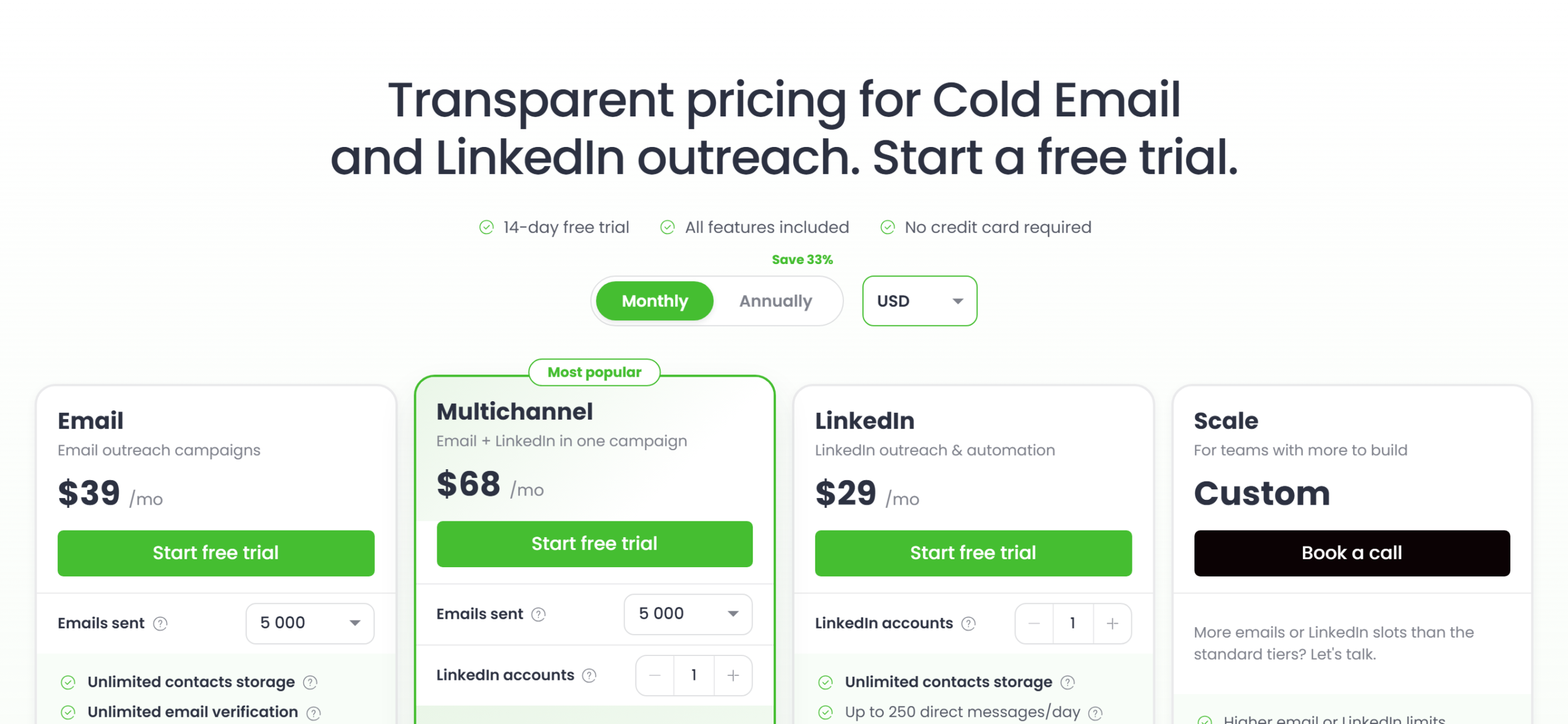
For this Woodpecker review we read the pricing page again on November 17, 2026. Opened from Europe it shows euros by default; switching the currency selector to USD shows the same numerals with a dollar sign, so 39 € becomes $39, and the figures below are the USD view. There are now four cards: Email, Multichannel (email plus LinkedIn in one campaign), LinkedIn on its own, and a custom Scale plan for higher limits. On Email and Multichannel you pick a number of emails sent per month, and the price, the free warm-ups and the Lead Finder credits scale with it. Annual billing is marked as a 33 percent saving. The trial is 14 days or 500 cold emails, whichever comes first, with every feature and no credit card, and the FAQ says you can ask support to extend it.
| Emails sent per month | Email plan, monthly | Email plan, billed annually | Multichannel, monthly | Per 1,000 emails (monthly) | Free warm-ups | Lead Finder credits |
|---|---|---|---|---|---|---|
| 5,000 | $39 | $26 | $68 | $7.80 | 3 | 100 |
| 50,000 | $79 | $52.66 | $108 | $1.58 | 10 | 250 |
| 100,000 | $119 | $79.33 | $148 | $1.19 | 15 | 300 |
| 250,000 | $219 | $146 | $248 | $0.88 | 30 | 450 |
| 500,000 | $499 | $332.66 | $528 | $1.00 | 65 | 800 |
| 1,000,000 | $999 | $666 | $1,028 | $1.00 | 95 | 1,200 |
| More | Scale plan, custom price on a call | Custom | Custom | |||
From woodpecker.co/pricing on November 17, 2026, currency set to USD, prices per month, no add-ons. Annual prices are the monthly equivalent of an annual bill. The per 1,000 column is our arithmetic on the monthly price.
Three things stand out. First, the price per email falls steeply from $7.80 per thousand at 5,000 to $1.58 at 50,000 and $0.88 at 250,000, and then rises again: the 500,000 tier costs $280 more than the 250,000 tier for twice the emails, about $1.00 per thousand, so the sweet spot for heavy senders is 250,000. Second, Multichannel is the Email price plus $29 for one LinkedIn account at every tier, and on annual billing only the email part is discounted: Multichannel at 5,000 emails is $55 a month billed annually, which is $26 plus the full $29. Third, every Email and Multichannel tier includes unlimited contact storage, unlimited email verification, unlimited team members and unlimited email accounts, so the email count is the only meter you need to watch.
Emails sent: how the meter works
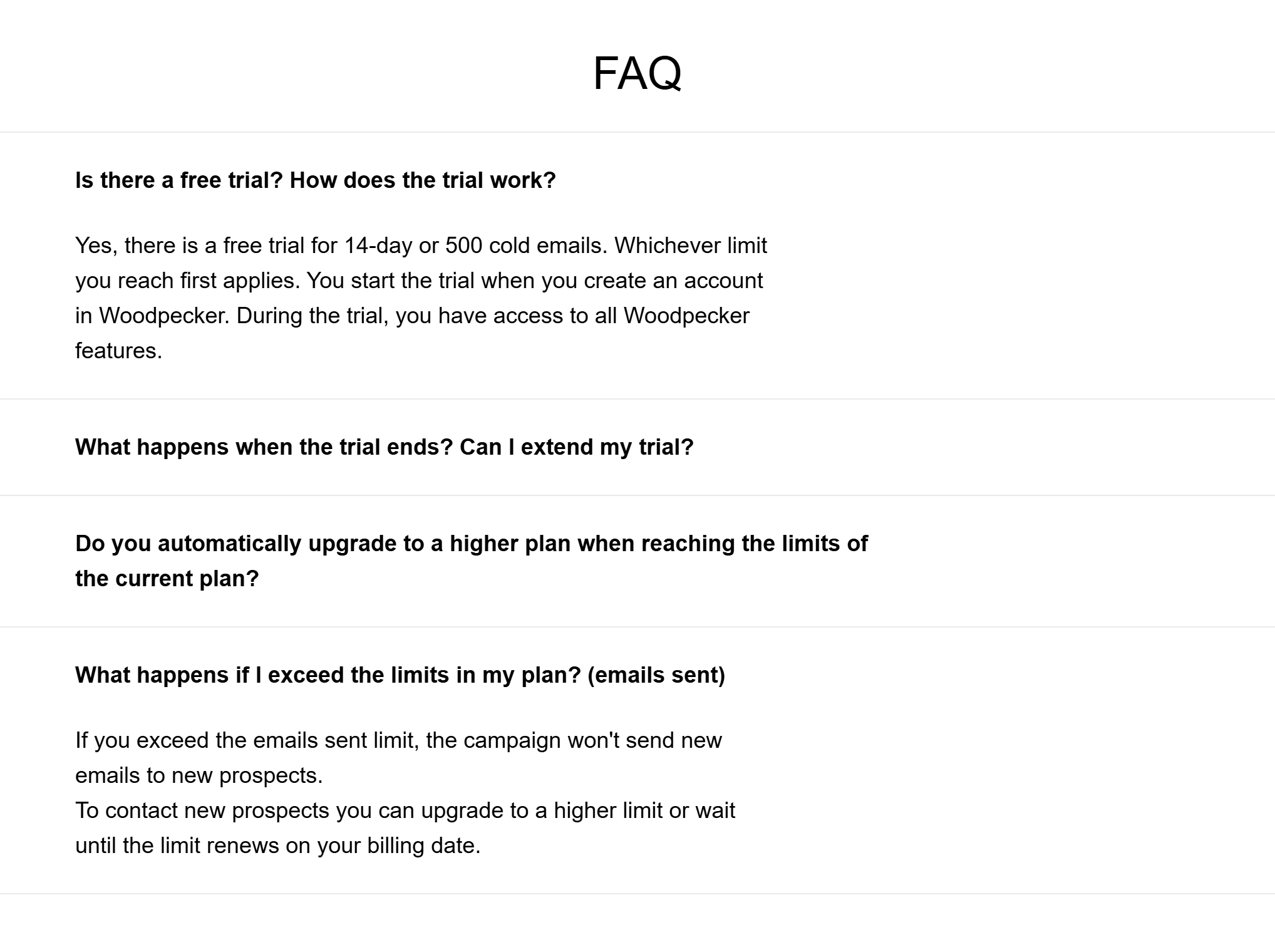
When this review first went up in September 2026, Woodpecker billed per contacted prospect, from $35 a month for 500 people, with a separate limit on stored prospects. By November 17, 2026 the pricing page had replaced both counters with one: emails sent. The tooltip next to the selector defines it plainly as the number of emails you can send every month, and every email counts toward the limit, follow-ups included. Contact storage is now unlimited on every plan, so the old trap of one person in five campaigns counting five times is gone; what counts instead is every message in every step of every sequence.
| Question | Woodpecker’s answer |
|---|---|
| What counts toward the limit? | Every email sent in the month, including follow-ups |
| Is there a contact limit? | No, unlimited contacts storage on every plan |
| Over the emails sent limit? | Campaigns stop sending new emails to new prospects until you upgrade or the limit renews on your billing date |
| Automatic upgrade? | No, you upgrade the plan yourself |
| Team members and email accounts | Unlimited, at no extra cost |
| Trial | 14 days or 500 cold emails, whichever comes first, all features, no card, extendable on request |
From the pricing page tooltips and FAQ on November 17, 2026.
The practical consequence is simple arithmetic: multiply the people you write to by the steps in your sequence. A recruiter who writes carefully to 300 people a month with an opener and four follow-ups sends 1,500 emails and sits comfortably in the $39 tier. A team that writes to 1,000 people with the same five steps uses exactly 5,000 and is one campaign away from the next tier, at $79. Shorter sequences stretch a plan further, which is a decent incentive to cut the sixth follow-up nobody reads.
Add-ons: LinkedIn, Lead Finder, inboxes, domains and the agency panel
The pricing page still prices every add-on on the same page, which is rarer than it should be. LinkedIn outreach is now a plan card of its own at $29 per LinkedIn account per month, with up to 250 direct messages, 30 connection requests and 500 profile visits a day and 50 InMail messages a month per account, within LinkedIn’s own limits. Extra Lead Finder credits start at $10 for 500. An extra warm-up beyond the free ones is $5 per email account a month. Woodpecker will also sell you infrastructure: a Google or Microsoft mailbox is $6 a month ($4 on annual billing), a Maildoso, Mailforge, Infraforge or Azure mailbox $4 ($3 on annual billing), a new domain about $1 a month billed annually, transferring your own domain $1, Azure domain hosting $20 and a dedicated Infraforge server $59. The integrations bundle, API, webhooks, MCP server and CLI plus the built-in HubSpot and Pipedrive integrations, is now a $20 a month add-on. The agency panel is $27 per active client per month, white label $5 per active client, and outbound workshops are $2,000 for four two-hour sessions.
| Add-on | Price | Unit |
|---|---|---|
| LinkedIn outreach (plan or Multichannel extra) | $29 | per LinkedIn account per month |
| Lead Finder credits | from $10 | per 500 credits |
| Additional warm-up | $5 | per email account per month |
| Google or Microsoft mailbox | $6 ($4 annual) | per mailbox per month |
| Maildoso, Mailforge, Infraforge or Azure mailbox | $4 ($3 annual) | per mailbox per month |
| New domain | about $1 | per domain per month, billed annually |
| Transfer your own domain | $1 | per domain per month, billed annually |
| Azure domain hosting | $20 | per domain per month |
| Dedicated server (Infraforge) | $59 | per server per month |
| Integrations, API, webhooks, MCP, CLI | $20 | per month |
| Agency panel | $27 | per active client per month |
| White label | $5 | per active client per month |
| Outbound workshops | $2,000 | four 2-hour sessions, $500 per extra session |
From the pricing page add-on section on November 17, 2026, currency set to USD.
Three of these change the comparison. LinkedIn at $29 per account means a one-person multichannel setup is $68 a month at 5,000 emails, well under lemlist’s $109 Multichannel seat on monthly billing. The integrations add-on at $20 matters to anyone who pushes replies into HubSpot or Pipedrive, which used to cost nothing. And the agency panel at $27 per client is how an agency’s bill grows: five clients is $135 on top of the email tier, in exchange for a sub-account per client, view-only client access, bulk campaign actions and clients connecting their mailboxes without sharing passwords. Price your own mix in the Woodpecker calculator before comparing, because the base tier alone understates an agency’s cost and overstates a solo sender’s.
Deliverability: warm-up, verification, rotation and adaptive sending
Woodpecker’s key features list, repeated on the homepage, the cold email page and the pricing page, is free email verification, free warm-up, inbox rotation, adaptive sending, a centralised inbox, a domain audit, condition-based campaigns and GDPR compliance. The cold email page adds a Deliverability Monitor and real-time list verification, and describes an algorithm that “acts human” and avoids mistakes such as emailing someone who already replied. Warm-up slots come free with the tier, three at 5,000 emails, ten at 50,000 and 95 at 1,000,000, and extra slots are $5 per email account a month, which is cheaper than most standalone warm-up services. Verification runs through Bouncer, according to the pricing page tooltip, and is unlimited on every plan.
The architecture matters for deliverability more than any feature. Woodpecker does not run its own sending servers for your campaigns; the quickstart guide says campaigns go out from your own connected account, with the daily limit defaulting to your provider’s stated sending limit and adjustable in settings. That keeps your sending reputation tied to your own domain and mailbox, which is what you want for measured outreach, and it means the tool cannot save a burned domain for you. Inbox rotation spreads a campaign across several connected accounts, all of which are free to connect, so the sensible pattern is several mailboxes on several domains, each at a low daily limit, and Woodpecker’s own infrastructure calculator on the free tools page will tell you how many.
Campaigns, conditions and the setup flow
The help centre’s quickstart, updated in June 2026, sets up a campaign in five steps: connect an email account, compose a personalised email, set a daily limit and delivery time, add prospects, preview and send. Connection is one click for Gmail and Outlook, or SMTP and IMAP for anything else, with bulk adding for many accounts, and Woodpecker sends a test message to confirm the connection worked. Condition-based campaigns, the feature the pricing page lists as a key feature, let a sequence branch on what the prospect does, so an opened but unanswered email gets a different follow-up from an ignored one. Replies land in the centralised inbox, and the sequence stops for anyone who answers.
Personalisation is field-based, snippets in the copy filled from the prospect record, and the cold email page’s pitch is that every message should “feel real and personal”. Reporting covers open, click and response tracking per campaign, which is what a small team needs to compare two subject lines and not much more. There is no built-in dialer, no SMS and no WhatsApp, which lemlist sells as channels; Woodpecker’s second channel is LinkedIn, and it is an add-on.

Integrations, API, MCP and the CLI
The integrations list on the pricing page on November 17, 2026 names Claude and a CLI, both marked new, Clay, an API, webhooks, an MCP server, Pipedrive and HubSpot two-way sync, Persana, Calendly, Google Sheets, Zapier, Zoho, Hunter and three warm-up and infrastructure partners, and the whole block now carries an add-on label. The add-on costs $20 a month and, in the calculator’s own description, covers the API, webhooks, MCP server and CLI for custom integrations and the built-in integrations with HubSpot, Pipedrive and others. In September the same block was priced at $0, so this is a real change for small teams. The API documentation is linked from the help centre. For a technical team the API, webhooks, MCP server and CLI mean campaigns can be driven from scripts or from an AI assistant, which is still unusual at this price and worth the $20 if your list building already lives in Clay or a spreadsheet; for a solo sender who reads replies in the Woodpecker inbox, it is a cost you can skip.
What is not in the list is a native data source of any size. Lead Finder credits are included, 100 at the 5,000 email tier rising to 1,200 at 1,000,000 emails, with more from $10 for 500, but Woodpecker is a sender that connects to a database rather than a database that sends, and buyers coming from Apollo should budget for the data separately.
How Woodpecker compares with lemlist, Instantly and Smartlead
The shortlist for a small outbound team usually contains these four, and for this update we read each pricing page on November 17, 2026, monthly prices in USD. Smartlead publishes its plans on its own site and was not re-checked for this article, so it appears below by model only.
| Tool | Meter | Entry price per month | What entry buys | Mailboxes and warm-up |
|---|---|---|---|---|
| Woodpecker | Emails sent | Email $39 (5,000 emails), $79 (50,000); Multichannel from $68 | Unlimited contacts storage, unlimited seats, 100 or 250 Lead Finder credits | Unlimited mailboxes; 3 or 10 free warm-ups, $5 each after |
| Instantly | Emails and uploaded contacts | Growth $47; Hypergrowth $107; Light Speed $358 | 5,000 emails and 1,000 contacts; 125,000 emails and 25,000 contacts; 500,000 emails and 100,000 contacts | Unlimited mailboxes and unlimited warm-up |
| lemlist | Emails (Email plan), per user (Multichannel) | Email $69 ($55 billed yearly); Multichannel $109 per user ($87 billed yearly) | 50,000 emails and unlimited users; unlimited emails and messages with LinkedIn, SMS and calling | Warm-up and deliverability hub included |
| Smartlead | Leads and emails per month | Published on smartlead.ai | Volume tiers with unlimited mailboxes | Unlimited mailboxes and warm-up |
From woodpecker.co/pricing, instantly.ai/pricing and lemlist.com/pricing on November 17, 2026.
Now that two of the three meter emails, the comparison is closer than it used to be. At 5,000 emails Woodpecker is $39 against Instantly’s $47, and it stores unlimited contacts where Instantly’s Growth plan uploads 1,000. At volume the order flips: Instantly’s Hypergrowth sends 125,000 emails for $107, more than Woodpecker’s 100,000 at $119, and Light Speed sends 500,000 for $358 against Woodpecker’s $499, a $141 gap. lemlist’s Email plan is the surprise: 50,000 emails with unlimited users and its lead database for $69 a month, $10 less than Woodpecker’s 50,000 tier on monthly billing, although on annual billing Woodpecker’s $52.66 edges lemlist’s $55. For multichannel, Woodpecker wins clearly: three people each with a LinkedIn account cost $327 a month on lemlist Multichannel (3 x $109), against $166 on Woodpecker Multichannel with 50,000 emails and three LinkedIn accounts, the figure the calculator shows. Where Woodpecker loses is channels beyond email and LinkedIn, which lemlist has and Woodpecker does not, and data, where lemlist bundles a database and Woodpecker sells credits.
Where Woodpecker falls short
The first weakness is that follow-ups count: every step of a sequence uses the emails sent allowance, so a long sequence eats a plan faster than the headline number suggests. The second is volume: above about 100,000 emails a month Instantly sends more for less, and Woodpecker’s own price per thousand rises again past 250,000. The third is data: 100 Lead Finder credits at the entry tier is a taster, and a team without its own list is buying it elsewhere. The fourth is that integrations, the API and CRM sync are now a $20 a month add-on rather than included. The fifth is that LinkedIn is $29 per account with no annual discount, and there is no calling, SMS or WhatsApp at all. The sixth is currency and tax: opened from Europe the page shows euros with the same numerals as the dollar list, so 39 € and $39 are both on offer depending on where you are, and the page says nothing about VAT, so check the total at checkout. The seventh is the absence of a free plan; the trial is generous but ends. The eighth is documentation depth: the help centre is thorough on setup, but feature articles load through the app’s help widget and are thin when read outside it, so the deeper questions go to chat support.
Who should buy Woodpecker, and who should not?
Scenario one: a founder or consultant writing to 300 people a month
An opener and four follow-ups to 300 people is 1,500 emails, well inside the 5,000 tier: $39 a month, or $26 billed annually, with one or two mailboxes on a second domain, three free warm-ups and the centralised inbox. Nothing else on the list gives this person unlimited seats, unlimited contacts and free warm-up for that price.
Scenario two: a recruiter sourcing candidates
The recruiter’s page exists for a reason: measured, personalised sequences to a few hundred candidates at a time. Six hundred candidates with four emails each is 2,400 emails, so the 5,000 tier covers it; when the role calls for LinkedIn, Multichannel with one LinkedIn account is $68 a month, or $55 billed annually.
Scenario three: a lead generation agency with five clients
Five clients writing to 2,000 people each with four emails is 40,000 emails, so the 50,000 tier at $79, with ten free warm-ups. The agency panel adds $27 per client, $135 for five, which brings the bill to $214 a month before mailboxes; add $20 if replies sync to HubSpot or Pipedrive and $25 for white label across five clients. Mailboxes bought through Woodpecker cost $4 to $6 each, or connect your own for free. The email allowance is shared across clients, so watch it, and price the 100,000 tier at $119 if the clients are busy.
Scenario four: a volume sender
Not this tool. At 500,000 emails a month Woodpecker is $499 and Instantly’s Light Speed is $358, and Instantly’s Hypergrowth at $107 already covers 125,000.
Common buying mistakes
Counting people instead of emails: four follow-ups turn 1,000 prospects into 5,000 emails. Assuming the integrations and CRM sync are still free. Expecting the annual discount to cover LinkedIn. Expecting a database. Comparing the euro price on a European screen with a dollar price list, or forgetting to check VAT at checkout. Reading an old review that still quotes per-prospect pricing.
Woodpecker pros and cons
Woodpecker
- Email plan from $39 a month for 5,000 emails sent, or $26 billed annually, with unlimited mailboxes, unlimited team members and unlimited contact storage at every tier.
- Free email verification and 3 to 95 free warm-ups depending on the tier, with extra warm-ups at $5.
- Deliverability tools built in: inbox rotation, adaptive sending, domain audit, Deliverability Monitor, sending from your own accounts.
- Every add-on priced on the page, including LinkedIn at $29, mailboxes from $3 on annual billing and the agency panel at $27 per client.
- Multichannel puts email and LinkedIn in one campaign for $68 a month, far below per-user multichannel plans.
- Follow-ups count toward the emails sent limit, so long sequences use a plan up quickly.
- Above about 100,000 emails a month Instantly is cheaper.
- Integrations, API, webhooks, MCP and CLI are now a $20 a month add-on.
- LinkedIn is $29 per account with no annual discount, and there is no calling, SMS or WhatsApp.
- No free plan; Lead Finder credits are small, and the page says nothing about VAT.
Part of our outbound sales stack guide, which covers lead data, sequencing and deliverability together.
Frequently asked questions
How much does Woodpecker cost?
On November 17, 2026, monthly billing in USD, the Email plan is $39 for 5,000 emails sent a month, $79 for 50,000, $119 for 100,000, $219 for 250,000, $499 for 500,000 and $999 for 1,000,000. Annual billing saves 33 percent, which makes the entry tier $26 a month. Multichannel adds one LinkedIn account for $29 more at every tier, from $68, and the LinkedIn plan alone is $29 per account. Opened from Europe the page shows euros with the same numerals.
Is there a free trial?
Yes: 14 days or 500 cold emails, whichever comes first, with all features and no credit card. The FAQ says you can ask support via chat to extend it, and you keep access to the account after it ends.
What counts as an email sent?
Every email your campaigns send in the month, follow-ups included. If you reach the limit, campaigns stop sending new emails to new prospects until you upgrade or the limit renews on your billing date; the plan is never upgraded automatically.
Is there a limit on contacts?
No. Every plan includes unlimited contacts storage. Until autumn 2026 Woodpecker charged per contacted prospect and capped stored prospects; both counters are gone.
Are mailboxes and team members extra?
No. Unlimited email accounts and unlimited team members are included at every tier. Warm-up slots are free up to the tier’s allowance, three at 5,000 emails and ten at 50,000, then $5 each. Buying mailboxes through Woodpecker costs $6 for Google or Microsoft and $4 for Maildoso, Mailforge, Infraforge or Azure, less on annual billing.
Does Woodpecker do LinkedIn?
Yes, at $29 per LinkedIn account per month, either as the LinkedIn plan or added to email in the Multichannel plan. There is no calling, SMS or WhatsApp channel.
Is Woodpecker cheaper than Instantly or lemlist?
At 5,000 emails it is cheaper than Instantly ($39 against $47). At volume Instantly wins: Hypergrowth sends 125,000 emails for $107 and Light Speed 500,000 for $358, against Woodpecker’s $499. lemlist’s Email plan is $69 for 50,000 emails against Woodpecker’s $79, but for a multichannel team Woodpecker is far cheaper than lemlist’s $109 per user.
Is this Woodpecker review based on hands-on testing?
No. It is built from the Woodpecker pricing page and FAQ, the homepage and cold email pages, the help centre quickstart and the Instantly and lemlist pricing pages, first read on September 7, 2026 and re-read for pricing on November 17, 2026.
Which should you choose?
The conclusion of this Woodpecker review: choose Woodpecker when you send measured, personalised campaigns rather than volume. A founder, a recruiter or a small agency sending a few thousand to a few tens of thousands of emails a month gets free mailboxes, free seats, unlimited contacts, free verification and free warm-up, and pays by the email. Start at $39, or $26 billed annually, move to $79 for 50,000 when your sequences outgrow it, and add LinkedIn per account only where it earns its $29.
Do not choose it for volume above about 100,000 emails a month, where Instantly is cheaper, or for a multichannel team that needs calls and SMS in the sequence, which is lemlist’s territory. For measured cold email from your own domains, Woodpecker is still the tool whose bill tracks what you send rather than your headcount.
8.3 Score
Pros
- Email plan from $39 a month for 5,000 emails sent ($26 billed annually), with unlimited mailboxes, seats and contact storage.
- Free email verification and 3 to 95 free warm-ups depending on the tier.
- Inbox rotation, adaptive sending, domain audit and sending from your own accounts, with every add-on priced on the page.
- Multichannel puts email and one LinkedIn account in one campaign from $68 a month.
Cons
- Follow-ups count toward the emails sent limit, so long sequences use a plan up quickly.
- Integrations, API, webhooks, MCP and CLI are now a $20 a month add-on.
- LinkedIn is $29 per account with no annual discount, and there is no calling, SMS or WhatsApp.
- Above about 100,000 emails a month Instantly is cheaper; no free plan, and the page says nothing about VAT.
Final Verdict
Woodpecker is the cold email tool for small teams that send measured, personalised campaigns from their own mailboxes. It now charges by emails sent, from $39 a month for 5,000 or $26 a month billed annually, and still includes unlimited mailboxes, seats and contact storage, free verification and free warm-ups. Every add-on is priced on the page: LinkedIn is $29 per account, and integrations, the API and CRM sync are now a $20 add-on. It is good value up to a few tens of thousands of emails a month; from about 100,000, Instantly sends more for less.