



Short answer: How much electricity does a 1500W heater use? Exactly 1.5 kilowatt-hours (kWh) for every hour it runs at full power, which costs about 27 cents in the US, about 39p in Great Britain and about 57 euro cents in Germany at the latest official average prices. A thermostat that switches the element off once the room is warm is what decides how far below that ceiling your real bill lands.
- Full power, eight hours a day: 12 kWh a day, about $2.18 at the US average, £3.16 under the GB price cap and €4.56 at the German average.
- The same heater at half its average draw: half the kWh and half the cost, which is what a thermostat or an ECO mode is for.
- The DREO Smart Wall Heater has three fixed levels of 900, 1300 and 1500 watts plus an ECO mode that picks the power for you and switches off at the set temperature, according to DREO’s manual.
- Your own tariff decides the bill: the US state averages alone run from 12.72 cents per kWh in Nevada to 47.18 in Hawaii.
As an Amazon Associate we earn from qualifying purchases. This article contains an Amazon affiliate link; TruePick may earn a commission at no extra cost to you. Heater prices change often, so check the current price on the listing. Electricity prices: EIA, August 2026 (published data read November 17, 2026); Ofgem price cap, 1 October to 31 December 2026; Destatis, first half of 2026.
Table of contents
How do you turn 1500 watts into kilowatt-hours?
A watt is a rate: how fast an appliance draws energy at a given moment. A kilowatt-hour is an amount: what your meter counts and what your supplier bills. To go from one to the other you multiply the power by the time and divide by 1,000. A heater drawing 1500 watts for one hour uses 1,500 watt-hours, which is 1.5 kWh. Run it for two hours and it is 3 kWh; for eight hours, 12 kWh. That is the whole formula, and it works for every electric heater regardless of brand, shape or price.
So when people ask how much electricity does a 1500W heater use, the honest answer has two parts. The first part is fixed by physics and the label: at full output it uses 1.5 kWh per hour, never more. The second part is behaviour: how many of those hours the heating element is actually switched on. A heater set to its highest level with no thermostat runs at full power the whole time it is on. A heater with a thermostat switches the element off when the room reaches the target and back on when it cools, so over an evening its average draw is lower than the number on the box.
The label number is also the heat you get. An electric resistance heater turns the electricity it draws into warmth in the room, which is why a 1500 watt fan heater, a 1500 watt oil-filled radiator and a 1500 watt wall heater all put out the same amount of heat at full power. What differs is how quickly you feel it, how evenly it spreads and how well the controls stop it from running when you no longer need it. If you think in British thermal units, the US Energy Information Administration’s conversion is 1 kWh to 3,412 Btu, so 1.5 kWh an hour is about 5,118 Btu an hour.
| Heater power | Energy in 1 hour | Energy in 4 hours | Energy in 8 hours | Energy in 30 days at 8 hours a day |
|---|---|---|---|---|
| 1500 W (full power) | 1.5 kWh | 6 kWh | 12 kWh | 360 kWh |
| 1300 W | 1.3 kWh | 5.2 kWh | 10.4 kWh | 312 kWh |
| 900 W | 0.9 kWh | 3.6 kWh | 7.2 kWh | 216 kWh |
| 750 W (half of 1500 W) | 0.75 kWh | 3 kWh | 6 kWh | 180 kWh |
The 1300 and 900 watt rows are not arbitrary: they are the two lower heat levels DREO lists for its Smart Wall Heater, which we come back to below. The 750 watt row stands for a 1500 watt heater whose thermostat keeps the element on half of the time, the simplest way to picture cycling.
What does an hour at 1500 watts cost in the US, UK and Germany?
Multiply the kWh by your price per kWh. Because prices differ so much between countries, we use one official average from each of three markets and give the date of every figure, so you can see exactly where the numbers come from and swap in your own rate from your bill.
| Market | Average household price | Period | Source |
|---|---|---|---|
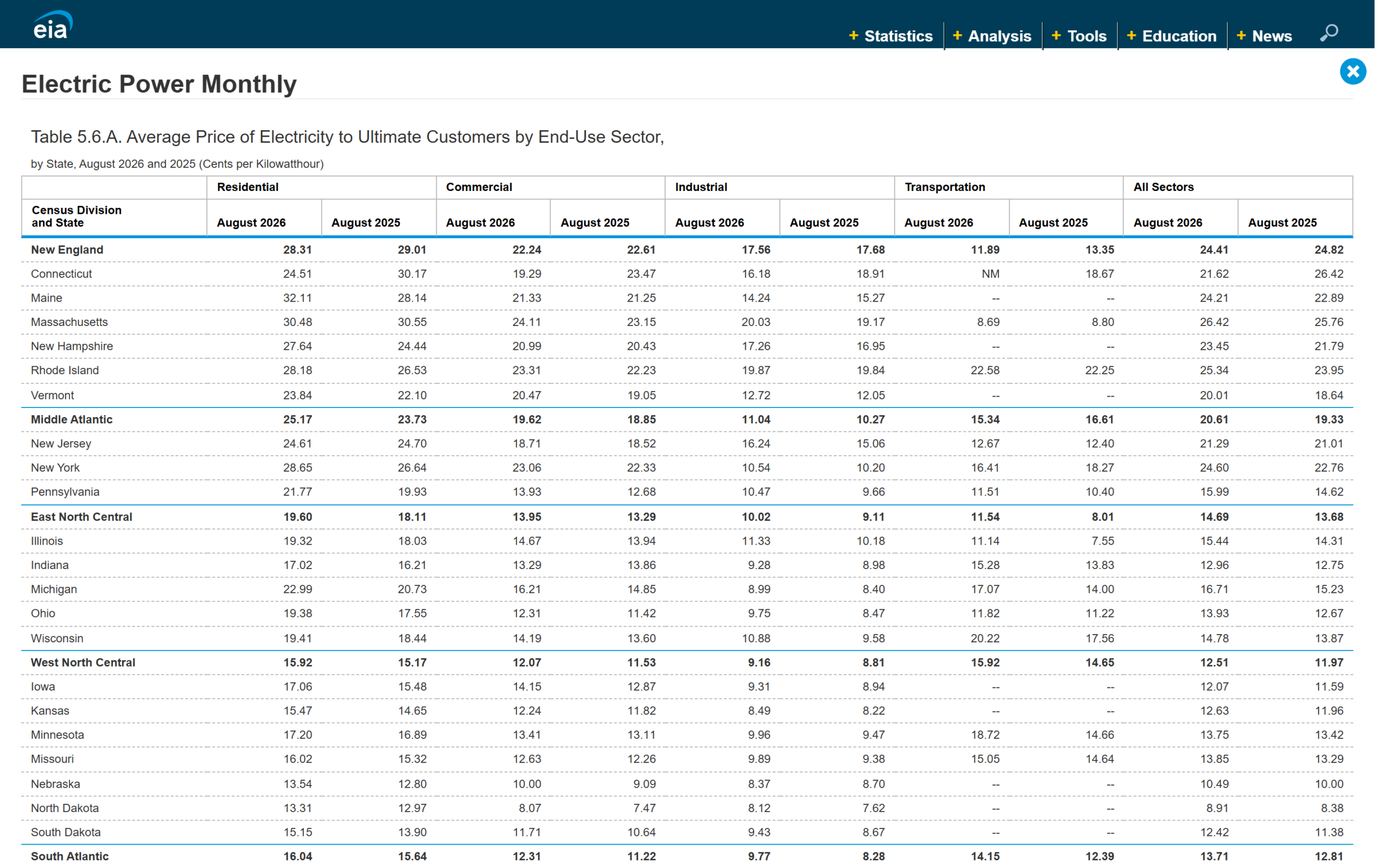
| United States | 18.16 cents per kWh | August 2026 (preliminary) | EIA Electric Power Monthly, Table 5.6.A |
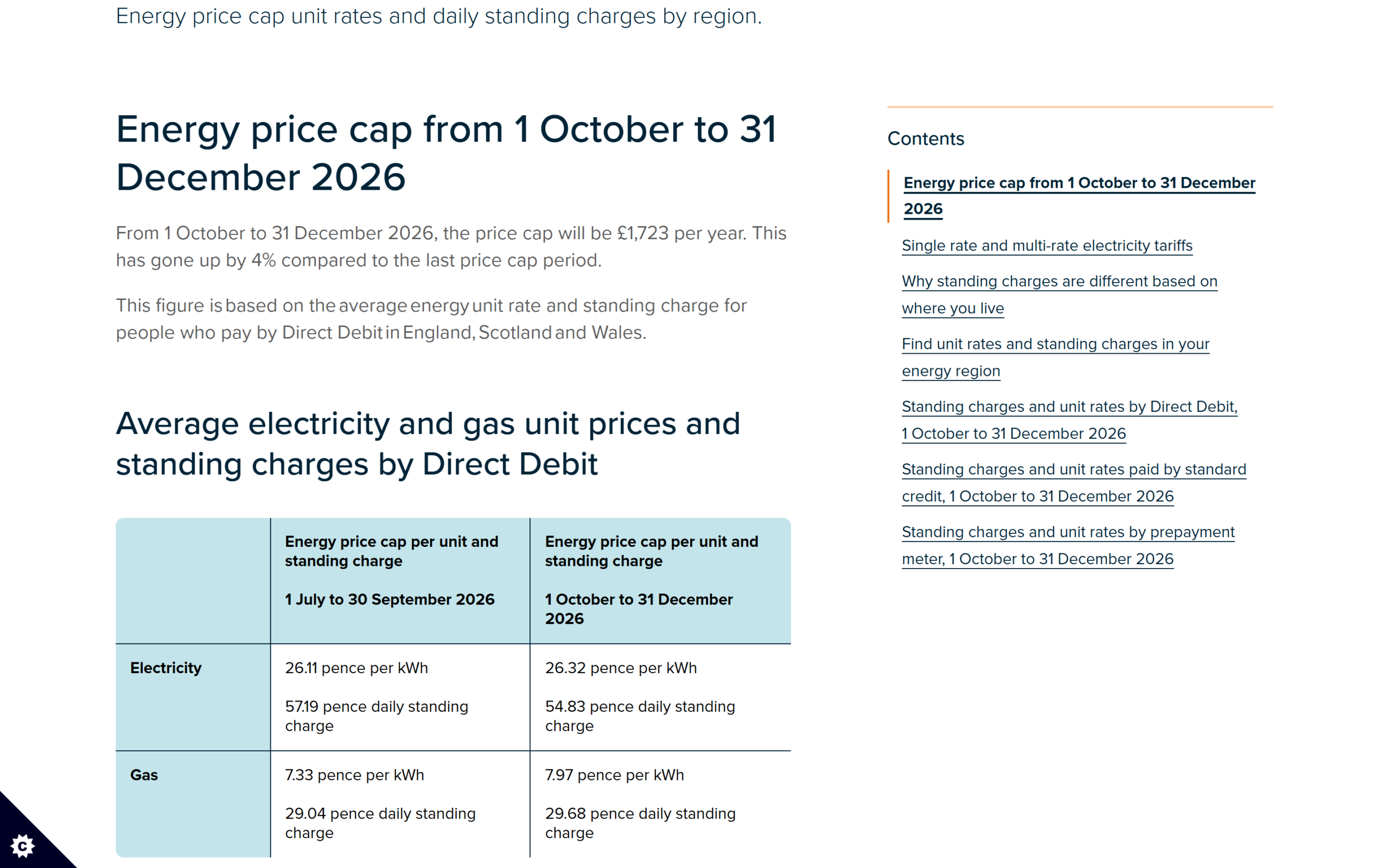
| Great Britain | 26.32 pence per kWh | 1 October to 31 December 2026 | Ofgem energy price cap, Direct Debit average |
| Germany | 37.97 euro cents per kWh | First half of 2026 | Destatis press release no. 345, 30 September 2026 |
The US figure is the residential “U.S. Total” in the EIA’s Table 5.6.A of the Electric Power Monthly, 18.16 cents per kWh for August 2026, against 17.57 cents a year earlier. The EIA marks its 2026 values as preliminary estimates. The British figure is the average electricity unit rate under the price cap for people paying by Direct Debit in England, Scotland and Wales, as published on Ofgem’s price cap unit rates page; Ofgem notes that there is no VAT on electricity from 1 October 2026 to 31 March 2027.
The German figure is the average that private households paid in the first half of 2026 according to the federal statistics office, Destatis, which reported it as 6.4 percent lower than in the second half of 2025.
Here is what those prices make of a 1500 watt heater running at full power.
| Use at 1500 W | Energy | US (18.16¢/kWh) | Great Britain (26.32p/kWh) | Germany (37.97 ct/kWh) |
|---|---|---|---|---|
| 1 hour | 1.5 kWh | $0.27 | 39p | €0.57 |
| 4 hours | 6 kWh | $1.09 | £1.58 | €2.28 |
| 8 hours | 12 kWh | $2.18 | £3.16 | €4.56 |
| 30 days, 4 hours a day | 180 kWh | $32.69 | £47.38 | €68.35 |
| 30 days, 8 hours a day | 360 kWh | $65.38 | £94.75 | €136.69 |
Treat the bottom rows as ceilings. They assume the heater is on its top setting and the element never switches off, which is what happens in a very cold, poorly insulated room or with a heater that has no thermostat. In a room that actually warms up, a thermostat brings the real number down, sometimes a long way.
Two details on the bill matter as much as the unit rate. In Britain you also pay a daily standing charge, 54.83p a day on the average Direct Debit cap for this quarter, but Ofgem’s explainer says it is a charge you pay every day even if you use no energy that day, so it does not change with how long the heater runs and is left out of the table. In Germany, the Destatis release shows how much the size of the household matters: homes using under 1,000 kWh a year paid 57.99 cents per kWh on average, and homes using over 15,000 kWh paid 30.55 cents. A one-hour run at 1500 watts is about 87 euro cents at the first price and about 46 cents at the second. Your contract price, not a national average, is what you will actually pay.
Why does the same heater cost more than three times as much in Hawaii as in Nevada?
Because electricity itself costs that much more. The heater uses 1.5 kWh an hour wherever it is plugged in, but the EIA’s state averages for August 2026 vary enormously, and the cost of running it follows the rate. If you live in the US, find your state in the EIA table or, better, read the price per kWh off your own bill, which includes your utility’s delivery charges.
| State (EIA residential, August 2026) | Price per kWh | 1 hour at 1500 W | 8 hours | 30 days at 8 hours a day |
|---|---|---|---|---|
| Nevada (lowest state average) | 12.72¢ | $0.19 | $1.53 | $45.79 |
| North Dakota | 13.31¢ | $0.20 | $1.60 | $47.92 |
| Florida | 14.99¢ | $0.22 | $1.80 | $53.96 |
| Texas | 15.91¢ | $0.24 | $1.91 | $57.28 |
| US average | 18.16¢ | $0.27 | $2.18 | $65.38 |
| New York | 28.65¢ | $0.43 | $3.44 | $103.14 |
| California | 29.75¢ | $0.45 | $3.57 | $107.10 |
| Massachusetts | 30.48¢ | $0.46 | $3.66 | $109.73 |
| Hawaii (highest state average) | 47.18¢ | $0.71 | $5.66 | $169.85 |
The spread is the reason a single “a space heater costs X a month” figure is misleading. At Nevada’s average a full-power evening costs a little over a quarter of what it costs in Hawaii. It also explains why the same heater can be a sensible top-up in one home and an expensive habit in another: where electricity is cheap, warming one room with a plug-in heater while the rest of the house stays cooler can make sense, and where it is dear, every hour of full power shows up on the bill quickly.
August is a summer month, and winter rates are not guaranteed to match it. That is another reason to use your own bill. The method does not change: kWh times your rate.
How much does thermostat cycling cut the real use?
It depends on the room, and anyone who gives you a single percentage without measuring your room is guessing. What we can show is the arithmetic. A thermostat does not make the heater more efficient per hour of full power; it reduces the number of hours of full power. If the element is on three quarters of the time, you use three quarters of the energy. If it is on a quarter of the time, a quarter.
| Share of time the element runs (8 hour evening) | Energy per evening | US | Great Britain | Germany | US, 30 evenings |
|---|---|---|---|---|---|
| 100% (no thermostat, or a room that never warms up) | 12 kWh | $2.18 | £3.16 | €4.56 | $65.38 |
| 75% | 9 kWh | $1.63 | £2.37 | €3.42 | $49.03 |
| 50% | 6 kWh | $1.09 | £1.58 | €2.28 | $32.69 |
| 25% | 3 kWh | $0.54 | £0.79 | €1.14 | $16.34 |
These are illustrations, not predictions for your home. What sets the share is how much heat the room loses. A small, well insulated bedroom with the door shut reaches its target quickly and then needs only short bursts to hold it. A large room with single glazing, a draughty door and a cold outside wall loses heat as fast as the heater can make it, so the element stays on and you are back in the first row. The colder it is outside, the further up the table you move.
Two practical points follow. First, the set temperature matters more than the brand. Each degree you ask for above what the room settles at without the heater means more minutes of full power every hour. Second, the heater cannot tell you its share of running time unless it has a meter in its app, so the easiest way to know your real use is a plug-in energy monitor between the heater and the outlet, read after a typical evening. Divide the kWh it shows by the hours, and you have your own average draw to plug into the formula.
Which DREO wall heater settings use the least electricity?
The lowest fixed heat level, or ECO mode once the room is warm. The DREO Smart Wall Heater is a 1500 watt PTC ceramic fan heater that mounts on the wall, and DREO’s user manual for it (model DR-HSH009S) lists its rated power as 1500 W at 120 V and 60 Hz. The manual describes three ways to run it, and they behave very differently on the meter.
| DREO setting (per the user manual) | What it does | Energy per hour | US cost per hour | GB cost per hour |
|---|---|---|---|---|
| Power Heat H1 | Fixed 900 W heating level | 0.9 kWh | $0.16 | 24p |
| Power Heat H2 | Fixed 1300 W heating level | 1.3 kWh | $0.24 | 34p |
| Power Heat H3 | Fixed 1500 W heating level | 1.5 kWh | $0.27 | 39p |
| ECO mode | Picks its own heating power from the gap between set and room temperature, turns off at the set temperature | Up to 1.5 kWh, less as the room warms | Up to $0.27 | Up to 39p |
| Fan Only | Moves air without heating | Not stated in the manual | n/a | n/a |
Power Heat is the manual mode. You choose H1, H2 or H3 with the plus and minus buttons and the heater stays at that level. DREO’s manual gives the three levels as 900 W, 1300 W and 1500 W. H1 uses 40 percent less energy per hour than H3, so if H1 keeps you comfortable in a small room, it is the cheapest way to run the heater on a fixed setting.
ECO mode is the thermostat mode. The manual says that in ECO the heater automatically selects its heating power depending on the difference between the set temperature, which you can choose from 41 to 95°F, and the room temperature, and that it turns off automatically when the set temperature has been reached. That is exactly the cycling described above, managed for you. The manual’s troubleshooting page also explains the one side effect: if the heater turns off too often for your liking, raise the set temperature or switch to Power Heat. In other words, ECO saves energy precisely by not running when the room is already at your target.
The other features that matter for electricity use are the timer and the schedule. The manual describes a timer from 0 to 24 hours after which the heater turns itself off, and the Amazon listing says the DREO app lets you schedule heating hours to match your routine. DREO’s own product page lists the same 24 hour timer, three heat settings, a fan only mode and a digital thermostat from 41 to 95°F in 1°F increments. A heater that switches itself off at bedtime or when you leave for work never runs through hours nobody is in the room, and those forgotten hours are the most expensive ones there are.
A practical routine for this heater: start the evening on H3 or ECO with a sensible set temperature so the room warms quickly, let ECO hold it, and set the timer for when you will go to bed. If you would rather keep a fixed level, try H1 first and only step up if the room does not get comfortable. If you are still choosing a heater and want one with these controls built in, see the DREO wall heater’s current price and listing.
The Amazon listing showed 4.4 out of 5 stars from 5,463 ratings when we checked it on November 17, 2026. Amazon’s AI summary of the reviews says customers find it heats rooms quickly and quietly, but that feedback on temperature control is mixed and some report units that stopped working, so test the thermostat inside the return window. Our DREO Smart Wall Heater review covers its installation, owner reports and rivals in detail; this article sticks to what it costs to run.
Can a 1500W heater overload an outlet or an extension cord?
It draws a lot of current, so it deserves its own outlet. On a 120 volt US circuit, 1500 watts divided by 120 volts is 12.5 amps, which is a large share of what a typical household circuit is designed to carry, before anything else on the same circuit is switched on. That is why heater manuals and fire safety advice tell you to plug a space heater straight into a wall outlet rather than a power strip or an extension cord, and to avoid sharing the circuit with another big load such as a kettle or a hair dryer.
DREO’s manual adds three model-specific points. The heater is intended for 120 volt outlets only; if it is plugged into a 240 volt outlet by mistake, the control board cuts the heating and shows a “UH” error. Furniture, curtains, bedding and other combustibles must stay at least 3 feet (0.9 m) from the front of the heater and away from its sides. And there is a thermal limiter inside that cuts power if the heater overheats. None of these change how much electricity it uses, but all of them decide where you can safely mount it.
For readers in the UK and Germany, note that the DREO Smart Wall Heater in this article is a 120 volt product sold for the US market. The electricity arithmetic above applies to any 1500 watt heater on any supply, but buy a heater rated for your own mains voltage.
How do you use less electricity with a space heater?
Every tip comes back to the same formula: fewer hours at full power, or a lower power level. Here are the ones that make a measurable difference.
- Heat the room you are in, with the door closed. A space heater is at its best warming one occupied room while the rest of the home stays cooler. An open door lets the warm air drift away and keeps the element on longer.
- Use the thermostat, not the top setting. Set the temperature you actually want and let ECO or the thermostat stop the heater once the room gets there. Running on full power with the door open and the window cracked is the expensive combination.
- Set a timer every time. The cheapest hour of heating is the one that never happens because the heater switched itself off after you fell asleep or left the house.
- Start lower than you think. On a heater with fixed levels, try the lowest one first. On the DREO, H1 draws 900 W against 1500 W on H3.
- Stop the draughts. A draught excluder on a door and a closed curtain over a cold window cut how fast the room loses heat, which shortens every on cycle.
- Aim the warm air at yourself. A fan heater that blows across the sofa or the desk makes you feel warm sooner, so you are more likely to accept a lower set temperature.
- Measure once. A plug-in energy monitor tells you your real kWh per evening, which is worth more than any estimate, including ours.
- Know your rate. Check the price per kWh on your latest bill and redo the arithmetic with it. Time-of-use tariffs change the answer by hour of the day.
Whether a space heater saves money overall depends on what it replaces. If it lets you turn down a central system that heats the whole house while you sit in one room, it can. If it runs on top of central heating that is already warming the same room, it simply adds its kWh to the bill. That comparison depends on your heating system and fuel prices, so we do not put a single number on it here.
Frequently asked questions
How many kWh does a 1500 watt heater use per hour?
At full power, 1.5 kWh per hour. Over eight hours that is 12 kWh, and over a 30 day month of eight hour evenings, 360 kWh. A thermostat or ECO mode reduces this by switching the element off once the room is warm.
How much does it cost to run a 1500 watt heater for 24 hours?
At full power it uses 36 kWh in 24 hours. At the EIA’s US average of 18.16 cents per kWh for August 2026 that is about $6.54; at Ofgem’s 26.32p cap rate it is about £9.48; at the Destatis German average of 37.97 cents it is about €13.67. Running a space heater unattended around the clock is not something heater makers recommend, and a thermostat would rarely let it run flat out for a whole day anyway.
Does a 1500 watt heater always use 1500 watts?
No. 1500 watts is the maximum. On a lower fixed level it draws less (the DREO wall heater’s H1 and H2 levels are 900 and 1300 watts according to its manual), and with a thermostat the element switches off when the room reaches the set temperature, so the average over an hour is lower.
Is ECO mode on the DREO wall heater cheaper to run?
Usually, yes, once the room is warm. DREO’s manual says ECO mode selects the heating power automatically from the difference between the set and room temperature and turns off at the set temperature. It cannot use more than the 1500 watt maximum, and it uses less whenever it throttles back or switches off.
Is a 1500 watt heater more efficient than a 900 watt one?
Per kWh, no: both turn the electricity they draw into heat. The 1500 watt heater simply makes more heat per hour, so it warms a room faster and costs more per hour at full power. A smaller heater on for longer can end up using the same energy as a larger one on for less time.
How many amps does a 1500 watt heater draw?
At 120 volts, 12.5 amps (1500 divided by 120). That is why it should be plugged directly into a wall outlet and not share a circuit with other heavy appliances.
Why is my electricity bill higher than these numbers suggest?
The tables use average unit prices only. Your own rate may be higher, your bill may include fixed charges such as Britain’s daily standing charge, and the heater may be running for more hours than you think. A plug-in energy monitor and the price per kWh from your latest bill give you the true figure.
The bottom line on 1500W heater electricity use
The answer to how much electricity does a 1500W heater use is simple at the top end and personal below it. At full power it is 1.5 kWh every hour, which at the latest official averages costs about 27 cents in the US, 39p in Great Britain and 57 euro cents in Germany, or about $2.18, £3.16 and €4.56 for an eight hour evening. How much less you actually pay depends on how often the thermostat lets the element rest, which depends on the room, the weather and the temperature you ask for.
The levers are the same on every heater: a lower heat level, a thermostat or ECO mode that switches off at your target, a timer that ends the session for you, and a closed door. The DREO Smart Wall Heater has all four, with fixed levels of 900, 1300 and 1500 watts, an ECO mode that throttles and switches off by itself, and a 24 hour timer plus app scheduling. If that is the kind of control you want on the wall, check the DREO Smart Wall Heater’s price on Amazon, then run the formula with the rate on your own bill before the first cold week arrives.
8.2 Score
Pros
- Three fixed levels of 900, 1300 and 1500 watts, so you can run it below full power on purpose.
- ECO mode picks its own power and switches off at the set temperature, per DREO's manual.
- A 0 to 24 hour timer and app scheduling end every session without you remembering.
- Digital thermostat from 41 to 95°F in 1°F steps holds a target instead of running flat out.
Cons
- No built-in energy meter is described in the manual, so measuring real use needs a plug-in monitor.
- A 120 volt US product: readers in the UK and Germany need a heater rated for their own mains.
- Amazon's review summary reports mixed feedback on temperature control and some units failing.
- At 1.5 kWh an hour on full power it is expensive where electricity is dear, whatever the controls.
Final Verdict
A 1500 watt heater uses 1.5 kWh an hour at full power, and the DREO Smart Wall Heater gives you the controls that keep it below that: 900 and 1300 watt levels, an ECO mode that throttles and switches off at your set temperature, a 24 hour timer and app schedules. It will not make electric heat cheap where your rate is high, but it makes it easy to pay only for the hours you need.